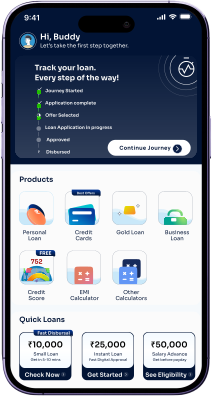
A salary slip is commonly requested when applying for a personal loan, but not every applicant receives one. Freelancers, self-employed professionals, gig workers, cash-salary employees, and new joiners may earn regularly without having conventional payslips. Such applicants may still qualify for a loan without a salary slip by providing alternative proof, including bank statements, Income Tax Returns (ITRs), Form 16, invoices or business documents. Approval depends on whether the lender can verify the applicant’s income, creditworthiness and repayment capacity. Not having a salary slip does not mean that no income verification will be required.
| Can You Get a Loan Without a Salary Slip?
Yes, you may get a personal loan without submitting salary slips if you can provide acceptable alternative income records. Depending on your occupation, lenders may consider bank statements, ITRs, Form 16, GST returns, client invoices, contracts, or an employer-issued salary certificate. Approval and final loan terms remain subject to the lender’s assessment. |


Difference Between Salary Slip & Income Proof
Although the terms are sometimes used interchangeably, a salary slip is only one of several documents that can be used to establish income.
| Factor | Salary slip | Income proof |
|---|---|---|
| Meaning | A monthly document issued by an employer showing earnings, allowances and deductions | Any verifiable document that establishes income from employment, business or another source |
| Commonly used by | Salaried employees | Salaried, self-employed and non-traditional earners |
| Possible sources | Employer’s payroll department | Bank, employer, Income Tax Department, clients or business records |
| Examples | Monthly payslip | Bank statement, ITR, Form 16, GST return, invoice or salary certificate |
| Purpose in lending | Confirms salary and employment details | Helps lenders assess income consistency and repayment capacity |
| Availability | May not be available to informal or independent workers | Can be available across several employment categories |
Who May Need a Loan Without a Salary Slip?
This loan arrangement may be relevant to applicants who earn regularly but do not receive standard monthly payslips.
- Self-employed individuals: Business owners and independent professionals generally do not issue salary slips to themselves.
- Freelancers and consultants: Their income may come from several clients and vary from one month to another.
- Gig workers: Delivery partners, drivers, creators and other platform workers may receive earnings through apps rather than payroll.
- Cash-salary employees: Employees of small or informal businesses may receive wages in cash without formal salary records.
- New employees: A person who has recently joined an organisation may not have received their first payslip.
- Contract workers: Applicants working on temporary or fixed-term contracts may receive professional fees instead of a formal salary.
- Commission-based workers: Sales agents and other professionals may earn through variable commissions.
- Pensioners and rental-income recipients: Their primary income may come from a pension or rent rather than employment.
- Homemakers: A homemaker without independent income may explore a joint application or a secured borrowing option.
- Individuals between jobs: Approval may be difficult without current income, but applicants with another verifiable source of income or security may have alternatives.
Loan Options Available Without a Salary Slip
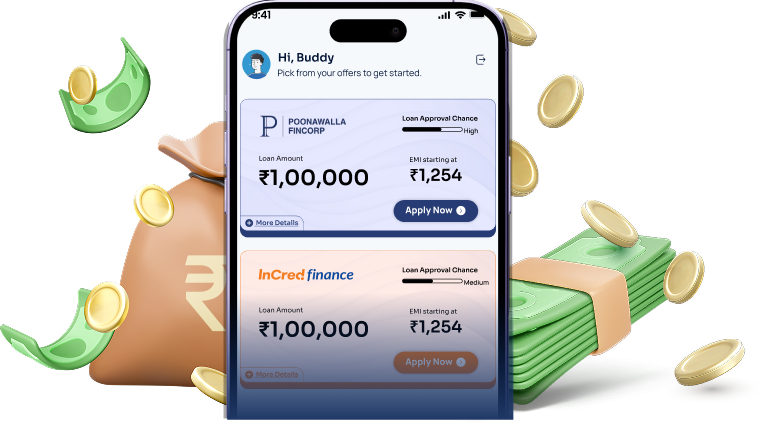
The appropriate option depends on the applicant’s income trail, credit profile, available assets and eligibility.
| Loan option | How it works | Suitable for |
|---|---|---|
| Digital personal loan | An unsecured loan assessed using KYC, bank transactions, credit history and alternative income documents | Applicants with traceable income but no payslips |
| Personal loan for non-salaried applicants | Eligibility is evaluated using ITRs, business income and financial records | Self-employed professionals and business owners |
| Pre-approved personal loan | An offer may be provided based on an existing banking or credit relationship | Eligible existing customers |
| Joint personal loan | A co-applicant’s income and credit profile may support the application | Applicants with limited individual eligibility |
| Loan against fixed deposit | The fixed deposit is used as security | FD holders seeking a secured borrowing option |
| Gold loan | Eligible gold assets are pledged to obtain funds | Applicants who own qualifying gold |
| Loan Against Property | Residential or commercial property is offered as collateral | Applicants requiring a larger secured loan |
| Peer-to-peer loan | Borrowers and lenders are connected through a regulated P2P platform | Eligible applicants comfortable with platform-specific terms |
| Employer salary advance | The employer provides an advance against future salary | Employees whose organisations offer the facility |
Note: Eligibility, interest rates and documentation vary by lender. A pre-approved offer is not the same as guaranteed approval.
Quick Overview of Personal Loan Without Salary Slip
The following table shows indicative features across different loan products and applicant profiles.
| Particular | Indicative details |
|---|---|
| Loan amount | Approximately ₹5,000 to ₹10 lakh; selected lenders may offer amounts of up to ₹35 lakh–₹50 lakh to highly eligible applicants |
| Interest rate | May start at approximately 9.99%–14% per annum and increase according to the applicant’s risk profile |
| Repayment tenure | Approximately 6 to 108 months, depending on the lender and loan product |
| Collateral | Usually not required for unsecured personal loans |
| Income documentation | Bank statements, ITRs, Form 16, GST returns or other accepted records |
| Credit Score | A score of around 700–750 or above may be preferred; some lenders may consider lower or unavailable scores |
| Processing fee | Usually calculated as a percentage of the sanctioned amount |
| Application mode | Online or offline, depending on the lender |
| Disbursal time | May be instant or take approximately 24–72 working hours after approval and verification |
Note: These ranges are indicative. The actual amount, rate, tenure and disbursal time depend on eligibility, verification and lender policy.
Eligibility Criteria for a Loan Without a Salary Slip
Lenders usually consider the following factors when assessing an application without traditional salary documents.
| Eligibility factor | Typical requirement |
|---|---|
| Age | Generally 21–60 years at the time of application or loan maturity |
| Nationality | Resident Indian citizen |
| Income | Regular and verifiable income from employment, business or another accepted source |
| Monthly income | Commonly ₹25,000 or more, although the threshold differs by lender |
| Occupation | Salaried, self-employed, freelance, professional or another accepted category |
| Bank account | Active account with a traceable transaction history |
| Credit score | Preferably 700–750 or above; selected lenders may consider scores around 650 |
| Business continuity | Self-employed applicants may need to demonstrate an established business history |
| Existing liabilities | Total EMIs should remain manageable relative to verified income |
| Serviceability | The applicant must live or work in an area serviced by the lender |
Documents Accepted Instead of a Salary Slip
Lenders may accept one or more alternative documents to establish identity, income, occupation and repayment ability.
| Document category | Documents that may be accepted |
|---|---|
| Identity proof | PAN card, Aadhaar card, passport, voter ID or driving licence |
| Address proof | Aadhaar card, passport, voter ID, utility bill or registered rental agreement |
| Bank records | Personal or business bank statements for the previous 3–12 months |
| Tax records | ITR acknowledgements, tax computation statements or Form 16 |
| Employment proof | Appointment letter, joining letter, employment certificate, employee ID or salary certificate |
| Business proof | GST registration, GST returns, Udyam registration, trade licence or business registration |
| Financial statements | Balance sheet, profit-and-loss statement or cash-flow statement |
| Freelance income proof | Client contracts, professional invoices and payment receipts |
| Pension proof | Pension Payment Order or bank statements showing pension credits |
| Rental-income proof | Rent agreement, property documents, ITR and bank credits |
| Photograph | Recent photograph or digital selfie for verification |
Alternative Income Proof by Applicant Type
The most suitable income document depends on how the applicant earns money.
| Applicant type | Possible alternative income proof |
|---|---|
| Self-employed individual | ITRs, GST returns, audited financial statements, business bank statements and registration documents |
| Freelancer or consultant | Client contracts, signed invoices, ITRs and bank statements showing client payments |
| Gig worker | Platform earning statements, transaction records and bank statements |
| Cash-salary employee | Employer-issued salary certificate, appointment letter, employee ID and regular bank deposits |
| New employee | Joining letter, appointment letter, employee ID and previous Form 16 |
| Pensioner | Pension Payment Order and bank statements showing regular pension credits |
| Rental-income recipient | Rental agreement, ITR and bank statements showing rent receipts |
| Commission-based worker | Commission statements, agency contracts, invoices and bank credits |
| Small-business owner | GST returns, trade licence, Udyam registration, ITRs and business financial statements |
| Professional | Professional registration, ITRs, invoices and current-account statements |
Is a Bank Statement Enough to Get a Personal Loan?A bank statement may be an important substitute because it helps lenders assess recurring income, expenses, existing EMIs and account conduct. However, it may not always be sufficient by itself. The lender can also request KYC, employment confirmation, ITRs, business documents or supporting records, especially when credits are irregular or their source is unclear. |
Lenders Offering Loans Without a Salary Slip
Several leading banks and digital-first financial institutions in India provide personal loans without requiring a traditional salary slip by assessing alternative income proofs like bank statements, Income Tax Returns (ITR), and digital credit profiles.
| Lender Name | Maximum Loan Amount |
|---|---|
| IDFC FIRST Bank | Up to ₹15 Lakhs |
| YES BANK | Based on eligibility |
| Union Bank of India | Up to ₹15 Lakhs |
| Kotak Mahindra Bank | Up to ₹35 Lakhs |
| Airtel Finance | Up to ₹10 Lakhs |
| Bajaj Finance | Up to ₹55 Lakhs |
| Stashfin | Up to ₹5 Lakhs |
| DMI Finance | Up to ₹10 Lakhs |
| Moneyview | Up to ₹10 Lakhs |
Loan Without Salary Slip Using an ITR
Income Tax Returns (ITR) are among the most credible and widely accepted alternatives to salary slips, providing lenders with official government-recognized proof of your annual earnings and financial stability.
| Feature of ITR for Loans | Details and Importance |
|---|---|
| Official Validation | Acts as solid proof that your income is legitimate and officially recognized by the government. |
| Stability Assessment | Lenders typically require ITR filings for the last 2 to 3 years to gauge long-term financial trends and stability. |
| Income Computation | Submitting an income statement computation alongside your ITR provides a clearer picture of your overall financial health. |
| Compliance Proof | Demonstrates a consistent history of tax compliance, which builds significant trust with financial institutions. |
| Higher Loan Quantum | Maintaining regular tax filings helps validate higher income levels, potentially qualifying you for larger loan amounts. |
| Repayment Reliability | A strong tax record reassures the lender of your ability to manage and repay the personal loan EMIs. |
Note: An ITR does not guarantee approval. Lenders may ask for additional financial and occupation-related records.
Loan Without Salary Slip for Self-Employed Applicants
Self-employed individuals can successfully secure personal loans without traditional salary slips by demonstrating financial stability through alternative business documentation and healthy digital transaction trails.
| Parameter/Factor | Details for Self-Employed Applicants |
|---|---|
| Primary Income Proofs | Bank statements (last 6 to 12 months), Income Tax Returns (ITR) for the past 2–3 years, and GST returns. |
| Business Legitimacy Documents | Business registration certificates, MSME/Udyam registration, trade licenses, or Shop & Establishment certificates. |
| Financial Statements | CA-certified Profit and Loss (P&L) statements and income computation sheets. |
| Eligibility Benchmarks | Minimum age of 21 years and a verifiable monthly income typically starting at ₹25,000. |
| Credit Score Importance | A high CIBIL score (ideally 750 or above) is often the deciding factor in the absence of salary slips. |
| Loan Quantum | Ranges from ₹5,000 to ₹10 Lakhs, with some lenders offering up to ₹50 Lakhs based on business turnover. |
| Approval Strategies | Showcasing consistent digital bank credits, maintaining a healthy average monthly balance, or adding a salaried co-applicant. |
| Lender Assessment Focus | Evaluation of overall cash flow consistency, repayment history, and “digital footprint” rather than just physical employment documents. |
Note: Minimum business vintage and financial-document requirements differ across lenders and products.
Loan Without Salary Slip for Freelancers and Gig Workers
Freelancers and gig workers can access a variety of personal loan options by demonstrating their income stability through diverse digital records and alternative financial documents instead of traditional payslips.
| Parameter/Factor | Details for Freelancers and Gig Workers |
|---|---|
| Primary Income Proofs | Bank account statements (last 6 to 12 months), Income Tax Returns (ITR) for the past 2–3 years, and Form 16 (if recently switched from a job). |
| Supplementary Evidence | Signed client contracts, project invoices, and GST filings (if applicable) to demonstrate expected future earnings. |
| Credit Score Target | A high CIBIL score (ideally 750 or above) is critical to prove financial discipline and secure competitive interest rates. |
| Lender Assessment Focus | Analysis of consistent digital bank credits from multiple sources, spending habits, and average monthly balance (AMB). |
| Loan Quantum | Typically ranges from ₹30,000 to ₹10 Lakhs, with some digital lenders offering up to ₹15 Lakhs based on verified cash flow. |
| Eligibility Benchmarks | Usually between 21 and 60 years of age, Indian nationality, and a minimum verifiable monthly income (often ₹25,000+). |
| Top Lender Types | RBI-registered digital NBFCs and fintech platforms that use advanced credit models to evaluate “digital footprints”. |
| Approval Strategies | Maintaining a healthy digital paper trail of client payments, avoiding cash-only transactions, and potentially adding a salaried co-applicant. |
Loan for Cash-Salary Employees Without Payslips
Employees receiving their salaries in cash can successfully secure personal loans by establishing a verifiable digital financial record or providing alternative employer-backed documentation to prove their repayment capacity.
| Document or Strategy | Importance for Cash-Salaried Applicants |
|---|---|
| Regular Bank Deposits | Regularly depositing cash earnings into a bank account builds a verifiable digital paper trail and transaction history. |
| Salary Certificate | A formal document on the employer’s official letterhead can serve as valid proof of earnings and employment status. |
| Income Tax Returns (ITR) | Submitting ITR filings (typically for the last 2-3 years) validates your income as legitimate and officially recognized. |
| Joint Application | Applying with a salaried co-applicant, such as a spouse or parent, significantly enhances your creditworthiness and secondary repayment source. |
| Asset Pledging | Offering collateral like gold, fixed deposits, or high-value investments reduces lender risk and makes approval easier without payslips. |
| Digital-First Lenders | Modern NBFCs and fintech platforms focus on your digital footprint and overall financial behavior rather than just traditional physical slips. |
Loan for New Employees Without a First Salary Slip
New employees may use employment documents while waiting to receive their first payslip.
| Alternative document | How it may be used |
|---|---|
| Appointment letter | Shows the employer, designation, salary and employment terms |
| Joining letter | Confirms that the applicant has joined the organisation |
| Employment confirmation | Provides further verification from the employer |
| Employee ID | Supports current employment status |
| Offer letter | Shows proposed compensation but may not independently prove active income |
| Previous Form 16 | Provides evidence of income from an earlier employer |
| Previous bank statements | Shows past salary credits and account conduct |
| Professional qualification | May support selected profession-specific loan applications |
How Lenders Verify Income Without Salary Slips
When payslips are unavailable, lenders may use several methods to assess the applicant’s financial position:
- Bank-statement analysis: Regular credits, average balances, repayment deductions and failed transactions may be reviewed.
- ITR verification: Declared income can be compared with banking and business records.
- Employment verification: The lender may contact the employer or review an appointment letter, salary certificate and employee ID.
- Business verification: GST registration, financial statements, licences and business premises may be checked.
- Invoice and contract review: Freelancers may be asked to provide client agreements, invoices and corresponding payments.
- Credit-report assessment: Existing accounts, payment history, overdue balances and recent loan enquiries may be reviewed.
- Existing relationship history: A bank may use past account activity, deposits, credit-card usage or repayment conduct.
- Video or physical verification: Some lenders may conduct video KYC, workplace checks or business verification.
- Document cross-verification: Names, addresses, income and occupation details are compared across all submitted records.
| Does Credit Score Matter for a Loan Without a Salary Slip?
Yes, credit score remains important because it indicates how the applicant has handled previous credit. A score of 750 or above may improve approval prospects and access to competitive terms, but it does not replace income verification. Applicants with no credit history may still be assessed using income records, bank activity and lender-specific criteria. |
Interest Rates and Charges on Loans Without Salary Slips
The total borrowing cost can include interest as well as several additional charges.
| Cost component | Indicative range or treatment |
|---|---|
| Interest rate | Approximately 9.99%–25% per annum, depending on the applicant and lender |
| Processing fee | Commonly around 1%–3% of the sanctioned amount |
| GST | Applicable to processing and other eligible service charges |
| Late-payment charges | Levied when an EMI is not paid by the due date |
| Penal charges | Applied according to the conditions in the loan agreement |
| EMI bounce charges | May apply when an auto-debit or repayment mandate fails |
| Part-prepayment charges | May be applicable when paying part of the outstanding balance early |
| Foreclosure charges | May apply when closing the entire loan before the scheduled date |
| Verification charges | Applicable only where specified by the lender |
| Documentation charges | May be levied according to the loan terms |
Note: Review the interest rate, Annual Percentage Rate, Key Facts Statement and loan agreement for the exact cost before accepting an offer.
| How Much Loan Can You Get Without a Salary Slip?
The loan amount depends on verified income, bank cash flow, credit score, existing obligations and the lender’s internal policy. Small emergency loans may range from ₹10,000 to ₹50,000, while applicants with strong ITRs and stable finances may qualify for considerably higher amounts, potentially reaching ₹50 lakh with selected lenders. The sanctioned amount may be lower than the amount requested. |
Loan Without Salary Slip EMI Calculator
The Buddy Loan EMI Calculator can help estimate your repayment obligation before you apply.
- Enter the loan amount: Add the principal amount you plan to borrow.
- Enter the interest rate: Provide the annual interest rate offered by the lender.
- Select the tenure: Choose the repayment period in months or years.
- Review the estimated EMI: Check the amount you may need to pay each month.
- Check the total interest: Review the approximate interest payable over the selected tenure.
- Compare the total repayment: See the combined principal and interest amount.
- Test different tenures: Adjust the tenure to compare monthly affordability with total interest cost.
How to Apply for a Personal Loan Without a Salary Slip Online
Buddy Loan allows eligible applicants to submit a personal loan application through a digital marketplace.
Step 1: Visit buddyloan.com or download & install the Buddy Loan app (Android or iOS).
Step 2: Open the personal loan application page. Provide the mobile number and enter the received OTP.
Step 3: Specify the desired loan amount & personal email. Next, choose the Personal Loan option
Step 4: Choose the employment type (Salaried, Self-Employed, or Student) and the salary mode (bank or cash).
Step 5: Enter your work details (Including company name, years of service and Designation)
Step 6: Enter your personal details (Including Full Name, PAN, address, DOB & Gender)
Step 7: Provide your communication address, and income details and Click the ‘Submit’ button.
Common Reasons Loan Applications Get Rejected
Applications without salary slips may be rejected for several reasons:
- Income cannot be verified: Submitted records do not establish a regular and identifiable source of earnings.
- Irregular cash flow: Bank statements show inconsistent credits or frequent periods with insufficient funds.
- Low income: Verified earnings do not meet the lender’s minimum requirement.
- High existing obligations: Current EMIs consume a significant portion of the applicant’s income.
- Poor repayment history: The credit report contains overdue accounts, defaults or settled loans.
- Too many recent enquiries: Multiple applications may indicate a high and immediate demand for credit.
- Requested amount is too high: The loan amount is disproportionate to verified income and repayment capacity.
- Insufficient business history: A self-employed applicant’s business has not operated long enough to satisfy the lender’s requirements.
- Incomplete documentation: Mandatory KYC, income or business records have not been provided.
- Mismatched information: Personal, employment or income details differ across documents.
- Unexplained deposits: Large or frequent cash deposits cannot be linked to a credible income source.
- Location is not serviceable: The applicant’s residence or workplace falls outside the lender’s operational area.
How to Improve Your Chances of Loan Approval Without Salary Slip
A clear income trail and responsible financial conduct can strengthen an application.
- Maintain consistent bank credits: Regular deposits from identifiable sources make income easier to verify.
- File ITRs on time: Accurate and consistent tax returns can support declared income.
- Maintain a healthy credit score: Pay EMIs and credit-card bills on or before their due dates.
- Request a realistic amount: Choose a loan amount that matches your income and existing obligations.
- Reduce current debt: Paying down outstanding balances can improve repayment capacity.
- Avoid multiple applications: Several applications within a short period can result in multiple credit enquiries.
- Keep documents consistent: Names, addresses, income and occupation details should match across the application and supporting documents.
- Organise business finances: Self-employed applicants should maintain clear business records and, where practical, separate personal and business transactions.
- Add a co-applicant when permitted: A co-applicant with stable income and a strong credit profile may support eligibility.
- Consider a secured option: A loan against an FD, gold or another eligible asset may be more accessible when unsecured-loan eligibility is limited.
- Wait for a stronger income trail: New employees or freelancers may benefit from establishing a few months of regular credits.
- Avoid fabricated documents: False records can lead to rejection and may result in legal consequences.
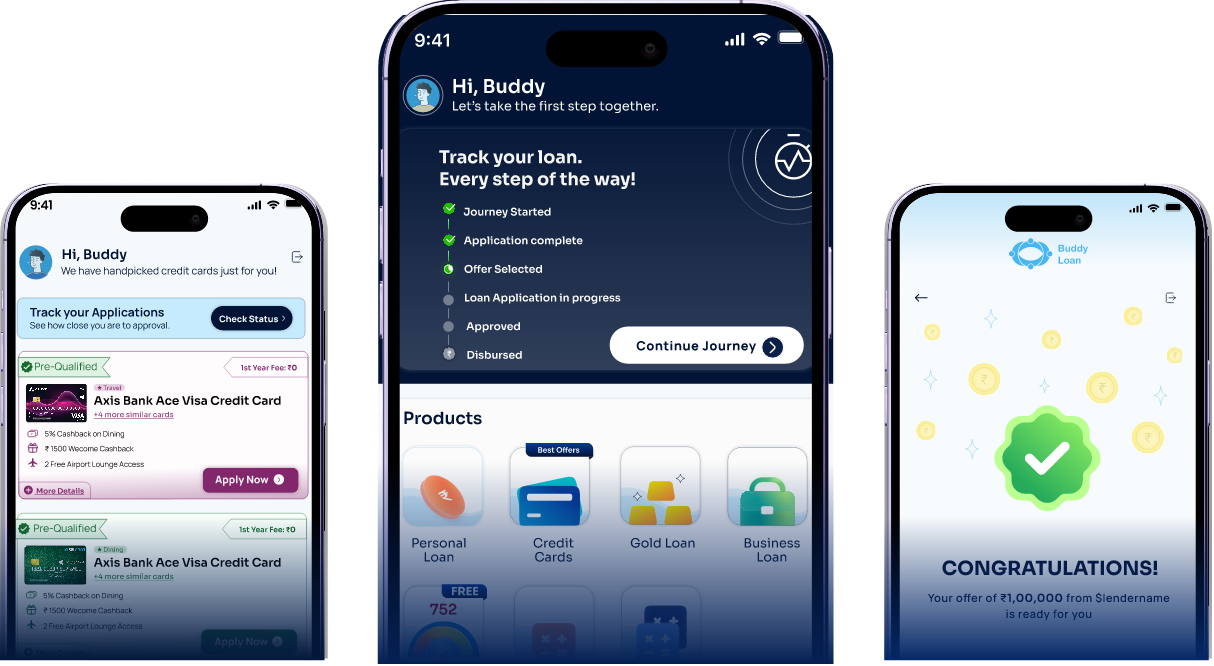
Download the Buddy Loan App Now!
One solution to each of your financial needs at your fingertip.

Scan to download now