Starting a new job often brings immediate expenses, from relocating and paying a rental deposit to purchasing essential work equipment. However, getting a loan with less than six months of experience can be challenging because many lenders prefer applicants with a longer employment history. Selected lenders may still consider new employees based on their current salary, employer profile, bank transactions, credit history and repayment capacity. Available options may include small personal loans, short-term loans, salary advances and secured loans. Approval is not guaranteed and depends on the eligibility requirements of the individual lending partner.
| Can You Get a Loan With Less Than 6 Months of Experience?
Yes, selected lenders may offer a personal loan to employees with less than six months of experience. Applicants with regular salary credits, a stable employer, manageable existing obligations, and a satisfactory credit profile may have better prospects. However, lenders requiring one or more years of employment may not accept the application. |


Who May Need a Loan With Less Than 6 Months of Experience?
Limited work experience is common among new earners and employees who have recently gone through a career change.
- Fresh graduates: Individuals who have recently completed their education and started their first full-time job.
- Young professionals: Early-career employees who have begun earning but have not yet built significant savings.
- Recently relocated employees: Professionals who need funds for transportation, rental deposits, and essential home expenses in a new city.
- Employees on probation: New joiners whose employment has not yet been formally confirmed.
- Recent job switchers: Experienced professionals who have spent less than six months with their current employer.
- Graduate trainees: Employees completing a structured training period before moving into a permanent role.
- Contract employees: Professionals working under fixed-term employment agreements.
- New-to-credit applicants: First-time borrowers who do not have a previous loan or credit-card repayment history.
- Employees returning after a career break: Applicants who have recently resumed working after a period without formal employment.
Why New Employees May Need a Personal Loan
Employees in the early months of a job may encounter expenses before they have had enough time to build an emergency fund.
- Relocation expenses: Moving to another city can involve travel, brokerage, rental deposits and basic home setup costs.
- Work equipment: New employees may need a laptop, smartphone, internet connection or other equipment for their role.
- Medical emergencies: An unexpected health expense may arise before the employee has accumulated adequate savings.
- Professional development: Certification programmes and specialised courses may support career growth but require upfront payment.
- Daily commuting: A new employee may need funds for a two-wheeler down payment, public transport pass or other travel costs.
- Family emergencies: Immediate financial support may be required for an urgent need at home.
- Temporary cash-flow gaps: The first salary may be delayed because of payroll cycles or the employee’s joining date.
- Limited debt consolidation: A personal loan may help combine a few high-cost obligations into one repayment, subject to the total cost being lower.
New employees should avoid borrowing for unnecessary lifestyle spending or recurring expenses that cannot be managed from regular income.
Loan Options for Employees With Limited Work Experience
Applicants should compare eligibility, cost and repayment requirements before selecting an option.
| Loan option | Typical tenure | Main feature | Suitable for |
|---|---|---|---|
| Short-term personal loan | 3–12 months | Faster debt closure with relatively high monthly instalments | Temporary financial requirements |
| Small personal loan | 12–36 months | Smaller loan amount with a structured repayment plan | Essential purchases and modest emergencies |
| Regular personal loan | Up to 72 months with selected lenders | Larger amount and a broader tenure range | Applicants who meet the lender’s experience requirements |
| Salary advance | Until the next salary or over a short period | Advance against expected salary | Employees whose organisation or banking provider offers it |
| Pre-approved personal loan | Varies | Offered based on an existing banking or credit relationship | Eligible existing customers |
| P2P loan | Varies | Borrowing facilitated through a registered peer-to-peer platform | Applicants meeting the platform’s assessment criteria |
| Loan against fixed deposit | Linked to the deposit | Secured by an existing FD | Applicants who own a fixed deposit |
| Gold loan | Short to medium term | Secured against eligible gold assets | Applicants who can provide collateral |
| New-to-credit loan | Varies | Assessed using income, banking activity and other factors | Applicants without a previous credit history |
Note: The availability of each option depends on the lender’s policy.
| Can You Get a Loan After Receiving Your First Salary?
Selected lenders may consider an application after the first salary is credited because the transaction provides initial evidence of employment and income. However, one salary credit may not satisfy lenders requiring a longer employment history. The applicant’s offer letter, employer profile, previous experience, credit history and requested loan amount may also influence the decision. |
Loan With Less Than 6 Months Experience Overview
The following table summarises indicative features across different personal-loan and short-term credit products.
| Feature | Indicative details |
|---|---|
| Loan amount | Approximately ₹1,000 to ₹5 lakh for selected short-term products |
| Interest rate | Approximately 10.99%–36% per annum |
| Repayment tenure | Approximately 1–36 months for short-term and small-loan products |
| Collateral | Usually not required for an unsecured personal loan |
| Minimum experience | Varies considerably between lenders |
| Income requirement | Usually determined by location, employer and loan product |
| Credit score | A score of 700 or above may be preferred |
| Application mode | Online or offline |
| Processing time | May include same-day processing after successful verification |
| Disbursal | Completed after approval and execution of the loan agreement |
Note: Actual rates, amounts, tenure and processing time depend on the applicant’s eligibility and the lending partner’s policies.
| Can You Get a Loan Without a Credit History?
Yes, selected lenders may consider new-to-credit applicants who have no previous loans or credit cards. They may give greater importance to salary consistency, bank-account activity, employer profile and repayment capacity. However, the initial loan amount may be lower, and approval remains subject to the lender’s risk assessment. |
Eligibility Criteria for a Loan With Limited Work Experience
Lenders assess whether the applicant has sufficient and stable income to repay the requested amount.
| Eligibility factor | Typical consideration |
|---|---|
| Age | Generally 21–58 or 65 years, depending on lender policy |
| Nationality | Resident Indian citizen |
| Employment | Salaried employment with an eligible organisation |
| Monthly income | Approximately ₹10,000–₹15,000 or more for selected products |
| Total work experience | Complete professional experience across employers |
| Current-employer tenure | Time spent with the present organisation |
| Salary credits | Regular salary deposits in an active bank account |
| Credit score | A score of 700 or above may be preferred |
| Employer profile | Company size, category, industry and perceived stability |
| Existing obligations | Current EMIs and credit-card payments |
| Probation status | Whether employment is probationary or confirmed |
| Serviceable location | Residence or employment within the lender’s operational area |
Experience-Based Loan Eligibility at a Glance
The length and quality of an applicant’s employment record can affect the number of loan options available.
| Work experience | Documents likely to be available | Possible loan availability |
|---|---|---|
| Less than 1 month | Offer letter and joining confirmation | Limited options; waiting for the first salary may help |
| 1–3 months | One or two salary slips and corresponding bank credits | Selected small-ticket or short-term options |
| 3–6 months | Multiple salary slips, bank statements and employment records | More options may become available, subject to lender policy |
| 6–12 months | Established salary-credit history | Selected personal loans and small-loan products |
| 1–2 years | Longer employment and income history | Wider access to standard personal-loan options |
| More than 2 years | Established career continuity | Potential eligibility for higher amounts and broader terms |
| Less than 6 months at a new employer with prior experience | Previous and current employment records | Generally stronger than a first-time employee with the same current tenure |
| Can You Get a Personal Loan During Probation?
Getting a personal loan during probation may be possible, but options can be limited because employment has not yet been confirmed. Lenders may examine the probation period, salary credits, employer reputation, previous experience, and credit history. Applying after confirmation or after receiving additional salary credits may improve eligibility. |
Short-Term Loan vs Regular Personal Loan
The right option depends on the required amount, repayment ability, and length of the financial need.
| Feature | Short-term personal loan | Regular personal loan |
|---|---|---|
| Typical tenure | 3–12 months | Up to 72 months with selected lenders |
| Loan amount | Generally smaller | May be considerably higher |
| Primary purpose | Temporary cash-flow gaps and urgent expenses | Medical, education, travel, wedding or home-related expenses |
| Monthly EMI | Usually higher because of the shorter tenure | May be lower when repaid over a longer tenure |
| Total interest | May be lower if the loan is repaid quickly | May increase with a longer tenure |
| Employment assessment | Income and employment stability are still evaluated | Formal employment criteria are generally applied |
| Main benefit | Faster debt closure | More time to repay |
| Main limitation | Higher monthly repayment burden | Longer financial commitment |
| Suitability for new employees | Only when the EMI is affordable from the current salary | Subject to the lender’s minimum work-experience criteria |
Documents Required for Loan With Less Than 6 Months of Experience
New employees should keep updated identity, address, income and employment documents ready.
| Document category | Documents that may be required |
|---|---|
| Identity proof | PAN card, Aadhaar card, voter ID, passport or driving licence |
| Address proof | Aadhaar, passport, utility bill or accepted rental agreement |
| Income proof | Available salary slips and Form 16, where applicable |
| Bank proof | Bank statements or salary-account statements for the previous 3–6 months |
| Employment proof | Appointment letter, joining letter, employment certificate or employee ID |
| Previous employment proof | Relieving letter, experience certificate or previous offer letter |
| Previous income proof | Earlier salary slips, bank statements or Form 16 |
| Photograph | Recent photograph or digital selfie |
| Additional records | Documents requested during verification |
An applicant who has worked for less than six months will not always have three to six current salary slips. In such cases, the lender may review the available salary records alongside the appointment letter and previous employment documents.
| Is an Offer Letter Enough to Get a Personal Loan?
An offer letter confirms proposed employment, designation and salary, but it may not independently prove that the applicant has joined or started receiving income. Lenders may also request a joining letter, employee ID, salary slip and bank statement showing salary credits. Acceptance of an offer letter depends on the lender’s documentation policy. |
How Lenders Evaluate Applications From New Employees
Lenders look beyond the number of months worked when assessing the overall risk of an application.
- Monthly income: A higher and stable take-home salary can improve the applicant’s repayment capacity.
- Salary-credit consistency: Regular credits from an identifiable employer provide evidence of ongoing income.
- Current-employer tenure: More time with the organisation can indicate greater employment stability.
- Total work experience: Previous employment may strengthen the profile of a recent job switcher.
- Probation status: Confirmed employees may be considered more stable than employees still on probation.
- Employer profile: The organisation’s category, size, industry and financial stability may influence the assessment.
- Credit score: A strong score can indicate responsible use and repayment of previous credit.
- New-to-credit status: Applicants without a score may be assessed using income, banking behaviour and other permitted information.
- Existing EMIs: Current loans and credit-card balances reduce the income available for a new EMI.
- Debt-to-income ratio: Lenders assess whether the applicant can manage all monthly obligations comfortably.
- Bank-account conduct: Failed auto-debits, cheque returns, frequent overdrafts or insufficient balances may weaken the application.
- Requested amount: An amount that is proportionate to the applicant’s salary may have better prospects.
- Recent credit enquiries: Several applications within a short period may indicate an urgent dependence on credit.
- Document accuracy: KYC, income and employment details must be complete and consistent.
How Much Loan Can an Employee With Limited Experience Get?
The following figures show indicative amounts available under selected short-term and small personal-loan products.
| Loan type or provider | Indicative loan amount |
|---|---|
| Short-term personal loan | ₹1,000–₹1 lakh |
| Tata Capital small personal loan | ₹40,000–₹1.5 lakh |
| Small-amount personal loan | Up to approximately ₹2 lakh |
| DMI Finance personal loan | ₹30,000–₹10 lakh |
| Selected digital personal loans | Based on income, credit profile and lender policy |
Note: The approved loan amount depends on salary, experience, credit history, existing obligations and lender criteria.
Loan EMI Calculator for New Employees
The Loan EMI Calculator can help new employees check whether the expected monthly repayment fits their salary and regular expenses.
- Enter the loan amount: Add the amount you plan to borrow.
- Provide the interest rate: Enter the annual interest rate offered by the lender.
- Select the tenure: Choose the repayment period in months or years.
- Review the estimated EMI: Check the approximate amount payable each month.
- Check the total interest: Review the estimated interest charged over the complete tenure.
- Review the total repayment: Compare the principal with the combined principal and interest amount.
- Try different combinations: Adjust the amount or tenure to find a more manageable EMI.
How to Apply for a Personal Loan Through Buddy Loan
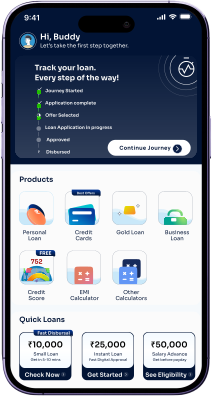
Buddy Loan operates as a digital fintech marketplace that connects eligible applicants with lending partners. Here is how you can apply for a personal loan:
- Step 1: Visit buddyloan.com or download & install the Buddy Loan app (Android or iOS).
- Step 2: Open the personal loan application page. Provide the mobile number and enter the received OTP.
- Step 3: Specify the desired loan amount & personal email. Next, choose the Personal Loan option
- Step 4: Choose the employment type (Salaried, Self-Employed, or Student) and the salary mode (bank or cash).
- Step 5: Enter your work details (Including company name, years of service, and Designation)
- Step 6: Enter your personal details (Including Full Name, PAN, address, DOB & Gender)
- Step 7: Provide your communication address and income details and click the ‘Submit’ button.
Buddy Loan is a loan marketplace and not the lender. The lending partner determines eligibility, approval, interest rate, loan amount, tenure, and disbursal time.
How to Improve Loan Eligibility With Less Than 6 Months of Experience
New employees can strengthen their applications by building a clearer record of income and responsible financial behaviour.
- Wait for additional salary credits: If the requirement is not urgent, a longer salary history may provide stronger evidence of employment stability.
- Apply after confirmation: Completing probation may improve eligibility with lenders that assess current-job stability.
- Request a smaller amount: A modest amount may produce a more manageable EMI relative to a new employee’s salary.
- Maintain a healthy credit score: Pay existing loans and credit-card bills on or before their due dates.
- Keep bank inflows consistent: Salary should be credited regularly to the declared bank account.
- Avoid failed payments: EMI bounces, cheque returns and unsuccessful auto-debits can weaken the application.
- Reduce existing obligations: Paying down high credit-card balances or smaller loans may improve repayment capacity.
- Provide previous employment records: A recent job switcher should submit previous salary slips, Form 16, experience letters and bank statements where required.
- Keep documents consistent: Name, address, employer and salary information should match across records.
- Avoid simultaneous applications: Multiple credit enquiries within a short period can affect the applicant’s profile.
- Check the credit report: Identify and correct inaccurate accounts, overdue balances or personal details before applying.
- Use an eligible co-applicant: Where the lending partner permits it, an earning co-applicant may strengthen the application.
- Consider a secured option: A loan against an FD or eligible gold may be considered when unsecured-loan eligibility is limited.
- Choose an affordable tenure: A very short tenure can create a high EMI, while a longer tenure can increase total interest.
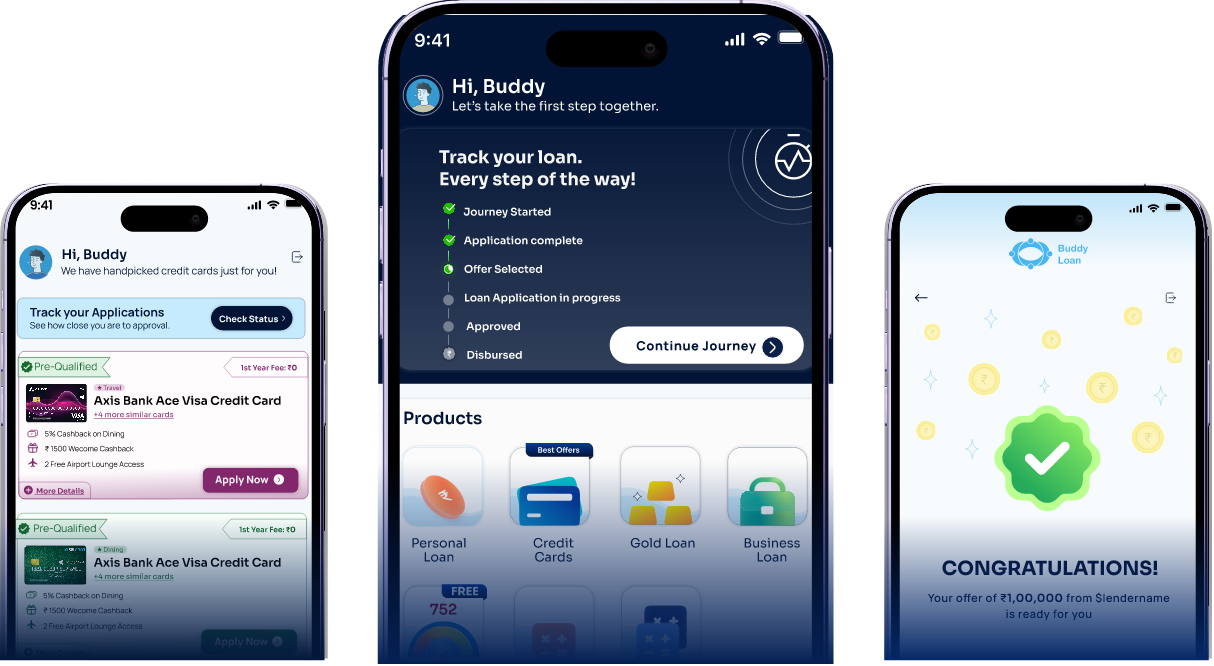
Download the Buddy Loan App Now!
One solution to each of your financial needs at your fingertip.

Scan to download now