
The aspiration to multiply one’s savings through wise investments is a common financial goal. Fortunately, for Indians, the post office savings scheme offers various plans that are designed to facilitate wealth accumulation. These schemes attract consistent growth and the prospect of doubling your investment over time. What sets them apart is not just their promise of financial security but also the peace of mind that comes from government-backed investments. Post Office Savings Schemes ensure reliability and trustworthiness in your financial journey. In this blog, let us explore the various government-backed post office schemes to double your money.
List of Post Office Schemes to Double the Money
Here’s a tabular list of post office double schemes, along with their approximate interest rates and the estimated years it might take to double the invested money:
| Scheme Name | Interest Rate | Years to Double the Money |
| Post Office Monthly Income Scheme | 7.40% | 8-9 years |
| Kisan Vikas Patra | 7.50% | 9-10 years |
| National Savings Certificate | 7.60% | 8-9 years |
| Sukanya Samriddhi Yojana | 8% | 9 years |
| Senior Citizens Savings Scheme | 8.20% | 9 years |
| Public Provident Fund | 7.10% | 10-15 years |

Post Office Monthly Income Scheme (POMIS)
A small post office scheme to double the money that is supported by the Government of India is called the Post Office Monthly Income Scheme (POMIS). It enables investors to save a certain amount every month. Here are the key features of the programme:
| Post Office Monthly Income Scheme (POMIS) | |
| Eligibility | Indians above the age of 10 years |
| Minimum Investment | ₹1000 |
| Maximum Investment | ₹9 lakhs individually, ₹15 lakhs for joint account |
| Interest Rate | 7.40% |
| Tax Implications | Up to ₹1.5 lakhs (Under Section 80C of IT Act, 1961) |
| Maturity Period | 5 years |
| Years to Double the Money | Approximately 8-9 years |
Who should invest in POMIS?
- It is a good option for people who want a predictable monthly income but don’t want to take any financial risks.
- Appropriate for investors who look for a one-time investment and want a steady income to support their standard of living.
- Senior citizens and retired people who have entered the “no-paycheck zone”.
- People who are willing to maximise their investments and returns; often known as long-term investors.
| Account Type | Maximum Investment |
| Minor Account | ₹3 Lakh |
| Single Account | ₹9 Lakh |
| Joint Account | ₹15 Lakh |
Kisan Vikas Patra Post Office (KVP)
Kisan Vikas Patra is a ‘Post Office Double Money Programme’. In a particular time period, depositors can double the money they invested. The following are the features of the KVP scheme.
| Kisan Vikas Patra (KVP) | |
| Eligibility | Indian Residents |
| Minimum Investment | ₹1000 |
| Maximum Investment | No Upper Limit |
| Interest Rate | 7.50% |
| Tax Exemption | Up to ₹1.5 lakhs (Under Section 80C of IT Act, 1961) |
| Maturity Period | 9 years 7 months (115 months) |
| Years to Double the Money | Approximately 9-10 years |
Investments have to be in multiples of 100. The sum can be withdrawn by the depositor either after the maturity time or, with a penalty after six months.

Double Your Money With KVP
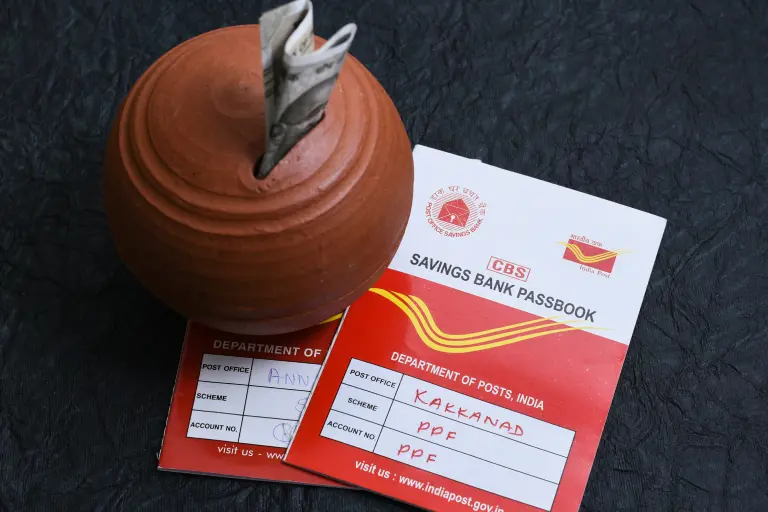
For Kisan Vikas Patra, the annual rate of interest that is specified at the time of account opening remains the same throughout the investment period. Let’s imagine that you opened a KVP account in January 2023 with an interest rate of 7.5%. This interest rate will be taken into account from the first to the third quarter of 2023, which is the duration of your investment period. Whereas, a new rate will apply to all accounts that are opened between the fourth and sixth quarters of 2023.
So, if you are planning to invest ₹10,000 today, after maturity, you will receive ₹20,000. Despite the increase or decrease in interest rates, you can still double your money with this Post Office programme. In addition, withdrawals from the maturity period are not restricted, so if you wish, you can encash it after two and a half years.
This is the reason the official website of the Indian Post Office confirms that Kisan Vikas Patra is a Post Office double money programme.
National Savings Certificate Post Office (NSC)
With the highest rates of return and low risk, NSC post office scheme is a fixed-income strategy. This government initiative aims to make small and medium savings easier for citizens. This post office scheme to double the money offers flexibility to its investors because of the low minimum deposit requirement. The Indian Government has promoted the National Savings Certificate as a personal savings programme. Here is a quick look at what the certificate offers:
| National Savings Certificate (NSC) | |
| Eligibility | Indian Residents |
| Minimum Investment | ₹1000 |
| Maximum Investment | No Upper Limit |
| Interest Rate | 7.6% & revised annually |
| Tax Exemption | Up to ₹1.5 lakhs (Under Section 80C of IT Act, 1961) |
| Maturity Period | 5 years (extended) |
| Years to Double the Money | Approximately 8-9 years |
Every year, the interest that is generated is compounded and added back into the programme. As a result, the investor’s investment grows without having to buy certificates. In addition to lowering tax obligations for investors while providing a steady return, it also provides complete capital protection with guaranteed interest.
Post Office Sukanya Samriddhi Yojana (SSY)
One of the most well-known post office double money programmes the Indian government has created for girls is the Sukanya Samriddhi Yojana. It was launched on the 2nd of January 2015 with the famous slogan “Beti Bachao, Beti Padhao” (Save girls, Educate the girl child). The Ministries of Health and Family Welfare, Women and Child Development, and Human Resource Development have worked together on this nationwide programme. Here are its salient features:
| Sukanya Samriddhi Yojana (SSY) | |
| Eligibility | Girl children up to 10 years of age |
| Minimum Investment | ₹250 (FY 2023-24) |
| Maximum Investment | ₹1.5 lakh annually |
| Interest Rate | 8% p.a |
| Tax Exemption | Up to ₹1.5 lakhs (Under Section 80C of IT Act, 1961) |
| Maturity Period | 21 years or 18 years (old enough to get married) |
| Years to Double the Money | Approximately 9 years |
While the return on your investments is compounded annually, the government announces the applicable interest rate for each fiscal year. Due to the power of compounding, the SSY account’s assets will have increased significantly by the time of maturity or until it is finally closed by the account holder.
Compared to other saving plans, it offers a higher rate of interest and gives girls double financial security.
Post Office Senior Citizen Saving Scheme (SCSS)

The Senior Citizens Savings Scheme (SCSS) scheme is a retirement benefit account backed by the Indian government. Its primary objective is providing senior citizens in India with a steady income or to double the money with the post office scheme. It provides attractive benefits and unparalleled security, making it a great long-term saving solution. Here are some of its features:
| Senior Citizen Savings Scheme (SCSS) | |
| Eligibility | 60+ years or 55 years (retired under superannuation) |
| Minimum Investment | ₹1000 |
| Maximum Investment | ₹30 lakh |
| Interest Rate | 8.2% p.a |
| Tax Exemption | Up to ₹1.5 lakhs (Under Section 80C of IT Act, 1961) |
| Maturity Period | 5 years + 3 years extension |
| Years to Double the Money | Approximately 9 years |
The scheme allows premature withdrawal with a 1% or 1.5% penal charge. The account can also be transferred across the country.
Also Read: List of Government Schemes Announced in Budget 2024-25
Post Office Public Provident Fund Account (PPF)
The Financial Ministry’s National Savings Institute introduced the Public Provident Fund programme in 1968. The scheme’s primary goal is to support people in making modest savings and to offer returns on them. This post office scheme helps double the money. Go through the following features for better understanding:
| Public Provident Fund (PPF) | |
| Eligibility | Indian Residents |
| Minimum Investment | ₹500 |
| Maximum Investment | ₹1.5 lakh annually |
| Interest Rate | 7.1% p.a |
| Tax Exemption | Up to ₹1.5 lakhs (Under Section 80C of IT Act, 1961) |
| Maturity Period | 15 years + 5 years extension |
| Years to Double the Money | Approximately 10-15 years |
Note: The interest rates, minimum balance, and maturity period for each scheme can vary as per the government norms.
Loan facility for the PPF scheme is available from 3rd financial year up to 6th financial year. Starting with the seventh fiscal year, withdrawals are allowed annually. Due to its combination of tax benefits, financial returns, and security, India’s Public Provident Fund (PPF) scheme is a particularly well-liked long-term savings plan.
For individuals who prefer a low level of risk, PPF is one of the best investment options.
Also Read: Top 10 Post Office Saving Schemes
Documents Required to Open A Post Office Savings Scheme
The required documents to open a Post Office Savings Scheme to double your money are listed below:
- Identification Proof: Aadhar card, PAN card, driving licence, passport, or voter’s ID.
- Address Proof: Aadhar card, utility bills, rent agreement, official documents with current address, etc.
- Passport-size Photographs: A couple of recent photos for documentation.
- Application Forms: Scheme-specific forms to initiate the process.
- Age and Relationship Proof: For schemes involving minors.
- Nominee Details: Information about the beneficiary’s nominee.
- Age and Relationship Proof: Required for schemes involving minors.
- Initial Investment: Required amount for scheme enrollment.
- Know Your Customer (KYC) Details: Compliance with KYC norms.
- Proof of Investment Source: For larger investments, provide proof of income/funds.
- Bank Account Details: Valid account for fund transfer, interest/maturity credit.
Ensure you have these documents ready for a smooth and successful investment journey with Post Office Savings Schemes.
Also Read: Earn 5,550, 7,400, or 9,250 Monthly Income Through Post Office Scheme
Benefits of Post Office Investment-Saving Schemes in India

The post office double money investment-saving plans in India have a lot of advantages, including
- Government Backing: Post office schemes are backed by the government, ensuring the safety of your investment.
- Steady Growth: These schemes offer consistent and steady growth over time, making them ideal for long-term goals.
- Diverse Options: With a variety of schemes catering to different needs, you can choose the one that aligns with your financial goals.
- Tax Benefits: Some schemes provide tax benefits, either through tax-free interest or deductions on the invested amount.
- Ease of Access: Post office branches are widespread across India, providing easy accessibility for investors across the country.
Also Read: Top Post Office Tax Saving Schemes
To Conclude
To make the most out of your investment plans, post office investment-savings schemes provide a reliable means to double your money. Whether it’s for your child’s education, retirement planning, or simply growing your wealth, these programmes offer a planned and secure means to accomplish your financial goals. Now, set yourself up for a financially secure future by making wise choices and taking advantage of post office double money initiatives.