
India’s inflation rate, measured by the Consumer Price Index (CPI), dropped to 1.55% in July 2025, the lowest level since 2017. For many, this might sound like financial jargon, but it carries real meaning for households, businesses, farmers, investors and the government.
A lower inflation rate means your monthly grocery bill might be lighter. It could lead to cheaper home loans or vehicle loans. It also gives India’s central bank, the RBI (Reserve Bank of India), more freedom to cut interest rates and support economic growth. But at the same time, it may put pressure on farmers’ incomes and rural demand.
So what’s behind this historic dip? Who gains? Who might lose? And what lies ahead? Let’s dive in.
CPI and Its Importance for the Indian Economy
The Consumer Price Index (CPI) is the most common way to measure inflation in India. It tracks how prices are rising or falling for a fixed basket of items that most Indian households buy, like vegetables, pulses, clothes, rent, electricity and healthcare.
If CPI rises too fast, it means high inflation, your money buys less, and everyday items become expensive. If it stays low for too long, it could point to weak demand, slow growth and fewer job opportunities. That’s why inflation is a balancing act.
Breakdown of the CPI Basket:
| CPI Component | Weight (%) |
| Food and Beverages | 45.86 |
| Miscellaneous (Health, Education) | 28.32 |
| Housing | 10.07 |
| Fuel and Light | 6.84 |
| Clothing and Footwear | 6.53 |
| Pan, Tobacco, and Intoxicants | 2.38 |
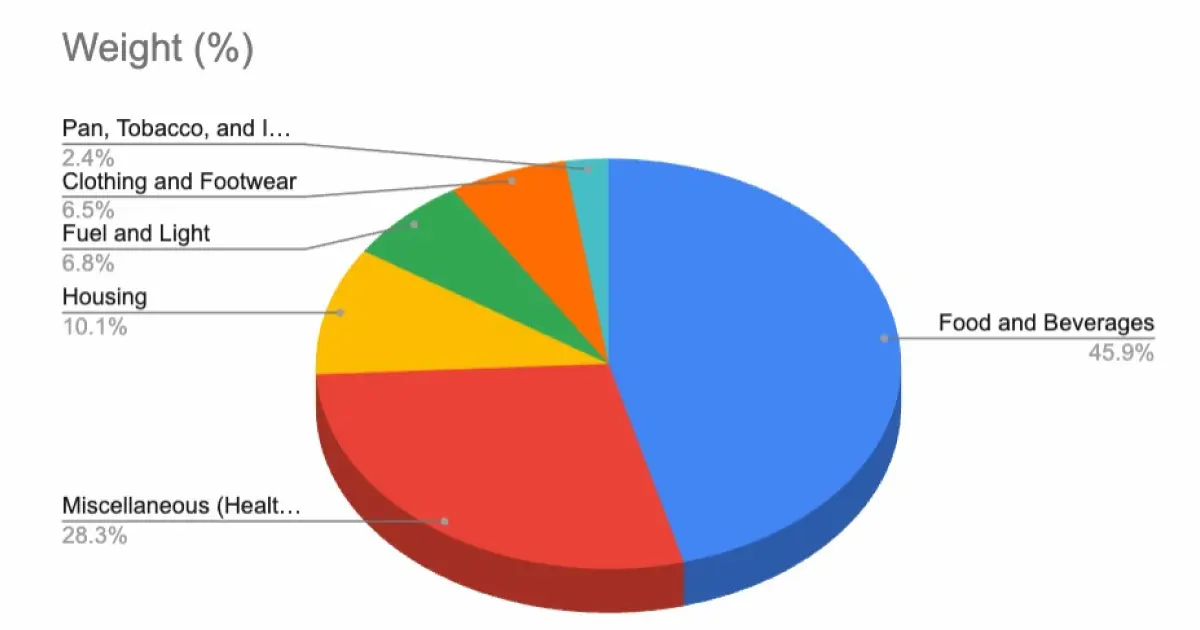
From the above Pie chart, we can understand that food alone makes up nearly half of the CPI. So, any big change in food prices, especially vegetables, cereals, or pulses, has a major impact on overall inflation. That’s exactly what we saw in July 2025.

What Changed in July 2025: Inflation Trends Across India
Let’s take a look at the month-to-month changes:
| Indicator | July 2025 | June 2025 | Change |
| Overall CPI Inflation | 1.55% | 2.10% | -0.55% |
| Food Inflation (CFPI) | -1.76% | -1.01% | -0.75% |
| Rural CPI Inflation | 1.18% | 1.72% | -0.54% |
| Urban CPI Inflation | 2.05% | 2.56% | -0.51% |
| Core Inflation (Ex-Gold) | 2.96% | 3.96% | -1.00% |
| RBI Core Estimate | 4.00% | 4.00% | No Change |
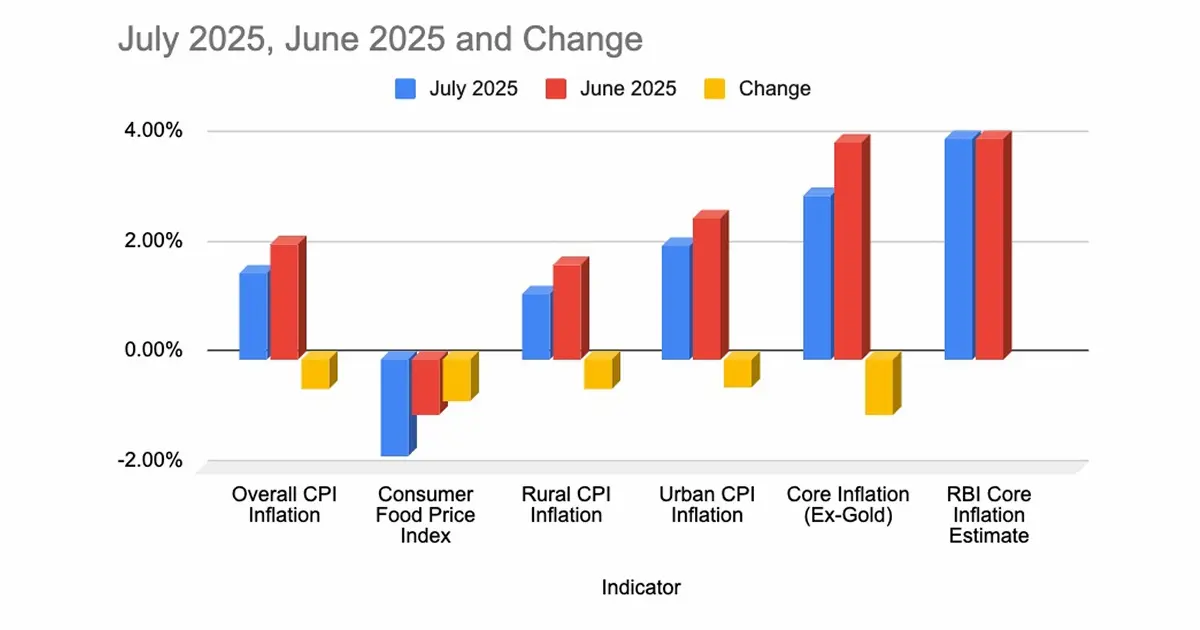
What this means:
- Food inflation turned negative, meaning prices fell compared to last year, especially for vegetables and pulses.
- Both rural and urban areas saw slower price increases, showing that the benefits were widespread.
- Even core inflation (which excludes food and fuel) fell sharply, signaling lower price pressure in everyday services like housing, transport, and healthcare.
Why Did India’s CPI Inflation Fall So Much in July 2025?
There were four main reasons:
1. Sharp Drop in Food Prices
Food prices were the biggest driver. Here are some specifics:
- Vegetables: down by 20.69%
- Pulses: down by 13.76%
- Cereal, sugar, and eggs also became cheaper
With such a large share of CPI driven by food, even small changes in food prices have a big impact, and this was a large drop.
2. Good Harvest and Supply Conditions
India’s farmers had a strong spring harvest, and there were no major supply disruptions. As a result, food supplies were steady and plentiful, helping keep prices low.
3. Base Effect
Last year, inflation was relatively high in July. When comparing current prices to those higher levels, the percentage drop appears bigger; this statistical impact is called the “base effect.”
4. Cooling in Other Categories
Besides food, inflation eased in education, transport, housing, and other essential services. Only healthcare and fuel prices rose slightly.

What Does This Low Inflation Mean for Indian Consumers?
Lower inflation is generally good news for consumers, especially for the middle and lower-income groups:
- Groceries, vegetables, pulses, and milk became cheaper
- More money can go towards savings or non-essential items
- Households get a break from rising expenses
Who Benefits the Most?
The biggest winners are low-income and rural households, who spend more of their income on food.
- For the poorest rural households, inflation fell from 4.0% to 0.8%
- For the urban poor, it dropped from 2.7% to 1.0%
This kind of relief directly improves living conditions, making it easier to afford basic necessities.
But There’s a Flip Side…
Lower prices also mean lower earnings for farmers, especially those selling vegetables and pulses. If farm incomes fall too much, it can weaken rural demand, reduce consumption and hurt small businesses that depend on village sales.
RBI’s Response: Interest Rates and Monetary Policy
The RBI (Reserve Bank of India) uses inflation as a key factor when deciding interest rates. Its main tool, the repo rate, affects the cost of loans and EMIs.
Now that inflation has dropped below 2%, the RBI has more space to focus on growth by:
- Keeping interest rates steady
- Possibly cutting rates to make borrowing cheaper
- Supporting credit growth, investment, and demand
RBI’s Outlook:
- Repo Rate: 5.50%
- GDP Forecast (FY26): 6.5%
- Inflation Forecast (FY26): 3.1%
- CPI Estimate (Q1 FY27): 4.9%
This means RBI is not worried about runaway inflation and is likely to maintain a growth-friendly policy in the near term.
Will Inflation Stay This Low in India?
Probably not, and that’s not a bad thing. Inflation at this level is unusually low and not sustainable long-term. Here’s why it may rise again soon:
- Base effect will fade: As we move into months with lower inflation from last year, the comparison won’t look as dramatic. So, even small price rises will push CPI up.
- Food price volatility: If monsoon rainfall is poor or harvests suffer, food inflation could spike again. Supply shocks can undo months of stable prices.
- Global factors: Factors such as oil prices, shipping disruptions, and US-China trade tensions can increase costs in India, too.
In short, inflation will likely rise again, but hopefully in a controlled, gradual manner.
India in 2025 vs. 2017: What’s Different This Time?
Back in 2017, inflation bounced back quickly due to food price shocks. The economy was also weaker, and the RBI had fewer tools.
This time, things are more balanced. Core inflation is stable, RBI is prepared, and GDP growth is steady. This gives India a better chance of managing inflation without sacrificing growth.
| Indicator | June 2017 | July 2025 |
| CPI Inflation Rate | 1.46% | 1.55% |
| RBI Repo Rate | 6.00% | 5.50% |
| RBI Policy Focus | Neutral | Growth-Focused |
| GDP Growth Trend | Slowing | Stable |
What Should India Do Now to Make the Most of This Opportunity?
This low-inflation period gives India a window of opportunity to act smartly. Here’s what should be done:
- Support farmers with income protection schemes, especially for perishables
- Invest in rural infrastructure and cold storage to stabilize food prices
- Encourage MSME credit and consumer spending through supportive interest rates
- Advance structural reforms in logistics, housing, and the digital economy
Conclusion: A Moment to Think Ahead and Act Smart
India’s 1.55% CPI inflation rate in July 2025 is a rare event, a combination of good harvests, strong supply chains, and favourable base effects. It brings immediate relief to consumers and opens the door for growth-oriented policies.
But it also comes with challenges, like protecting farm incomes, preventing rural distress and staying prepared for global and domestic risks.
This moment should not be wasted. It’s a chance to build a stronger, more balanced and inclusive economy, where inflation stays under control, growth is stable and opportunity reaches every corner of the country.
Download the Buddy Loan App Now! One solution to each of your financial needs at your fingertip. Scan to download now