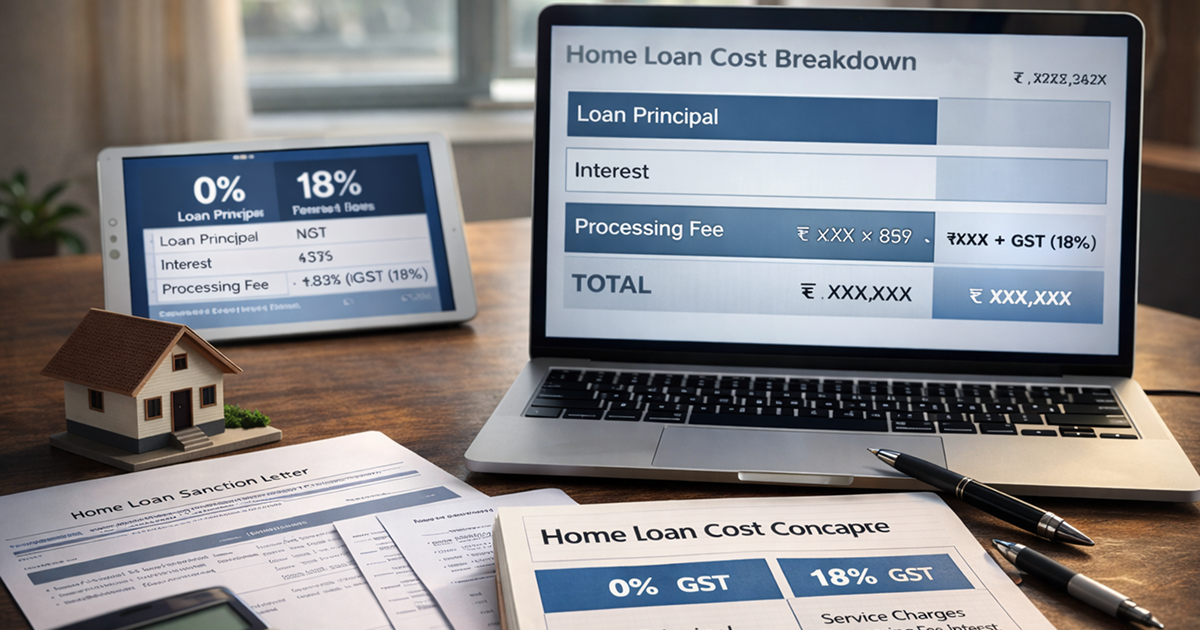
The single biggest misconception in the Indian real estate market is that an increase in monthly EMI is due to GST on your home loan. This is actually incorrect. Under the GST Act, lending money is a financial transaction, not a supply of goods or services. Consequently, your loan principal and interest are entirely exempt from GST. However, while the loan itself is exempt, the services associated with it are not.
Banks and NBFCs collect various service charges for processing, administering, and closing your loan. These are classified as financial services and attract GST. Understanding the GST framework and its effects on the home loan is essential for any homebuyer to avoid overpaying during the closing process.
Continue reading to gain a comprehensive understanding of GST on home loans, including what to look for and what to avoid.
What GST Applies to & What It Doesn’t
The single biggest misconception in the home loan space is that GST somehow increases your monthly EMI or the interest you pay. As stated before, this is factually incorrect. Under the GST Act, lending money is not a ‘supply of goods or services’ – it is a financial transaction. Accordingly, loan principal and interest are entirely exempt from GST.
What GST does apply to are the service charges that banks and NBFCs collect for processing, administering, and closing your loan because those are classified as ‘financial services’ under the GST framework.
Let’s take a quick look at what will be added as taxable:
| NO GST | GST APPLIES |
| Loan Principal Amount | Loan Processing Fee (18%) |
| Home Loan EMI | Legal & Documentation Charges (18%) |
| Interest Charged by Bank | Property Valuation Fee (18%) |
| Stamp Duty & Registration | Prepayment / Foreclosure Charges (18%) |
| Ready-to-Move Properties | GST on under-construction property (5% / 1%) |
| Penal Interest on Late EMI | Cheque Bounce / Late Payment Fees (18%) |
CBIC Clarification: Penal interest (charged when you miss an EMI) is treated as part of the loan interest and is exempt from GST. However, other late fees, such as bounced cheques or reminder service fees, are considered service charges and attract 18% GST.
The 2026 GST Charge Table
Below is a comprehensive reference for every home loan charge and its GST treatment. If you are worried about your housing loan gst, audit your loan sanction letter line by line against these rates.
| Charge Type | GST Rate | Charged On | Key Notes |
|---|---|---|---|
| Loan Processing Fee | 18% | 0.25%–1% of loan amount (base fee) | Most common GST charge. Deducted upfront at disbursement. |
| Legal / Documentation Charges | 18% | Fixed amount or % of loan | The fee includes a title search, a legal opinion, and the preparation of documents. |
| Property Valuation Fee | 18% | Fixed per valuation | The bank pays the fixed 18% to empanelled valuers. |
| Prepayment / Part-Payment Charges | 18% | % of outstanding principal prepaid | RBI mandates nil charges on floating-rate loans for individuals. Fixed rate: up to 2% + 18% GST. |
| Foreclosure / Loan Closure Charges | 18% | 0.5%–2% of outstanding amount | GST applies to the fee, not the loan balance being closed. |
| Cheque Bounce / NACH Failure Fee | 18% | Fixed per instance | Distinct from penal interest, this is classified as a service fee under GST. |
| Loan Cancellation Fee | 18% | Fixed or a percentage of sanctioned amount | It applies if a loan is cancelled post-sanction. |
| EMI / Loan Principal | Exempt | — | Lending is not a supply of goods/services under GST law. |
| Loan Interest | Exempt | — | Financial services are exempt from GST, regardless of the rate type. |
| Under-Construction Property (Non-Affordable) | 5% | Property value (excl. land) | No ITC. The current rate has been in effect since April 2019. The builder collects the ITC and remits it to the government. |
| Affordable Housing (PMAY-eligible) | 1% | Property value (excl. land) | No ITC. The property has a value of approximately 45L, with a carpet area of 60 sq m in the metro area and 90 sq m in the non-metro area. |
| Ready-to-Move Property | 0% | — | The completion/occupation certificate issued is GST-exempt. Stamp duty applies separately. |

GST on Home loan by Property Type
The GST rate on a property purchase depends entirely on the construction stage and whether it qualifies as affordable housing. These three scenarios cover every situation.
1. Under-Construction Property (Non-Affordable) — 5% GST
If you are buying a flat or apartment that has not yet received its Occupancy Certificate (OC), GST applies at 5% to the property value, excluding land. The builder collects this from you and remits it to the government. Builders cannot claim ITC under this structure. This is a deliberate trade-off by the GST Council in April 2019 to reduce the headline rate for buyers.
| Several sources still cite 12% with ITC as the rate for under-construction homes. This is the pre-2019 rate and is no longer applicable. The correct current rate is 5% without ITC, effective since April 1, 2019 and unchanged in 2026. |
Also Read: 5% GST Item List
2. Affordable Housing (PMAY-Linked) — 1% GST
Properties qualifying under the affordable housing definition attract a significantly reduced rate of 1% GST. A property must meet all of the following criteria simultaneously:
- Property value ≤ ₹45 lakhs
- Carpet area ≤ 60 sqm in metro cities (Delhi-NCR, Mumbai, Chennai, Kolkata, Hyderabad, Bengaluru)
- Carpet area ≤ 90 sqm in all other cities and towns
- Must be a residential housing project (not commercial)
This is directly relevant to PMAY (Pradhan Mantri Awas Yojana) beneficiaries. No ITC (Input Tax Credit) is available to the builder under this structure.
3. Ready-to-Move-In Property — 0% GST
Properties that have received their Completion Certificate (CC) or Occupancy Certificate (OC) are completely exempt from GST. Note that stamp duty and registration charges are separate state-level taxes. They apply to all property transactions regardless of GST status and are never interchangeable.
Also Read: 0% GST Items List
Real-Money Calculation Examples
To accurately estimate your total outflow, you must separate the tax on the property from the tax on the loan services. While a GST on home loan calculator provides quick figures, understanding the underlying equations helps you audit bank sanction letters for errors.
Here is the step-by-step breakdown of the two primary tax components.
The Equations
To find your total tax liability, use these three primary formulas:
- Property GST Equation:
(Total Agreement Value × 0.66) × Applicable GST Rate (1% or 5%).
Note: The 0.66 multiplier accounts for the standard one-third land abatement allowed by the government. - Loan Service GST Equation:
(Loan Processing Fee + Legal Charges + Valuation Fees) × 18%. - Total GST Outflow:
Property GST + Loan Service GST.
Calculation 1: Affordable Housing (The 1% Rule)
Consider a gst on flats below 45 lakhs scenario. Suppose you purchase an under-construction flat with an agreement value of ₹40,00,000. You take a housing loan of ₹30,00,000 to fund the purchase. The bank charges a 0.5% loan processing fee and ₹10,000 for legal and valuation services.
Step 1: Calculate GST on Property Purchase
The government considers two-thirds of the agreement value for taxation.
- Taxable Value: ₹40,00,000 × 0.66 = ₹26,40,000.
- GST at 1%: ₹26,40,000 × 0.01 = ₹26,400.
Step 2: Calculate GST on Home Loan Processing Fee and Services
The bank applies 18% GST on all service-related gst charges on home loans.
- Processing Fee: ₹30,00,000 × 0.005 = ₹15,000.
- Total Service Charges: ₹15,000 (Processing) + ₹10,000 (Legal/Valuation) = ₹25,000.
- GST at 18%: ₹25,000 × 0.18 = ₹4,500.
Step 3: Total GST Liability
Sum the property and loan service taxes.
- Total: ₹26,400 + ₹4,500 = ₹30,900.
2. Calculation 2: Standard Under-Construction (The 5% Rule)
Now, consider a gst on residential property purchase for a premium unit. Suppose the agreement value is ₹90,00,000. You secure a loan of ₹70,00,000. The bank charges a 1% processing fee for home loan and ₹15,000 for documentation and appraisal.
Step 1: Calculate GST on Purchase of Flat
Since this exceeds the affordable housing limit, the 5% rate applies.
- Taxable Value: ₹90,00,000 × 0.66 = ₹59,40,000.
- GST at 5%: ₹59,40,000 × 0.05 = ₹2,97,000.
Step 2: Calculate GST Applicable on Housing Loan Services
The 18% rate applies to the administrative costs of the loan.
- Processing Fee: ₹70,00,000 × 0.01 = ₹70,000.
- Total Service Charges: ₹70,000 (Processing) + ₹15,000 (Legal/Valuation) = ₹85,000.
- GST at 18%: ₹85,000 × 0.18 = ₹15,300.
Step 3: Total GST Liability
- Total: ₹2,97,000 + ₹15,300 = ₹3,12,300.
| Critical Takeaway for Borrowers
In Scenario 2, the gst on under construction property accounts for nearly 95% of your total tax outflow. If you wait for the Occupancy Certificate (OC) to buy the same house, you save ₹2,97,000 instantly. However, the gst on home loan services (₹15,300) remains mandatory regardless of the property’s construction stage. Always verify that your bank does not charge GST on the interest component of your EMI. |
Can You Claim Input Tax Credit (ITC)?
Most articles explain ITC from the builder’s perspective. For an individual home buyer, the answer is unambiguous: You cannot claim ITC on the GST you pay on processing fees or on an under-construction property.
| The ITC Answer for Individual Buyers
As an individual home buyer, you cannot claim ITC on the GST you pay on processing fees or on an under-construction property. ITC on loan-related charges is available only if the loan is taken for a business purpose by a GST-registered entity. Home loans for personal residential purchases are outside the ITC chain entirely. |
Before April 2019, builders could claim ITC on construction materials and were expected (in theory) to pass savings to buyers. The 2019 revision removed builder ITC in exchange for lower headline rates. The GST Council judged this more transparent for buyers than relying on voluntary cost pass-through.
GST and Income Tax Deductions: How They Interact
GST and Income Tax operate as separate systems, but both shape your total cost of purchase.
- Section 80C (Principal Repayment): You can claim up to ₹1.5 lakh/year on principal repaid. GST on service charges does not affect this deduction.
- Section 24(b) (Interest Deduction): You can claim up to ₹2 lakh/year on interest paid for self-occupied property. Since interest is GST-exempt, this remains unaffected.
- Section 80EEA (First-Time Affordable): This provides an additional ₹1.5 lakh/year on interest for first-time buyers of affordable housing, the same category that attracts 1% GST.
Practical Tax Note: GST paid on processing fees, legal charges, and valuation cannot be directly claimed as an Income Tax deduction. However, when capitalised into the cost of acquisition, these charges may reduce your capital gains tax liability when you eventually sell the property.
Be practical. Use a GST calculator to calculate your taxes accurately.
Also Read: New GST Rates on Food Items | New GST Rates on Dairy Products
Common GST Myths
There are a lot of common myths around GST on home loans. Use this table to verify the facts for 2026.
| What’s Circulating Online | Correct (2026) |
| GST on under-construction homes is 12% with ITC. | The 12% + ITC rate ended in 2019. Current rate is 5% without ITC. |
| Affordable housing attracts 8% GST with ITC. | Outdated. The rate is 1% without ITC since April 2019. |
| The GST on home loan EMIs is 18%. | Zero GST on EMI. Principal and interest are fully exempt. |
| GST 2.0 (2025–26) revised home loan rates. | GST 2.0 was a compliance exercise. Home loan and property rates remained unchanged. |
Conclusion
To summarize the fuss around GST on home loan, the core financial components of your borrowing, namely the loan principal and the interest, are completely exempt from GST. The tax only comes into play on the service side of the transaction. You will pay an 18% tax on the loan processing fee, legal documentation, and valuation charges. On the property side, the gst rate on property purchase is dictated by the construction status: 5% for standard under-construction homes, 1% for affordable housing, and 0% for ready-to-move properties.
The most critical insight for any homebuyer in 2026 is that your property selection drastically outweighs your loan selection when it comes to tax optimization. While you cannot escape the 18% gst on home loan processing fee, you can save lakhs of rupees by targeting the gst on flats below 45 lakhs to secure the 1% affordable housing rate. Alternatively, opting for a ready-to-move-in home eliminates the property GST entirely. Always review your bank’s sanction letter carefully to ensure that gst charges on home loan are only applied to administrative fees and never to your actual EMI or interest payments. By understanding these rules, you can accurately forecast your closing costs and step into your new home with complete financial confidence.
If you are looking for a home loan, before you jump right in, use an EMI calculator to know what you will be actually paying back monthly. This is crucial, because many missout on the actual amount that is being paid back or the actual monthly payment amounts.

Download the Buddy Loan App Now!
One solution to each of your financial needs at your fingertip.

Scan to download now