There is a saying in finance, “Return of capital is more important than return on capital”. For many of us, the fear of losing our hard-earned money (the risk) far outweighs the greed for overnight returns. We want our savings & investments to grow, yes, but not at the cost of sleepless nights watching stock market tickers turn red.
However, playing it too safe has its own danger, especially for us Indians: Inflation. If your money is sitting idle or in a low-yield account, its purchasing power is silently evaporating. The challenge, therefore, is finding the ‘Goldilocks’ zone—investments that offer the safety of a fortress but the growth of a garden. And everyone interersted in wealth is drawn towards one goal: low risk investment with high returns.
This article is not an investment advice; rather, it is an educational deep-dive into the instruments that form the bedrock of a stable Indian portfolio. Let’s explore five categories of low-risk avenues, dissecting them through the lens of risk, liquidity, and real returns.
What Investment Grounds Looks Like in 2026
In the investment battleground of 2026, the definition of ‘safe’ has evolved significantly. It is no longer just about putting money under the mattress or in a savings account; it is about mastering the trifecta of sovereign guarantees, credit ratings, and tax efficiency.
Today, the Real Return (Return minus Inflation minus Tax) is the only metric that matters. Historically, India’s inflation hovered around 6%. However, as we start 2026, we are seeing a relaxed CPI inflation outlook of 2% to 3%. While this sounds comforting, it is not a cue for investors to relax. Lifestyle inflation — the cost of healthcare, education, and travel — continues to grow much faster than the official CPI, meaning your money still needs to work hard to retain its purchasing power.

The Budget 2026 Taxation Reset
The introduction of the Union Budget 2026 has fundamentally shifted the playbook for conservative, low risk-craving investors:
- Debt Funds: These are now taxed at your income slab rate, removing the long-term indexation benefit. This makes them tax-inefficient for those in the 30% bracket, bringing traditional instruments like FDs and PPF back into focus.
- Equity Funds: On the flip side, gains on equity; up to ₹1.25 Lakh are now tax-free, incentivising a slight risk-on approach even for conservative portfolios.
- The SGB Slap: The government has tightened the noose on Sovereign Gold Bonds. The coveted tax-free maturity benefit is now strictly for original subscribers, making secondary market purchases less attractive — if sold early.
So, where does the safe money go now?
With debt mutual funds losing their tax edge and SGBs becoming restrictive, the spotlight returns to foundational assets. We have identified the top 5 low-risk investments that still offer the perfect blend of safety and return yield in this new tax regime and upcoming financial wormhole.
Read this: Earn ₹1,46,000 with Daily Investment of ₹200 in KVP
1. Fixed Deposits (FDs): The Capital Safety Foundation
Fixed Deposits (FDs) remain the most utilised low risk investment option in India for a singlular reason: psychological comfort. When you book an FD, you know exactly what you will get as retun at maturity, down to the last rupee. In 2026, FDs are offered by both Banks and Non-Banking Financial Companies (NBFCs). Post office FD schemes are also a growing interest for traditional investors.
While they are often criticised for lower returns, their role is not wealth multiplication, but wealth preservation. They can act as the emergency brake in your portfolio — money that is safe, accessible, and unaffected by the chaos of the stock market.
The Nuances of FDs
- Bank vs. Corporate: Bank FDs are generally safer, backed by the DICGC insurance (up to ₹5 Lakh). Corporate FDs offer higher interest, often 1-2% more, but carry the risk of the company defaulting.
- Taxation: The interest is fully taxable at your income slab. For someone in the 30% tax bracket, a 7% FD return effectively becomes ~4.9%.
- Liquidity: They are highly liquid. You can break an FD anytime, usually for a small penalty (0.5% to 1% reduction in interest).

Investment Parameters of Fixed Deposits
Here is a full outlook into FD as a low-risk investment high return option, considering all the investment parameters:
| Parameter | Fixed Deposit (FD) Details |
| Risk Appetite / Tolerance | Low. Ideal for risk-averse individuals seeking guaranteed capital. |
| Expected Returns | 3% to 8% p.a., varying by institution (Bank vs. NBFC) and tenure. |
| Investment Horizon (Tenure) | Flexible. Ranges from 7 days up to 10 years. |
| Liquidity Requirements | High. Partial or full premature withdrawal is allowed (usually with a penalty). |
| Inflation-Adjusted Returns | Low/Negative. Often fails to beat inflation post-tax. |
| Tax Efficiency | Low. Interest is added to income and taxed at slab rates; TDS applies. |
| Capital Protection vs. Appreciation | High Capital Protection. Focuses on fixed growth rather than appreciation. |
| Asset Allocation & Diversification | Acts as a core defensive asset in a diversified portfolio. |
| Volatility & Market Sentiment | Zero Volatility. Unaffected by daily market fluctuations. |
| Credit Quality / Sovereign Safety | High. Bank FDs insured up to ₹5 lakh (DICGC); Corporate FDs depend on credit ratings (AAA is safest). |
| Cost Efficiency | High. Generally no entry loads or management fees. |
| Lock-in Periods | None (except 5-year Tax-Saving FDs). |
| Cash Flow Requirements | Flexible. Offers monthly, quarterly, or lump-sum payout options. |
| Regulatory & Legal Compliance | Regulated by RBI and governed by individual bank policies. |
2. EPF & PPF: The Best Retirement Options
If FDs are for the short-to-medium term investment, the Employee Provident Fund (EPF) and Public Provident Fund (PPF) are the heavy lifters for the long term low risk investment. Although there is a slight difference between EPF and PPF, these are government-managed schemes designed to mobilise small savings into productive capital while offering the highest level of security — Sovereign Guarantee.
Best Benefit of EPF & PPF: The Power of EEE
The biggest advantage of PPF (and EPF to an extent) is the ‘Exempt-Exempt-Exempt’ (EEE) tax status.
- Investment is Exempt: You get a tax deduction on the money you put in (under Section 80C).
- Interest is Exempt: The interest earned every year is tax-free.
- Maturity is Exempt: The final amount you withdraw is tax-free.
For a conservative investor, a tax-free return of ~7.1% (PPF) is mathematically equivalent to a taxable return of over 10% for someone in the highest tax bracket.

Investment Parameters of EPF & PPF
Here is a full outlook into EPF & PPF as a long-term low risk investment option, considering all the investment parameters:
| Parameter | EPF & PPF Details |
| Risk Appetite / Tolerance | Very Low. Backed by central government guarantee. |
| Expected Returns | PPF ~7.1%; EPF ~8.25% p.a. (Subject to periodic government revision). |
| Investment Horizon (Tenure) | Long-term. 15 years for PPF; Tenure of employment for EPF. |
| Liquidity Requirements | Moderate. Partial withdrawals allowed after 5-7 years or specific conditions. |
| Inflation-Adjusted Returns | Moderate to High. Generally stays ahead of inflation due to compounding and tax benefits. |
| Tax Efficiency | High (EEE). Tax-free maturity and interest. |
| Capital Protection vs. Appreciation | Absolute Capital Protection with steady compounding growth. |
| Asset Allocation & Diversification | Essential for the debt portion of long-term retirement portfolios. |
| Volatility & Market Sentiment | Zero. Interest rates are fixed or revised quarterly by the state. |
| Credit Quality / Sovereign Safety | Sovereign Guarantee. The highest level of safety in India. |
| Cost Efficiency | Highly Efficient. No management fees or entry loads. |
| Lock-in Periods | 15 Years for PPF; Till retirement/exit for EPF. |
| Cash Flow Requirements | Growth-oriented. Provides a lump sum at maturity/retirement. |
| Regulatory & Legal Compliance | Governed by the Ministry of Finance and EPFO. |
Also Read: Best Government Investment Schemes in India
3. Sukanya Samriddhi Yojana (SSY)
The Sukanya Samriddhi Yojana (SSY) is arguably the best debt investment in India today, provided you meet the eligibility criteria: being the parent of a girl child under the age of ten. It was launched to encourage financial security for the girl child, specifically for education and marriage. It is essentially, the best low risk investment with high returns, but only accessible for a few, and is locked out of reach.
Why SSY Stands Out as as Investment?
SSY typically offers a premium interest rate over the PPF (currently around 8.2%). Like the PPF, it enjoys the EEE tax status. The compounding effect over the 21-year maturity period can create a substantial corpus. It forces discipline because the money is locked away for a specific future goal, preventing parents from dipping into it for impulsive expenses.
Investment Parameters of SSY
Here is a full outlook into SSY as an low risk high return investment option, considering all the investment parameters:
| Parameter | Sukanya Samriddhi Yojana (SSY) Details |
| Risk Appetite / Tolerance | Very Low. Government-backed security. |
| Expected Returns | ~8.2% p.a. Typically the highest among small savings schemes. |
| Investment Horizon (Tenure) | Very Long-term. Matures in 21 years from account opening. |
| Liquidity Requirements | Low. Withdrawals limited to 50% for education after age 18. |
| Inflation-Adjusted Returns | High. High potential to beat inflation over two decades due to high rates. |
| Tax Efficiency | Full EEE Status. Section 80C benefits apply. |
| Capital Protection vs. Appreciation | Guaranteed Principal and compounded interest. |
| Asset Allocation & Diversification | Specific goal-based asset for children’s future planning. |
| Volatility & Market Sentiment | Non-volatile. Interest revised periodically by the government. |
| Credit Quality / Sovereign Safety | Sovereign Safety. Backed by the Government of India. |
| Cost Efficiency | Highly Efficient. Minimal administrative costs. |
| Lock-in Periods | 21 Years (or until marriage after age 18). |
| Cash Flow Requirements | Growth-oriented. Focused on a terminal lump-sum payout. |
| Regulatory & Legal Compliance | Managed under the Small Savings Schemes framework. |
4. NSC and SCSS: The Guaranteed Medium-Term Growth
The National Savings Certificate (NSC) and Senior Citizen Savings Scheme (SCSS) can be considered as low risk investments but they deliver for two very different needs but share the same DNA: Government Security.
- NSC (The Accumulator): This is a 5-year instrument. You deposit money, and you get it back with interest after 5 years. It is ideal for mid-term goals where you cannot afford to take risks (e.g., a down payment for a house in 5 years).
- SCSS (The Income Generator): This is the gold standard for retirees. It allows deposits up to ₹30 Lakh and pays interest quarterly. For a senior citizen, this provides the regular cash flow needed for daily expenses, with returns often beating bank FDs.
Investment Parameters of NSC & SCSS
Here is a full outlook into NSC & SCSS as a low risk investment option, considering all the investment parameters:
| Parameter | NSC & SCSS Details |
| Risk Appetite / Tolerance | Very Low. Sovereign-backed instruments. |
| Expected Returns | NSC ~7.7%; SCSS ~8.2% p.a. |
| Investment Horizon (Tenure) | 5 Years for both (SCSS extendable by 3 years). |
| Liquidity Requirements | Low. Premature exit involves penalties or specific rules. |
| Inflation-Adjusted Returns | Moderate. Typically matches or slightly exceeds inflation. |
| Tax Efficiency | NSC: Interest is taxable but qualifies for 80C reinvestment. SCSS: Interest is fully taxable. |
| Capital Protection vs. Appreciation | Highest Capital Safety. Guaranteed periodic (SCSS) or terminal (NSC) returns. |
| Asset Allocation & Diversification | Provides debt component stability for medium-term or retired portfolios. |
| Volatility & Market Sentiment | Zero. Fixed returns agreed at the time of deposit. |
| Credit Quality / Sovereign Safety | Government of India Guarantee. |
| Cost Efficiency | High. Minimal account-keeping charges. |
| Lock-in Periods | 5 Years for both. |
| Cash Flow Requirements | NSC: Growth (Cumulative). SCSS: Income (Quarterly payouts). |
| Regulatory & Legal Compliance | Post office and nationalized bank operations. |
5. Government and Private Bonds: The Debt Market
Investing in bonds is essentially lending money. You are the bank. You lend money to the Government (G-Secs) or a Corporation, and they pay you interest (coupon) and return your principal at the end. The catch in 2026 is that debt funds maynot perform as well as equities, considering strictly post tax savings. However, some bonds may sustain the value, depending on the entity or investment type.
Government Securities (G-Secs): These are the safest low risk investment in the country. They carry zero default risk because the government can always print money to pay you back. A notable mention here is the RBI Floating Rate Savings Bond, which currently yields ~8.05% and resets every six months.
Corporate Bonds: These are issued by companies. They offer higher returns than G-Secs but carry a Credit Risk—the risk that the company might go bankrupt. Investors should stick to ‘AAA’ rated bonds (like Bajaj Finance, HDFC, etc.) for safety, and not rush into less popular or backed bonds.
Suggested Read: Difference Between Bonds And Debentures
Investment Parameters of Govt & Private Bonds
Here is a full outlook into bonds as a low risk righ return investment option, considering all the investment parameters:
| Parameter | Govt & Private Bond Details |
| Risk Appetite / Tolerance | Low (Govt) to Moderate (Private). |
| Expected Returns | 7% to 10% p.a., depending on issuer and duration. |
| Investment Horizon (Tenure) | Ranges from 1 year to 30 years. |
| Liquidity Requirements | Moderate. Tradable on exchanges, but RBI bonds are non-transferable. |
| Inflation-Adjusted Returns | Moderate. Floating rate bonds offer better inflation protection. |
| Tax Efficiency | Interest is generally taxable as per income slab. |
| Capital Protection vs. Appreciation | High in Govt bonds; depends on credit rating in private ones. |
| Asset Allocation & Diversification | Diversifies the fixed-income portion beyond traditional deposits. |
| Volatility & Market Sentiment | Moderate. Bond prices fluctuate with interest rate changes (if traded). |
| Credit Quality / Sovereign Safety | Highest for G-Secs; variable for corporate bonds. |
| Cost Efficiency | Moderate. May involve brokerage or fund management fees. |
| Lock-in Periods | Depends on the specific bond (e.g., 7 years for RBI bonds). |
| Cash Flow Requirements | Typically provides semi-annual or annual interest payouts. |
| Regulatory & Legal Compliance | Regulated by SEBI and RBI. |

Overview: Top 5 Low-Risk Investments with High Returns
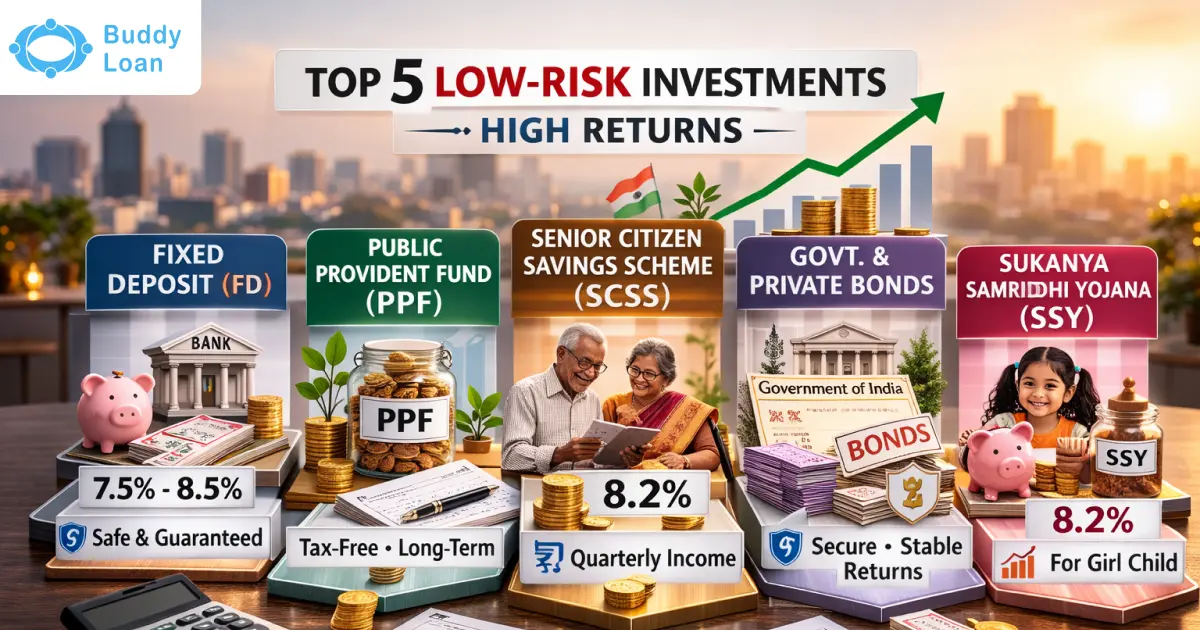
Based on historical performance, stability, and the current economic environment of 2026, here are the top 5 low risk investment picks that balance safety with return yield:
- Sukanya Samriddhi Yojana (SSY): The undisputed winner for parents of girl children. Superior interest rates (~8.2%) combined with tax-free returns make it unbeatable.
- Senior Citizen Savings Scheme (SCSS): The lifeline for retirees. 8.2% guaranteed quarterly payouts offer unmatched cash flow security.
- Public Provident Fund (PPF): The tax-efficiency king. While the rate (~7.1%) is lower than SSY, the EEE status makes the real return extremely high for those in the 30% tax bracket.
- RBI Floating Rate Savings Bonds: A hidden gem. These provide a premium over NSC rates (currently ~8.05%), offering sovereign safety with returns that adjust to the economy.
- AAA-Rated Corporate Fixed Deposits: For those willing to take a tiny step up the risk ladder, top-tier corporate FDs (like Bajaj Finance) offer rates up to 7.30%+, providing a safe bump over traditional bank FDs.
Checkout this Strategy: Personal Loan for Investment
List of Investments Based on Risks
Here is a list of all notable types of investments in India, listed based on the risk level, so that you can take an informed decision on low risk investments with high returns.
| Risk Level | Investment Type | Typical Examples (2026 Context) | Target Return | Primary Risk |
| Tier 1-A: Ultra-Safe | Govt. Schemes (Fixed) | PPF, Sukanya Samriddhi (SSY), NSC | 7.1% – 8.2% | Liquidity Risk (Long lock-ins) |
| Tier 1-B: Sovereign Debt | Govt. Bonds (Sovereign) | RBI Floating Rate Bonds (8.05%), SGBs, T-Bills | 6.7% – 8.1% | Interest Rate Risk (Returns can fluctuate) |
| Tier 2: Predictable | Fixed Deposits (FD/RD) | SBI/HDFC Bank FDs, Post Office FD | 6.5% – 7.5% | Inflation Risk (Might not beat rising prices) |
| Tier 3: Institutional | AAA Corporate Bonds | HDB Financial, Tata Capital, NHAI (Tax-free) | 7.5% – 8.5% | Credit Risk (Though minimal for AAA) |
| Tier 4: Balanced | Hybrid / Debt Funds | Balanced Advantage Funds, Liquid Funds | 7% – 10% | Market Volatility (Moderate) |
| Tier 5: Growth | Equity Mutual Funds | Index Funds (Nifty 50), Large Cap Funds | 11% – 14% | Capital Risk (Value can drop) |
| Tier 6: Aggressive | Direct Stocks / Small Cap | Individual shares (Reliance, Zomato, etc.) | Unlimited | Capital Wipeout (Highest risk) |
Final Thoughts: The Art of Conservative Investing
Successful investing isn’t always about finding the next multi-bagger stock. As said by Morgan Housel, it is more about aligning your money with your goals. Successful investing should be about growing your wealth.
- Diversification is key: Don’t put all your money in one scheme. A mix of PPF for the long term, FDs for liquidity, and Bonds for income creates a resilient portfolio.
- Review regularly: Interest rates change. Tax rules change. An investment that was “best” in 2020 might not be the best in 2026.
- Respect Inflation: Always calculate your ‘Real Return’ (Interest Rate minus Inflation). If your FD gives 7% and inflation is 6%, your wealth grew by only 1%.
By not focusing just on returns, by choosing these low-risk investments wisely, you ensure that your financial foundation is solid enough to support your future aspirations.