If you are someone keen about investments, the thought of taking a loan and investing that amount might have crossed your mind at least once.
Sounds like a silly idea, right? But have you really thought about taking a loan for investment like mutual funds, Nifty‑50, or SGB (sovereign gold bonds) to make financial sense?
You see, when certain tranches open, you might not be financially equipped to buy them in bulk. What about then? Taking a loan might not sound like a bad idea now.
Let’s explore when it might work, when it doesn’t and how to think like a pro when assessing those tempting tranche openings.
Consider Personal Loans for Investments
Taking a personal loan at an interest rate of, let’s say, 11% for an investment that yields about 9% return can sound pretty irrational, especially when you can do the investment as SIPs. But what about tranches, like RBI’s May 2025 redemption at ₹9,453/gm, that open once in a while and have to be brought in bulk? There is no EMI option there and a huge sum of money might not be lying around in your hands, right?
A personal loan for investment can deliver fast liquidity, perfect for time‑sensitive tranches like SGBs. But there are certain factors that have to be taken into consideration.
With personal loan interest rates dipping into the high single digits (as low as 9.75% per annum with certain banks), investors are tempted when returns feel assured. If you add peer pressure, FOMO during bull markets and instant approvals, suddenly borrowing to invest seems smart.
You see, however tempting it might sound, there are certain things you have to consider before making this move. You could think of it like a ritual that can be done when all planets align. (pun intended!)

The Reality of Risks Versus Returns
Loan Costs vs. Potential Returns
Let’s take this example.
At 14% p.a., a ₹1 lakh loan repaid over five years means that your EMI is around ₹2,390, so in total, about ₹1.43 lakh is to be repaid.
Meanwhile, investing that ₹1 lakh in an SGB gives about 8% CAGR plus 2.5% fixed interest. That’s roughly a 10.5% return. Over five years, that’s ~₹1.65 lakh before taxes.
You see, for SGB, in reality, there will be exiting loads and other charges. So after all the pluses and minuses, you are left with ~₹1.5 lakhs.
Hidden Dangers
- Banks may not allow the use of loans for investments (except personal loans). If that violates the terms, it could invalidate your loan.
- Emotional pressure builds when EMI obligations persist, regardless of investment performance. It may not be an issue for some, while that might not be the case for others.
- If returns underperform interest rates, you’re essentially losing money while still paying EMIs. So what kind of investment and how sure you are about the returns makes a lot of sense here.
In short, this ‘idea’ of using a loan for investment might not be a good one for most. But then again, there are exceptional cases.

When Loan-for-Investment Might Work
Under tightly controlled circumstances, it could pay off:
- Low-interest loans. Strictly speaking, if the interest rate is below 10%. Of course, not every bank provides those and not everyone can get those.
- High-confidence investments, like SGB tranches with a track record of strong returns (e.g., the 2017–18 SGB yielded over 220% in 7.5 years, per RBI).
- Clear repayment buffer, backed by an emergency fund or alternate income.
- When you have the need for some more money, suppose you are close to the full amount but somehow not complete yet (for example, you received a recent bonus).
| Here is a scenario:
Rohit, a 35‑year‑old engineer, took a ₹2 lakh personal loan at 10% interest to buy SGBs during a bullish gold phase. He ensured his monthly EMI was covered by his bonus. The gold rose steadily, he got interest payouts semi-annually and after maturity, he repaid the loan with profits intact. But when markets lagged, he paused and used systematic mutual fund SIPs instead. |
Smart Plans When Borrowing for Investments
- SIP (Systematic Investment Plan): Spread risk over time. However, it may not be applicable in cases of tranches.
- Loan Against Securities/Funds: Offers lower interest rates and is often collateral-backed.
- Staggered investing or margin trading (only for experienced investors).
- Building an emergency fund first: Avoid emotional pressure.
The 3‑Check RuleIf you are considering the loan for an investment option, keep these 3-check rules with you so that you can easily understand that the idea is practical in your situation.
If yes to all and you’ve run calculations, then cautiously proceed. Otherwise, opt for safer paths. Keep in mind, if there is an option for SIP, it is always best to go with that instead of a loan. |
Final Guideline: Borrow Smart, Invest Smarter
In rare, calculated scenarios, like low-rate loans, high-confidence instruments (SGBs or stable mutual funds) and when you have clear repayment strategies, using a personal loan for investment can work. But for most of us, a small disciplined investment via SIPs or collateralised loans is safer.
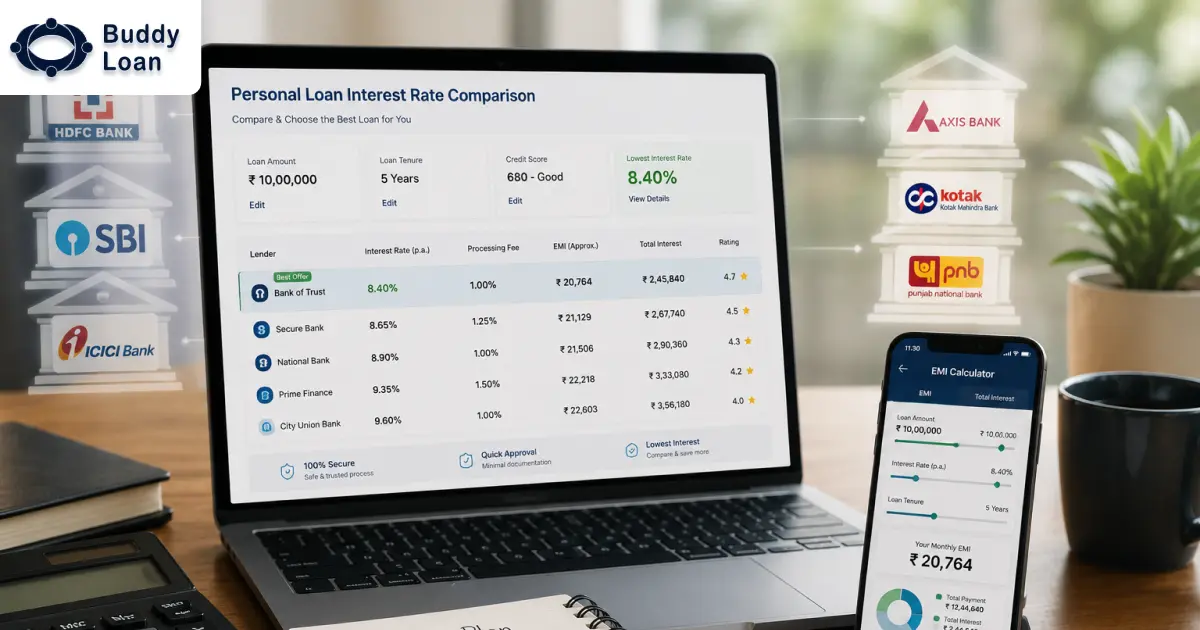
If you’re considering a personal loan, lending platforms like Buddy Loan can help you estimate loan EMIs, check your credit score, or plan repayment easily, ensuring clarity before you leap. Platforms like these can help you get the best loans according to your credit profile.
Download the Buddy Loan App Now!
One solution to each of your financial needs at your fingertip.

Scan to download now