Are you someone looking to save without getting caught in the realm of taxes and taking big risks?
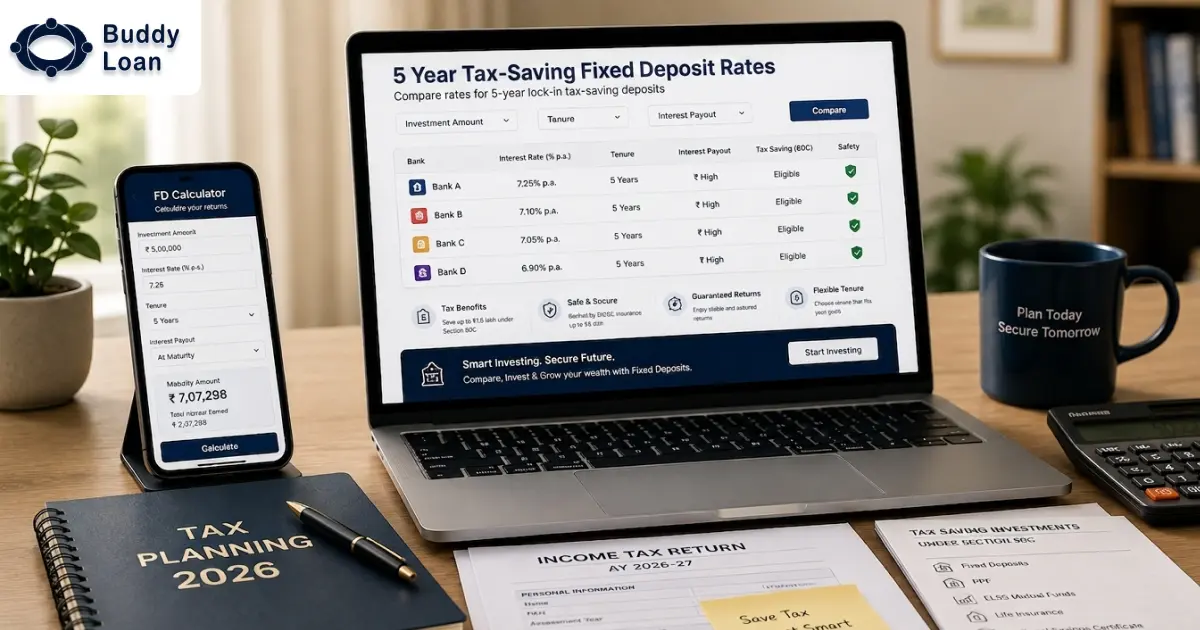
Your solution could be a simple 5-year tax-saving Fixed Deposit. These fixed deposits not only offer guaranteed returns but also help you claim deductions under Section 80C, up to ₹1.5 lakh per year.
But here’s what most people miss, interest rates vary sharply across banks, and choosing the wrong one could cost you thousands over five years.
What you need is a proper guide to discover the latest tax-saving FD interest rates from top banks all across India and learn how to pick the one that gives you the best return for your money. It is always wise to use smart tools to know how to calculate your post-tax interest and make the process easier.
If you’re planning your investments before the financial year closes, this is the right place to start.
What exactly is a tax-saving FD?
A tax-saving fixed deposit (FD) is a special type of term deposit that allows you to claim a deduction of up to ₹1.5 lakh under Section 80C of the Income Tax Act.
The catch? Your money is locked in for five years, and you can’t break it early.
That said, it’s one of the most straightforward, risk-free ways to reduce your taxable income while earning steady interest.
The interest itself, however, is taxable, which is where things get a bit tricky.
These FDs are offered by most major banks, including SBI, HDFC, ICICI, and others. But not all banks offer the same interest rate, and those differences can significantly affect your total returns over five years.

Who’s offering the best rates right now: Banks vs NBFCs
This is where it gets interesting. The interest rates on tax-saving FDs vary based on the bank and whether you’re a regular or senior citizen.
Let’s take a look at some top options (based on July 2025 official rates):
Tax-Saving FD Interest Rates, Top Banks in India (5-Year Lock-in)
Here is a comprehensive list of the best banks to choose from if you are looking for the best FD options.
| Bank Name | Regular Rate (p.a.) | Senior Citizen Rate (p.a.) |
|---|---|---|
| HDFC Bank | 7.00% | 7.50% |
| ICICI Bank | 7.00% | 7.50% |
| Axis Bank | 7.00% | 7.75% |
| Kotak Mahindra Bank | 6.20% | 6.70% |
| Yes Bank | 7.25% | 8.00% |
| IndusInd Bank | 7.25% | 7.75% |
| RBL Bank | 7.10% | 7.60% |
| IDFC FIRST Bank | 6.75% | 7.25% |
| Federal Bank | 7.10% | 7.60% |
| DCB Bank | 7.15% | 7.65% |
| State Bank of India (SBI) | 6.50% | 7.50% |
| Punjab National Bank | 6.50% | 7.00% |
| Bank of Baroda | 6.80% | 7.40% |
| Canara Bank | 6.70% | 7.20% |
| Union Bank of India | 6.40% | 6.90% |
| Indian Bank | 6.25% | 6.75% |
| Central Bank of India | 6.00% | 6.50% |
| Bank of India | 6.00% | 6.50% |
High-Interest FD Options from Top NBFCs in India
Here is a comprehensive list of the best NBFCs in the market, offering the best FD options.
| NBFC Name | Regular Rate (p.a.) | Senior Rate (p.a.) |
|---|---|---|
| Muthoot Capital | Up to 8.50% | Up to 8.75% |
| Shriram Finance | Up to 7.60% | Up to 8.10% |
| Sundaram Finance | Up to 7.15% | Up to 7.65% |
| Bajaj Finance Ltd. | Up to 7.40% | Up to 7.75% |
| Mahindra Finance | Up to 7.00% | Up to 7.50% |
| ICICI Home Finance | Up to 7.00% | Up to 7.35% |
| PNB Housing Finance | Up to 6.90% | Up to 7.40% |
The trick is to understand that, while these rates may seem close, over five years, the difference adds up.
For example, investing ₹1.5 lakh in a bank that gives you 7.1% instead of 6.5% can mean thousands of extra rupees in interest.
Also Read: Tax Saving Investments Under 80C
Daring Investor Picks High-Yield Options
If you are daring and are flexible with non-popular options, you should also look into some high SFBs (Small Finance Banks) that offer better interest rates and returns on a long term, like 5 years.
| Institution Name | Regular Rate (p.a.) | Senior Rate (p.a.) |
|---|---|---|
| Suryoday Small Finance Bank | 8.60% | 9.10% |
| Jana Small Finance Bank | 8.20% | 8.20% |
| Unity Small Finance Bank | 8.15% | 8.65% |
| Northeast (Slice) SFB | 8.00% | 8.50% |
| Utkarsh Small Finance Bank | 7.75% | 8.35% |
| AU Small Finance Bank | 7.25% | 7.75% |
| Ujjivan Small Finance Bank | 7.20% | 7.70% |
| Shivalik Small Finance Bank | 6.50% | 7.00% |
Keep in mind that although these options are unpopular, all the banking facilities associated with the RBI can be regarded as a ‘safe investment’ and if the worst happens and these banks cease to exist, don’t panic your funds are safe with the RBI.
The smart move? Compare before you commit. And if you want to play around with different rates, the FD Calculator lets you estimate your potential returns easily, even if you’re just exploring.
Why a 5-year lock-in can be smarter than it sounds
Let’s face it, committing your money for five years might sound restrictive.
But here’s another way to look at it: You’re forced to save. No midway withdrawals, no temptations. And while you’re at it, you’re also reducing your tax outgo.
That kind of disciplined saving can come in handy, especially if you’re building a financial cushion for a major life goal, like a house down payment or your kid’s school fund. Plus, as you know, this amount is locked in; it won’t interfere with your short-term budgeting or other emergency savings.
And here’s the upside: if you choose a bank offering a higher tax-saving FD interest rate, you’re actually getting paid better than many standard savings options. Furthermore, the more tenure you invest, the greater your return is, and in some cases, the lesser the taxable amount.
How to save tax on FD interest and not just the principal
Here’s something many people miss: While the principal (up to ₹1.5 lakh) is tax-deductible, the interest you earn on a tax-saving FD is fully taxable. That means your bank will likely deduct TDS (Tax Deducted at Source) if your interest crosses ₹40,000 in a year (₹50,000 for senior citizens).
So, how can you reduce the tax on your interest?
- Spread your FDs across banks to stay under the TDS limit
- Submit Form 15G/15H (if eligible) to avoid TDS
- Choose banks offering higher interest rates to maximise your post-tax gains
| Remember: the interest you earn is taxable, so your actual return will be less than the rate you see.
For example, You invest ₹1,00,000 in a tax-saving FD at 7% interest. Over a year, you earn ₹7,000 in interest. If you’re in the 30% tax bracket, you’ll pay ₹2,100 in tax on that interest. So your actual gain is ₹7,000 – ₹2,100 = ₹4,900. Your real return is effectively 4.9%, not 7%. |
Tips Before you Lock in Your ₹1.5 lakh
The ₹1.5 lakh figure is tied to Section 80C of the Income Tax Act, which allows you to claim a deduction of up to ₹1.5 lakh per financial year when you invest in eligible instruments, including 5-year tax-saving FDs.
It’s not about saving that amount but rather the maximum you can invest in a tax-saving FD to get the full tax benefit. Before locking in your tax-saving FD for five years, here are a few last-minute sanity checks:
- Check your credit score.
If it’s high, you might want to explore better financial products than FDs, like bonds or short-term mutual funds. You can check your credit score for free before deciding.
- Use multiple FDs.
Rather than investing all in one bank, consider splitting into a couple of FDs. This gives you more flexibility and TDS control.
- Read the fine print.
Some banks compound interest quarterly, others annually. That affects your maturity amount. Know what you’re signing up for.
- Even little variations matter
Most importantly, don’t assume your primary bank has the best rate. A 0.5% difference across five years is money you could easily earn just by doing a little homework upfront.
So, what now?
A tax-saving FD may not be flashy, but it’s one of the cleanest, stress-free tax tools to safeguard your savings available to you today, especially if you prefer guaranteed returns over market-linked risks.
If you’re already planning your 80C investments or simply want to avoid the March-end panic, start comparing today. You don’t need to commit right away, just visit Buddy Loan and explore loan options, interest calculators, and tax-saving strategies side by side.
Need liquidity but still want to save on tax? Some people even use personal loans to manage cash flow while investing. If that sounds like something you’d explore, you can apply for a personal loan via the Buddy Loan App (Android App or iOS App), which connects you to verified lenders, not random offers.
Remember: The best tax-saving FD isn’t just about the highest rate it’s about what fits your financial plan.
Choose wisely, compare often, and let your money grow without regrets.
Download the Buddy Loan App Now!
One solution to each of your financial needs at your fingertip.

Scan to download now