Are you planning to sell shares, property, or mutual funds and make a quick profit?
Great. But don’t forget some things that can quietly chip away at your gains, such as the short-term capital gains tax. It may not seem like much, but if you’re not paying attention, it could catch you off guard and cost you your “supposed to be” profit.
Read on to learn what short-term capital gains are, how much you’re taxed, and why timing matters more than you think. Because, hey — understanding the issue is the first step in solving it, right?
Understanding Short-Term Capital Gains
Short-term capital gains (STCG) occur when you sell certain assets within a short period of owning them. The government has set specific time frames that determine whether your gains are short-term or long-term:
- Listed equity shares and equity mutual funds: Sold within 12 months
- Real estate (land or property): Sold within 24 months
- Other capital assets such as gold and certain bonds: Sold within 24 months
- Specified mutual funds, market-linked debentures, unlisted bonds, and unlisted debentures: Treated as short-term as per Section 50AA rules, where applicable
There are more distinct differences between short-term vs. long-term capital gains. In short, if you sell within this window, your gains are treated as short-term and taxed differently compared to long-term gains.

Tax on Short-Term Capital Gains in India
Your tax rate depends on the type of asset and the applicable section of the Income Tax Act. These are as follows:
Shares & Equity-Oriented Mutual Funds — 20% tax
If you’ve sold listed shares or equity-orientated mutual funds within 12 months of buying them and if you paid STT (Securities Transaction Tax) while selling, then your gains fall under Section 111A of the Income Tax Act.
What does that mean for you?
A flat 20% tax on the profits.
However, resident individuals and HUFs can adjust the unused basic exemption limit against STCG covered under Section 111A before applying the 20% tax rate.
Debt Mutual Funds, Gold & Bonds? It’s a Bit Different
If you’re dealing with gold or certain bonds and you sell them within 24 months, it’s considered a short-term gain too – but there’s no flat rate here.
What happens instead?
The short-term capital gain (STCG) you earn from these assets gets added to your total income and is taxed as per your regular income tax slab.
Specified debt mutual funds acquired on or after April 1, 2023, follow Section 50AA treatment and are generally taxed as short-term capital gains irrespective of the holding period.
This means if you’re in the 30% slab, your gain could be taxed at the highest rate, so be mindful when redeeming these assets early.
In simple terms, STCG from gold, certain bonds, and specified debt mutual funds is treated as part of your total income and taxed according to your income tax slab, not at a flat rate like equities. So, if you’re in the 30% bracket, that’s the rate you’ll likely pay on your gains.
Suggested Read: List of Tax-Free Bonds in India
Real Estate (Property Sales): Regular Tax Rules Apply
Are you planning to sell a house or a plot of land? If it’s been less than 24 months since you bought it, then the profit is treated as a short-term capital gain.
What does that mean for tax?
No special rate — just like above, the gain is added to your income and taxed based on your slab. This is where high earners may feel the pinch, especially with no special tax breaks.
If you’re thinking of selling early, do a quick maths check — it might be smarter to hold off until it becomes a long-term asset and qualifies for long-term capital gains treatment.
Quick Glance of Short-Term Capital Gains Tax Rates on 2026
Here is a comprehensive outlook of short-term capital gains tax rates as of 2026:
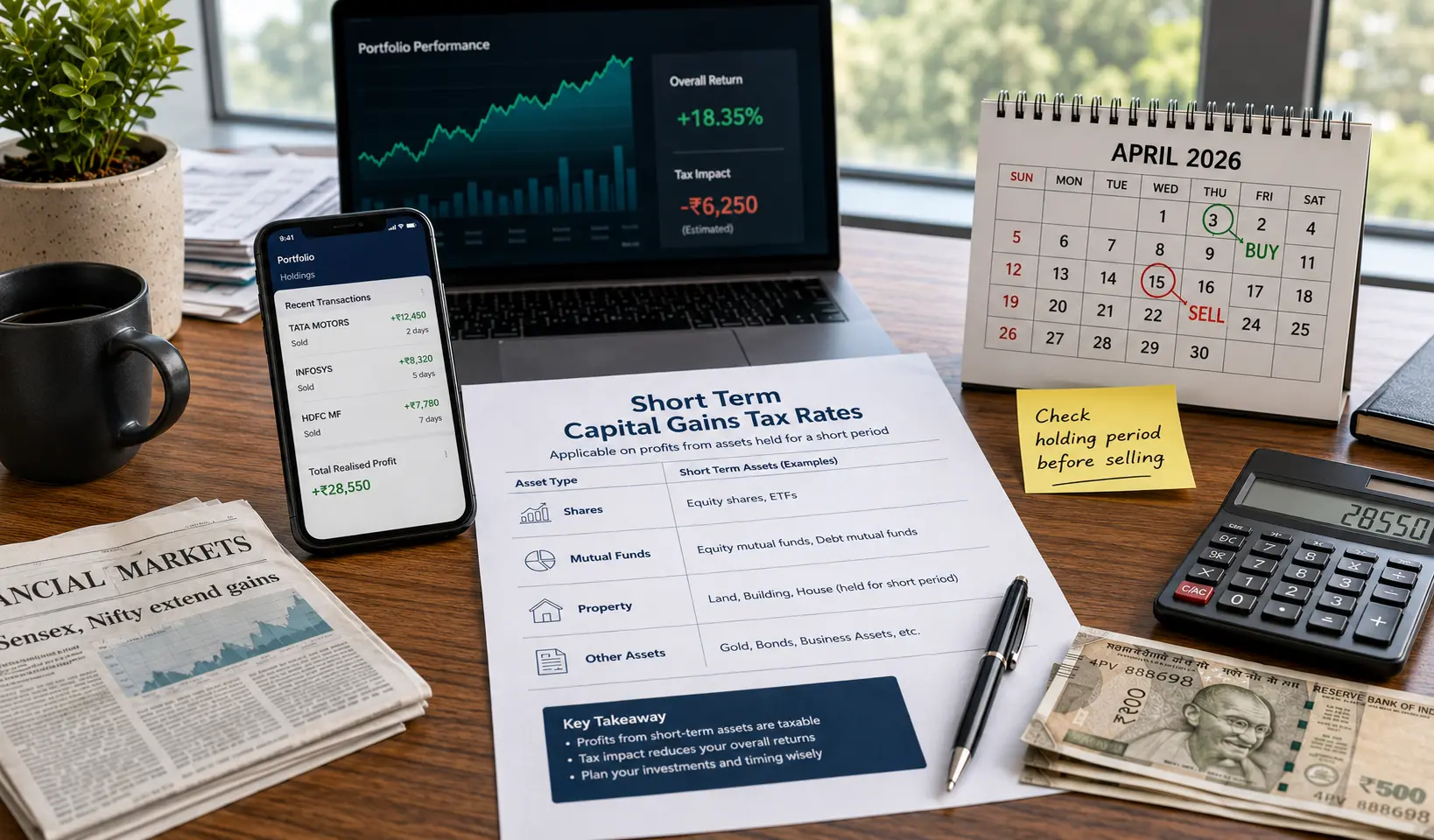
| Asset Type | When It’s Considered Short-Term | Applicable Tax Rate |
|---|---|---|
| Equity Shares & Equity Mutual Funds | Sold within 12 months | Flat 20% under Section 111A, if STT is paid |
| Gold and Certain Bonds | Sold within 24 months | Taxed as per income slab |
| Specified Debt Mutual Funds, Market-Linked Debentures, Unlisted Bonds and Debentures | Short-term as per Section 50AA rules, where applicable | Taxed as per income slab |
| Real Estate (Property / Land) | Sold within 24 months | Taxed as per income slab, no flat-rate |

How Are Short-Term Capital Gains Calculated?
Here’s the basic calculation:
| Capital Gain = Sale Price − (Purchase Price + Cost of Improvements + Expenses on Sale) |
Let’s take a hypothetical example for better understanding.
- You bought stocks for ₹1,00,000 and sold them for ₹1,25,000 within 12 months. You also paid ₹500 in broking.
- Your short-term capital gain would be:
₹1,25,000 − ₹(1,00,000 + 500) = ₹24,500 - And your short-term capital gain tax would be
20% of ₹24,500 = ₹4,900 (as per the updated rate effective July 23, 2024)
For shares or mutual funds, related costs like broking can be subtracted. STT cannot be deducted while calculating capital gains. The more precise your records, the more accurate your tax filing will be.
Let’s take another example to understand the difference.
Suppose you bought gold for ₹50,000 and sold it within 24 months for ₹70,000. Remember that no special flat rate applies here.
- Your gain will be ₹70,000 − ₹50,000 = ₹20,000
Now, this ₹20,000 is added to your total income and taxed according to your income tax slab.
- If you fall under the 30% bracket, your tax is ₹6,000 (plus cess).
Short Term vs Long Term: Why Timing Matters
The length of time you hold an asset can significantly change how much tax you owe. Here’s why:
- Long-Term Capital Gains (LTCG) on equity: Taxed at 12.5% beyond ₹1.25 lakh per year
- LTCG on real estate: Generally taxed at 12.5% without indexation. For land or building acquired before July 23, 2024, resident individuals and HUFs may be able to choose between 12.5% without indexation and 20% with indexation, where applicable.
So, if you’re close to the holding period cutoff, it might make sense to wait and save on taxes.
When’s the Right Time to Sell to Avoid STCG
If you’re just a few weeks away from crossing into “long-term” territory, waiting could mean a lower tax rate and bigger savings.
Always check your holding period before making a move. In the case of investments like mutual funds, gold bonds, or other securities, the tax treatment can differ based on the asset type and applicable tax section.
Ways to Manage or Offset STCG
Unfortunately, there aren’t many exemptions available on short-term capital gains, but you still have some ways to soften the impact:
- Offset your short-term losses against your gains
- Keep track of expenses and improvement costs
- If your total income is below the exemption limit, you may get partial relief, including for Section 111A STCG in the case of eligible resident individuals and HUFs
- There is also a specific capital gains tax exemption up to 10 crores in very specific cases.
Important Future Update from Tax Year 2026-27 Onwards
If you have any long-term capital losses (LTCL) from investments made on or before March 31, 2026, starting from FY 2026–27, transitional rules may allow you to use those losses to reduce capital gains, including short-term capital gains (STCG), subject to the final rules and conditions.
Think of it as a transition provision to help taxpayers adjust eligible past losses under the new tax framework. It should not be treated as a regular recurring set-off rule.
Suggested Read: Save Short-Term Capital Gains
The Final Outlook
You don’t need to be a financial expert to benefit from tax planning. Even a little knowledge about how short-term capital gains work can help you make smarter investment decisions and time your transactions better.
If you’re in a situation where you need funds urgently but don’t want to sell your assets yet, platforms like Buddy Loan can assist you in finding the right lender. You can explore flexible personal loan options matched to your credit profile — all in one place.
If you are worried about your credit score before going towards personal loans, check your credit score for free on Buddy Score to stay ahead.

Download the Buddy Loan App Now!
One solution to each of your financial needs at your fingertip.

Scan to download now