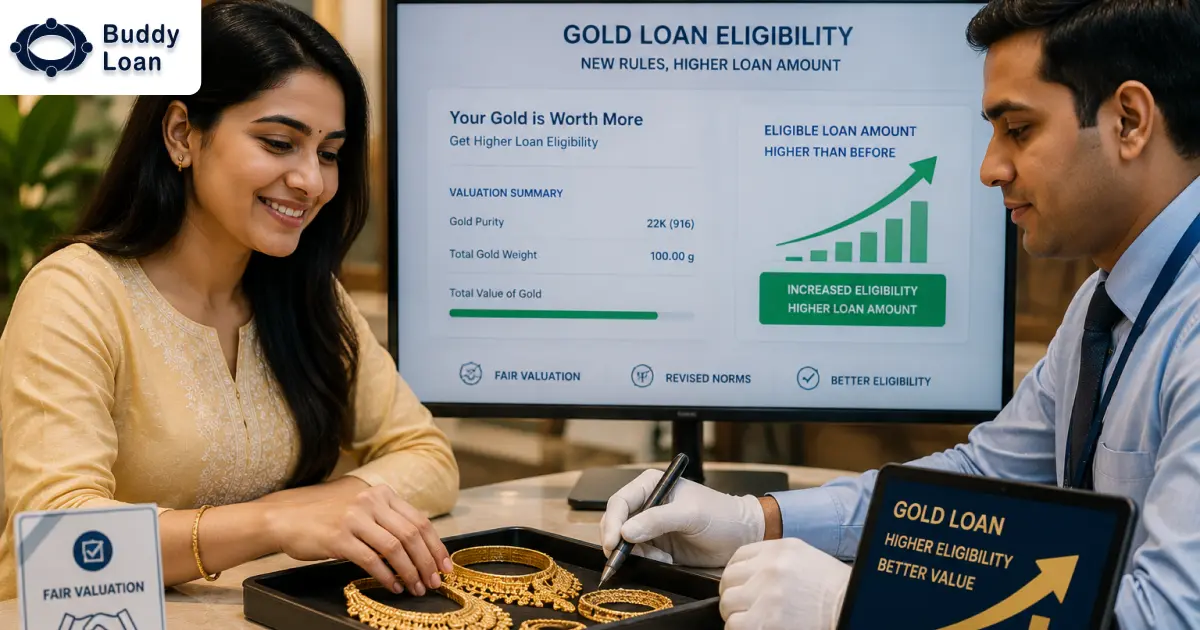
RBI’s new gold loan rules change how banks and NBFCs value pledged gold, decide loan limits, explain charges, handle auctions, and return jewellery after repayment. These changes matter because many borrowers use gold loans for short-term needs such as medical expenses, business working capital, education fees, farming costs, or family emergencies.
The RBI has introduced a more structured framework for loans against gold and silver collateral. The rules do not stop people from taking gold loans. Instead, they make the process more transparent and standard across regulated lenders. The gold loan update 2026 also gives small-ticket borrowers a higher loan-to-value benefit while keeping larger loans under tighter risk control. Read on to learn more about the latest update and how to benefit the most out of it.


Overview of Latest Rules for Gold Loans in 2026
Earlier, most gold loan products worked around a broad LTV cap, and the final process often depended heavily on the lender’s internal policy. One lender could explain valuation in detail, while another could simply give the final eligible amount. Borrowers often focused only on the amount they could get, without understanding how the lender valued purity, deducted stone weight, calculated interest, or planned auction steps in case of default.
1. Higher LTV for Small Gold Loan Borrowers
LTV means loan-to-value ratio. It shows how much loan you can get against the assessed value of your pledged gold. Under the new gold loan rule, the permitted LTV depends on the total consumption loan amount per borrower.
| Loan Amount | Maximum LTV | What It Means |
|---|---|---|
| Up to Rs. 2.5 lakh | 85% | You may borrow up to 85% of eligible gold value. |
| Above Rs. 2.5 lakh and up to Rs. 5 lakh | 80% | You may borrow up to 80% of eligible gold value. |
| Above Rs. 5 lakh | 75% | You may borrow up to 75% of eligible gold value. |
Earlier, many standard gold loan products worked around a broad 75% LTV cap. Under the gold loan update 2026, borrowers seeking smaller loan amounts may receive a higher borrowing limit against the same gold collateral. This can help households, small business owners, farmers, and self-employed borrowers access short-term credit without pledging extra jewellery.
2. Better Access to Credit for Small Borrowers
The RBI designed the revised framework to improve credit access for small borrowers and bring more uniformity across banks, NBFCs, co-operative banks, and housing finance companies. This means borrowers should see clearer rules, more consistent gold valuation practices, and better disclosure of loan terms.
3. Standard Gold Valuation Process
The new gold loan rule also focuses on transparent valuation. Lenders need to follow a more standard method while assessing pledged jewellery. They must consider the eligible gold content and exclude stones, gems, fastenings, and other non-gold parts from the loan value. This reduces confusion and helps borrowers understand how the final loan amount is calculated.
4. Stronger Borrower Protection Measures
The updated gold loan RBI framework adds stricter borrower protection rules. Lenders must follow clearer auction procedures if a borrower defaults. They also need to return pledged gold within the specified timeline after full repayment. These steps help borrowers track their jewellery, understand their rights, and avoid uncertainty after loan closure.
5. Closer LTV Monitoring During the Loan Tenure
Gold prices can move up or down during the loan period. The RBI guidelines for gold loan require lenders to monitor the LTV ratio more carefully throughout the loan lifecycle. This becomes especially important for bullet repayment loans, renewals, and top-ups, where the total repayment amount and gold value must remain within the permitted limit.
Gold Loan Rule with Example
Assume a borrower pledges gold jewellery. After checking purity and excluding stones, the lender values the usable gold as per the below-given numbers:
| Gold Value | Old Rules (75% LTV) | New Rules (85% LTV) | Extra Loan Available |
| ₹1,00,000 | ₹75,000 | ₹85,000 | ₹10,000 |
| ₹1,50,000 | ₹1,12,500 | ₹1,27,500 | ₹15,000 |
| ₹2,00,000 | ₹1,50,000 | ₹1,70,000 | ₹20,000 |
| ₹2,50,000 | ₹1,87,500 | ₹2,12,500 | ₹25,000 |
| ₹2,94,118 | ₹2,20,588 | ₹2,50,000 | ₹29,412 |
*Note that 85% LTV is for gold loans upto ₹2.5 lakhs.
Now consider a bullet repayment loan. If the interest rate is 12% for 12 months, the lender cannot look only at the principal. It must check the total amount payable at maturity.
If the gold value is ₹4,00,000 and the LTV cap is 80%, the total repayment due should stay within ₹3,20,000. So, the practical principal may be around ₹2,85,714 because ₹2,85,714 plus 12% interest comes close to ₹3,20,000.
This protects both the borrower and the lender from an LTV breach at maturity.
| Key takeaway: Under the new RBI guidelines, borrowers looking for loans up to ₹2.5 lakh can get up to 85% of their gold’s value, compared with the earlier 75% cap. This means less gold needs to be pledged to obtain the same loan amount, or borrowers can receive a larger loan against the same gold. |
If you are wondering how much gold is wanted for the required loan amount, the below sample amounts can help to get a perspective:
| Gold Value | Eligible Loan | Loan Required | Applicable LTV as per Loan Needed |
| ₹1,00,000 | ₹85,000 | ₹75,000 | 85% |
| ₹1,50,000 | ₹1,27,500 | ₹1,00,000 | 85% |
| ₹2,00,000 | ₹1,70,000 | ₹1,50,000 | 85% |
| ₹3,00,000 | ₹2,55,000 | ₹2,50,000 | 85% |
| ₹3,75,000 | ₹3,00,000 | ₹3,00,000 | 80% |
| ₹5,00,000 | ₹4,00,000 | ₹4,00,000 | 80% |
| ₹6,25,000 | ₹5,00,000 | ₹5,00,000 | 80% |
| ₹10,00,000 | ₹7,50,000 | ₹7,50,000 | 75% |
| ₹13,33,333 | ₹10,00,000 | ₹10,00,000 | 75% |
Other Important Gold Loan Rules by RBI in 2026
- Valuation method: Lenders must value gold using the lower of the 30-day average closing price or the previous day’s closing price from approved sources.
- Only gold value counts: Stones, gems, fastenings, and non-gold parts do not add to the loan value.
- Borrower presence: The borrower should be present during assaying and valuation at the time of sanction.
- Certificate requirement: The lender must record purity, gross weight, net weight, deductions, image, and value of the collateral.
- Credit assessment: Detailed repayment capacity assessment applies when the total loan amount exceeds ₹2.5 lakh.
- Top-up and renewal: Lenders can renew or top up loans only within the permitted LTV and only if the loan remains standard.
- Bullet loan tenure: Consumption loans with bullet repayment cannot exceed 12 months.
- Gold return: After full repayment, the lender must return the pledged gold on the same day or within 7 working days.
- Delay compensation: If the lender causes a delay beyond the allowed timeline, it must compensate the borrower at ₹5,000 per day.
- Auction transparency: Lenders must give notice, publish auction details, set a proper reserve price, and return surplus auction proceeds within 7 working days.
Top Gold Loan Providers 2026
Gold loan interest rates, processing fees, repayment options, and maximum loan amounts can vary by lender, city, scheme, gold purity, loan tenure, and borrower profile. The tables below compare leading NBFCs and banks offering gold loans in India. Borrowers should check the final sanction letter, valuation charges, repayment method, and applicable fees before accepting the loan.
Gold Loan by NBFCs
| Gold Loan Lenders | Min. ROI p.a. | Max. ROI p.a. | Processing Fee | Max Loan Amount | EMI |
|---|---|---|---|---|---|
| IIFL Gold Loan | 11.88% | 27.00% | Up to 2% of loan amount | ₹30 lakh | Available |
| Muthoot Gold Loan | 12.99% | 32.00% | Up to 1% | ₹5 crore | Scheme-based |
| Manappuram Gold Loan | 9.90% | 24.00% | ₹25 plus tax; repledge charges may apply | ₹25 lakh | Scheme-based |
| Bajaj Finserv Gold Loan | 9.50% | 24.00% | 0.20% of loan amount, subject to a minimum of ₹150 and a maximum of ₹1,000 | ₹2 crore | Available |
| India Gold | 9.12% approx. | Scheme-based | Scheme-based; processing fee may be charged once in 6 months | As per partner lender policy | Scheme-based |
| Rupeek Gold Loan | 8.88% | 20.28% | Case-based or scheme-based | ₹20 lakh | Monthly or one-time repayment options |
| Money2Me Gold Loan | 14.28% approx. | Scheme-based | Not clearly disclosed | Scheme-based | Monthly interest model shown |
| Capri Gold Loan | 11.88% | 30.00% | 0.15% to 0.25% of loan amount plus GST | ₹5 crore | Scheme-based |
Gold Loan by Banks
| Banks | Min. ROI p.a. | Max. ROI p.a. | Processing Fee | Max Loan Amount | EMI |
|---|---|---|---|---|---|
| SBI Gold Loan | 8.65% | 8.95% | Rs. 200 plus GST to 0.50% of loan amount, depending on scheme | ₹50 lakh | Available |
| HDFC Gold Loan | 9.00% | 19.00% | Maximum 1% of disbursal amount plus applicable taxes | ₹1 crore | Available |
| ICICI Gold Loan | 8.55% | 16.50% | Up to 2% of loan amount plus applicable taxes | ₹2 crore | Available |
| IDFC Gold Loan | 10.80% | 18.00% | Up to 1% of loan amount plus GST | ₹50 lakh | Available |
| Axis Bank Gold Loan | 9.75% | 17.00% | Up to 1.5% of sanctioned loan amount plus applicable taxes | ₹40 lakh | Available |
| Canara Bank Gold Loan | 8.80% | Scheme-based | Up to ₹2,750 plus GST or scheme-based charges | ₹35 lakh | Scheme-based |
| Bank of Baroda Gold Loan | 9.00% | Scheme-based | Nil up to ₹3 lakh; applicable charges above ₹3 lakh | ₹50 lakh | Scheme-based |
| PNB Gold Loan | 8.50% | Scheme-based | 0.30% of loan amount plus GST or ₹500 plus tax, whichever is higher | ₹25 lakh | Scheme-based |
| Federal Bank Gold Loan | 8.15% | 22.90% | 0.25% to 1% of loan amount | ₹1.5 crore | Available |
| Indian Overseas Bank Gold Loan | 7.75% | 8.60% | 0.25% of sanctioned limit, subject to a minimum of ₹500 and a maximum of ₹2,500 plus GST | ₹50 lakh | Available |
| Union Bank Gold Loan | 9.10% | 9.35% | 0.50% of loan amount plus GST | ₹50 lakh | Scheme-based |
| Indian Bank Gold Loan | 8.25% | Scheme-based | 0.50% of loan amount | No upper limit publicly specified | Scheme-based |
| Bank of Maharashtra Gold Loan | 8.50% | Scheme-based | Nil up to ₹3 lakh; ₹500 to ₹2,000 for higher slabs | ₹1 crore | Available |
Note: These rates are indicative and may change at the lender’s discretion. The final loan amount also depends on gold purity, net gold weight, prevailing gold price, repayment type, and the applicable RBI loan-to-value limit.
What Borrowers Should Check Before Applying
- Ask how the lender calculates net gold weight after excluding stones and non-gold parts.
- Compare the annual interest rate, processing fee, valuation fee, overdue charges, and auction charges.
- Check whether the loan uses EMI, regular interest payment, or bullet repayment.
- Do not borrow the maximum amount only because the lender allows it.
- Ask for the collateral certificate and keep one copy safely.
- Repay on time if the jewellery has emotional or family value.
- Check the lender’s gold return timeline before closing the loan.
Conclusion
RBI’s latest gold loan rules give borrowers clearer rights and a more predictable loan process. Small loans can now receive higher LTV support, while larger loans continue under safer limits. The rules also improve valuation transparency, bullet repayment discipline, auction fairness, and return timelines for pledged gold.
For borrowers, the best approach is simple; check the rate, understand the LTV slab, confirm the repayment method, and borrow only what you can repay comfortably. A gold loan can solve a short-term cash need, but the pledged jewellery deserves careful handling.

Download the Buddy Loan App Now!
One solution to each of your financial needs at your fingertip.

Scan to download now