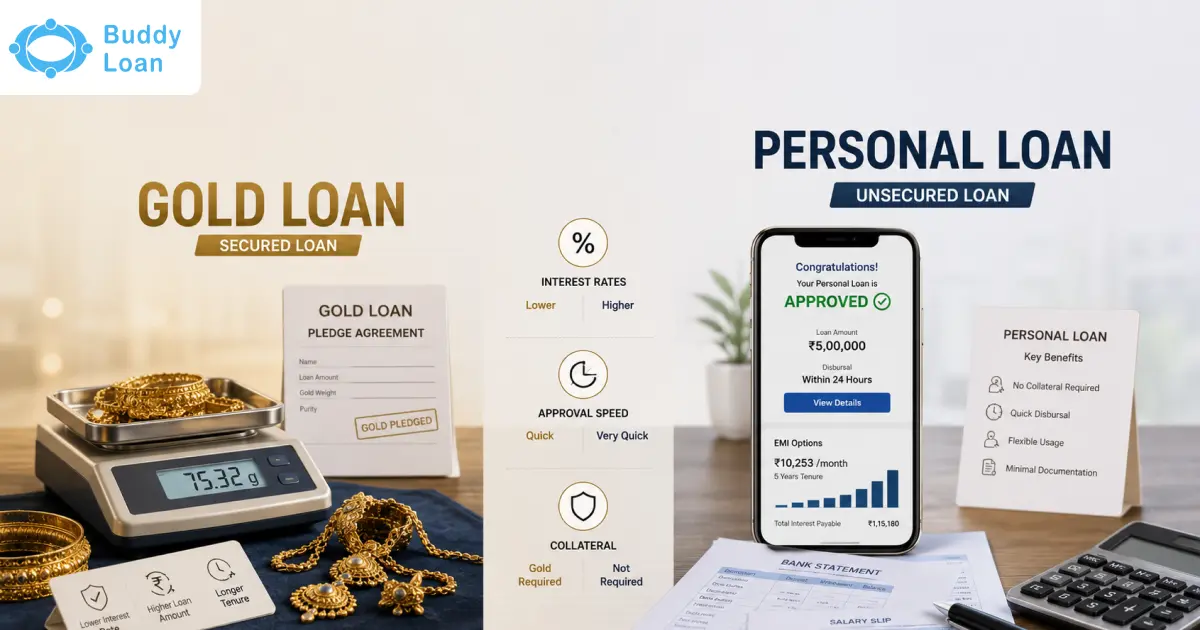
A choice of a gold loan vs a personal loan can feel confusing, especially when you need funds quickly. Both options can help during medical needs, education expenses, business cash flow gaps, home repairs, weddings, or other urgent financial requirements. But they work very differently. A gold loan is secured against pledged gold, while a personal loan is usually unsecured and does not require collateral.
So, the better choice depends on what you need, how soon you need the money, whether you own gold, and how comfortable you are with repayment. Read on for a detailed gold loan vs personal loan comparison that will help you understand the key differences, benefits, risks, and use cases before making a decision.


Gold Loan vs Personal Loan: Quick Comparison
Here is a quick outlook on how a gold loan and a personal loan compare against each other.
| Comparison Point | Gold Loan | Personal Loan |
|---|---|---|
| Loan Type | Secured loan | Unsecured loan |
| Collateral | Gold required | No collateral |
| Interest Rate Range | Around 8.55% to 27% p.a. | Around 8.75% to 30% p.a. |
| Loan Amount Range | Usually ₹5,000 to ₹1 crore or more | Usually ₹10,000 to ₹40 lakh or more |
| LTV Ratio | Generally up to 75% to 85% of gold value | Not applicable |
| Processing Fee | Usually 0% to 2% | Usually 0.5% to 4% |
| Tenure Range | Usually 3 to 36 months | Usually 12 to 72 months |
| Approval Time | Same day possible | Few hours to few days |
| Credit Score Role | Less strict | Important |
| Repayment Options | EMI, bullet, interest-only | Fixed EMI |
| Main Risk | Gold auction risk on default | Credit score impact on default |
| Best For | Short-term needs with gold | Needs without pledging assets |
What is a Gold Loan?
A gold loan is a secured loan where the borrower pledges gold ornaments or eligible gold jewellery to get funds from a lender. The lender checks the gold weight, purity, and current market value before deciding the eligible loan amount. The gold remains with the lender until the loan is fully repaid.
The loan amount is usually based on the loan-to-value ratio. This means the lender gives only a certain percentage of the gold’s assessed value as the loan. For example, if the pledged gold is valued at ₹2,00,000 and the applicable LTV is 75%, the eligible loan amount may be around ₹1,50,000. The final amount can vary based on lender rules, purity checks, and applicable regulations. It is best to use a gold loan EMI calculator to know details in depth.
Advantages of Gold Loan
- Lower interest possibility: Since the loan is secured against gold, the interest rate may be lower than many unsecured loan options.
- Faster approval: Approval can be quicker once gold valuation and KYC checks are completed.
- Flexible repayment: Some lenders offer EMI, bullet repayment, and interest-only repayment options.
- Credit score may have lower impact: A gold loan may be easier to access for borrowers with limited or average credit histories.
- Useful for short-term needs: It can be practical for urgent expenses, temporary cash flow gaps, business needs, or medical requirements.
- Loan amount linked to gold value: The eligibility mainly depends on the gold pledged instead of only income proof.
Disadvantages of Gold Loan
- Gold is pledged: You must deposit your gold with the lender until the loan is closed.
- Risk of auction: If repayment is not made on time, the lender may auction the pledged gold after following the required process.
- Loan amount depends on gold value: If the gold value or purity is lower, the loan amount may also be lower.
- Shorter tenure: Gold loan tenure is often shorter than personal loan tenure.
- Valuation charges may apply: Some lenders may charge for gold valuation, processing, renewal, or other fees.
- Emotional value of gold: Many borrowers pledge family jewellery, which can create stress if repayment becomes difficult.
What is a Personal Loan?
A personal loan is an unsecured loan that does not require collateral. The borrower does not need to pledge gold, property, fixed deposits, or any other asset. Instead, the lender checks the borrower’s income, credit score, repayment capacity, employment stability, existing EMIs, and overall financial profile.
Personal loans are commonly used for medical expenses, education, weddings, travel, home renovation, debt consolidation, and other personal needs. The loan is usually repaid through fixed monthly EMIs over the selected tenure. A personal loan EMI calculator can help estimate the personal loan EMI before applying.
Advantages of Personal Loan
- No collateral needed: You do not have to pledge any asset.
- Flexible usage: Funds can usually be used for many personal needs such as medical bills, travel, education, or home repairs.
- Higher loan amount possible: Eligible borrowers with strong income and credit profiles may get higher loan amounts.
- Longer repayment tenure: Personal loans may offer longer tenure options compared to many gold loans.
- Fixed EMI structure: Monthly personal loan EMI payments make repayment easier to plan.
- No risk of losing pledged assets: Since no asset is pledged, there is no auction risk on jewellery or property.
Disadvantages of Personal Loan
- Higher interest rate possibility: Since the loan is unsecured, the personal loan interest rate may be higher than a gold loan rate.
- Credit score matters: A low credit score can reduce approval chances or increase the interest rate.
- More income checks: Lenders usually assess salary, bank statements, employment, or business income.
- Processing fee may be higher: Personal loan processing fees can go up to a few percent of the loan amount.
- Missed EMIs affect credit health: Late payments can reduce credit score and affect future borrowing.
- Not always ideal for short-term borrowing: If you need money only for a very short period, a personal loan may be costlier due to fees and interest.

When Should You Choose a Gold Loan?
A gold loan may be suitable when you need money quickly and have gold jewellery that you are willing to pledge. It can also be useful when you want a secured loan option with potentially lower interest compared to an unsecured loan.
- You own gold and are comfortable pledging it.
- You need funds for a short-term requirement.
- You want a loan where eligibility depends largely on gold value.
- You want flexible repayment options, depending on lender availability.
- Your credit score is not strong enough for a good personal loan offer.
However, you should choose a gold loan only if you are confident about repayment. Missing payments can put your pledged gold at risk.
When Should You Choose a Personal Loan?
A personal loan may be better when you do not want to pledge gold or any other asset. It may also work well for larger expenses, longer repayment tenures, or planned financial needs where you want fixed monthly EMIs.
- You do not own gold or do not want to pledge it.
- You have a good credit score and stable income.
- You need a higher loan amount based on your income eligibility.
- You prefer fixed personal loan EMI payments.
- You want a longer tenure for repayment.
The main thing to watch is the personal loan interest rate. Since it is unsecured, the cost may be higher if your credit profile is weak.
Repayment and EMI Planning
Both Gold Loan & Personal Loan options need proper EMI planning. The right option should not be chosen only by looking at the approved amount. The monthly EMI, total interest, tenure, and repayment flexibility also matter.
- Gold loan EMI depends on repayment type: If you choose a regular EMI-based gold loan, the gold loan EMI calculation will depend on the loan amount, interest rate, and tenure.
- Gold loans may offer flexible repayment: Some lenders may offer regular EMI, interest-only repayment, bullet repayment, or partial repayment options.
- Bullet repayment needs discipline: In this option, the borrower may repay the principal at the end of the tenure. It can reduce monthly pressure, but the final repayment amount should be planned carefully.
- Personal loans usually follow fixed EMI: A personal loan is commonly repaid through fixed monthly EMIs that include both principal and interest.
- Personal loan EMI is easier to budget: Since the EMI is fixed in most cases, borrowers can plan monthly expenses more clearly.
- Longer tenure reduces EMI but increases interest: This applies to both loan types. A longer tenure can make the loan EMI smaller, but the total interest paid may increase.
- Use calculators before applying: A gold loan EMI calculator and personal loan calculator can help compare different interest rates, tenures, and repayment amounts.
- Check total repayment, not just EMI: A lower EMI may look comfortable, but the total repayment amount may be higher if the tenure is too long.
Documentation and Approval Process
The documentation process is usually simpler for a gold loan because the loan is secured against pledged gold. A personal loan may need more documents because the lender checks income, credit score, employment, and repayment capacity before approval.
| Personal Loan Documents | Gold Loan Documents |
|---|---|
| Aadhaar Card | Aadhaar Card |
| PAN Card | PAN Card |
| Passport | Passport |
| Voter ID | Voter ID |
| Driving Licence | Driving Licence |
| Utility Bill | Utility Bill |
| Passport-size Photograph | Passport-size Photograph |
| Salary Slips | Gold Ornaments for Valuation |
| Bank Statements | Gold Ownership Declaration, if required |
| Form 16 or ITR | Loan Application Form |
| Employee ID | |
| Employment Proof | |
| Business Proof, for self-employed applicants | |
| GST Registration or Udyam Registration, if applicable |
In terms of approval, a gold loan mainly depends on KYC verification, gold purity, gold weight, and lender valuation. A personal loan depends more on credit score, income, employment stability, existing EMIs, and repayment capacity.
Approval Process Difference
- Gold loan: Approval usually depends on KYC, gold valuation, purity check, and lender policy.
- Personal loan: Approval usually depends on credit score, income, repayment capacity, existing EMIs, and document verification.
- Processing speed: A gold loan may be faster if the gold valuation and KYC are completed quickly. A personal loan can also be quick, but it usually needs stronger credit and income checks.
Gold Loan vs. Personal Loan: Which is Better?
There is no single answer. A gold loan can be better if you need quick funds, own gold, and want a secured borrowing option. It may also be useful for short-term needs where you can repay comfortably. A personal loan can be better if you do not want to pledge assets and need funds based on your income and credit profile.
Think of it this way. If your priority is lower interest and fast access to gold, a gold loan may make sense. If your priority is no collateral and a structured EMI over a longer tenure, a personal loan may be more suitable.
Final Thoughts
The Gold Loan vs Personal Loan decision should depend on your need, repayment comfort, and risk level. If you have gold and need short-term funds, a gold loan may be practical. If you want funds without pledging any asset and have a stable income, a personal loan may be easier to manage.
Before choosing, compare the interest rate, tenure, loan EMI, charges, and repayment terms. Also, calculate the EMI in advance. A loan should solve a financial need, not create a bigger repayment problem later.
Download the Buddy Loan App Now!
One solution to each of your financial needs at your fingertip.

Scan to download now