In the world of finance, understanding a company’s financial health is critical for stakeholders, including investors, lenders, and business leaders. One of the most reliable tools for assessing a company’s financial stability is the Altman Z Score. Introduced by Edward Altman in 1968, the Altman Z Score is a financial model designed to predict the likelihood of bankruptcy. By combining key financial ratios into a single score, provides a snapshot of a company’s risk level, helping users make informed decisions. In this blog, we’ll delve into the Altman Z Score meaning, its formula, applications across industries, and how it aids in financial statement analysis. Whether you’re a business owner, investor, or student, understanding the Z Score is essential for effective financial analysis.
Understanding the Altman Z Score
The Altman Z Score is a metric used to evaluate the financial health of a company and its potential for bankruptcy. It analyzes multiple financial ratios and consolidates them into a single numerical value to gauge a company’s risk level.
Key Components of the Altman Z Score
The Z Score is based on five critical financial ratios that measure different aspects of a company’s financial performance:
1. Working Capital to Total Assets: Indicates liquidity and short-term financial health.
2. Retained Earnings to Total Assets: Reflects the company’s profitability over time.
3. Earnings Before Interest and Taxes (EBIT) to Total Assets: Measures operational efficiency and asset productivity.
4. Market Value of Equity to Total Liabilities: Compares the company’s market valuation to its debt level.
5. Sales to Total Assets: Evaluate how efficiently the company is utilizing its assets to generate revenue.

Altman Z Score Formula and Calculation
The Formula combines five financial ratios to assess a company’s financial health. Each component is assigned a weight based on its significance, and the final Z Score is calculated using the following formula:
Altman Z Score Formula (for Manufacturing Firms)
Z=1.2(X₁)+1.4(X₂)+3.3(X₃)+0.6(X₄)+1.0(X₅)
Where:
- X₁ = Working Capital / Total Assets
- X₂ = Retained Earnings / Total Assets
- X₃ = EBIT / Total Assets
- X₄ = Market Value of Equity / Total Liabilities
- X₅ = Sales / Total Assets
Calculation Example
Let’s calculate the Z Score for a hypothetical manufacturing company:
| Financial Metric | Value | Ratio (X) |
| Working Capital | ₹20,00,000 | X₁ = 0.25 |
| Retained Earnings | ₹15,00,000 | X₂ = 0.19 |
| EBIT | ₹10,00,000 | X₃ = 0.12 |
| Market Value of Equity | ₹50,00,000 | X₄ = 0.62 |
| Sales | ₹1,00,00,000 | X₅ = 1.25 |
Using the formula:
Z=1.2(0.25) + 1.4(0.19) + 3.3(0.12) + 0.6(0.62) + 1.0(1.25)
Z=0.30+0.27+0.40+0.37+1.25= 2.59
The Z Score of 2.59 suggests that the company is in the “Grey Zone”.

Understanding the Altman Z Score Table
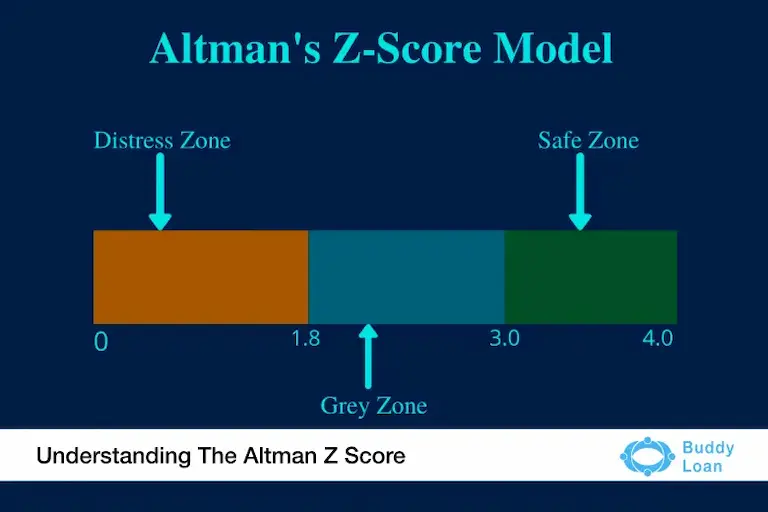
The Z Score Table categorizes companies into three zones based on their risk levels. These zones help identify whether a company is financially stable, at risk, or nearing bankruptcy.
| Z Score Range | Zone | Meaning |
| Z > 2.99 | Safe Zone | Financially healthy; low risk of bankruptcy. |
| 1.81 ≤ Z ≤ 2.99 | Grey Zone | Moderate risk of financial distress; requires closer monitoring. |
| Z < 1.81 | Distress Zone | High risk of bankruptcy; urgent corrective actions needed. |
Z Score for Non-Manufacturing Firms and BanksThe formula and interpretation vary slightly for different sectors: 1. Non-Manufacturing Firms: Excludes the “Sales to Total Assets” ratio. |
Applications of the Altman Z Score
The Altman Z Score is a versatile tool used across industries to evaluate financial health and predict bankruptcy. Here are its primary applications:
1. Predicting Bankruptcy Risk
- The Z Score helps identify companies at risk of financial distress.
- Investors and lenders use this metric to avoid high-risk investments or loans.
2. Investment Analysis
- Helps investors evaluate the financial stability of potential investments.
- Companies in the Safe Zone are generally considered reliable for long-term investments.
3. Credit Risk Assessment
- Banks and financial institutions use the Z Score to assess a borrower’s creditworthiness.
- Businesses with low scores may face stricter loan terms or rejections.
4. Corporate Decision-Making
- Management teams use the Z Score to identify financial weaknesses and implement corrective measures.
- Example: A company in the Grey Zone may focus on reducing debt or improving operational efficiency.
5. Mergers and Acquisitions (M&A)
- In M&A deals, the Z Score is a key metric for evaluating a target company’s financial health.
- Buyers avoid companies in the Distress Zone unless they have plans for financial restructuring.
6. Industry and Peer Benchmarking
- Companies compare their Z Scores with industry averages to gauge performance.
- This benchmarking helps identify areas for improvement.
Limitations of the Altman Z Score
While the Altman Z Score is a powerful tool, it has limitations. Understanding these can help users interpret results more accurately:
1. Industry-Specific Variations
- The original formula was designed for manufacturing firms and may not be accurate for service-based or technology companies.
- Modified formulas for banks and non-manufacturing firms attempt to address this limitation but may still lack precision in some cases.
2. Reliance on Historical Data
- The Z Score is based on past financial performance, which may not always predict future events.
- Example: A company with strong historical financials could still face unexpected challenges, such as market disruptions.
3. Limited Scope
- The Z Score focuses solely on financial ratios and doesn’t account for qualitative factors like market trends, management quality, or competitive landscape.
4. Vulnerable to Data Manipulation
- Companies can potentially manipulate financial statements to inflate their Z Scores.
- Example: Artificially reducing liabilities to improve the Market Value of Equity to Total Liabilities
5. Not Always Predictive for Emerging Markets
- The Z Score may not account for the unique dynamics of companies operating in developing economies.
- Additional metrics or localized adjustments may be required for accuracy.
Conclusion
The Altman Z Score is a key tool for assessing financial health and bankruptcy risk by analyzing ratios. It aids investors, lenders, and leaders by simplifying complex data for informed decisions. While valuable, it should be used with other metrics for a complete view. Staying in the Safe Zone boosts trust, attracts investors, and ensures success. Understanding the formula, results, and limitations maximizes its effectiveness in financial analysis.
Download Personal Loan App
Get a loan instantly! Best Personal Loan App for your needs!!
Looking for an instant loan? Buddy Loan helps you get an instant loan from the best-verified lenders. Download the Buddy Loan App from the Play Store or App Store and apply for a loan now!
Download the Buddy Loan App Now! One solution to each of your financial needs at your fingertip. Scan to download now



Frequently Asked Questions
Q. What is the Altman Z-Score?
A. The Altman Z-Score is a financial metric used to predict the likelihood of a company facing bankruptcy within two years.
Q. What is a good value for Altman Z-Score?
A. A Z-Score above 3 indicates a low risk of bankruptcy, while scores below 1.8 suggest high risk.
Q. What is Altman Z-Score McKinsey?
A. McKinsey often references the Altman Z-Score as part of risk assessments to evaluate a company’s financial stability.
Q. What is Best Buy Altman Z-Score?
A. Best Buy’s Altman Z-Score is a specific calculation for assessing the company’s financial health; current data should be obtained from financial analysis sources.
Q. What is a good Z-Score?
A. A Z-Score above 3 is generally considered good, indicating strong financial health and low bankruptcy risk.
Q. What is the Altman rule?
A. The Altman rule refers to using the Z-Score model to determine financial distress and predict potential insolvency.
Q. What does Altman mean?
A. Altman refers to Edward Altman, the economist who developed the Z-Score model for assessing corporate bankruptcy risk.
Q. What is too high for Altman Z-Score?
A. There is no “too high” value; higher scores simply indicate excellent financial health and minimal bankruptcy risk.
Q. What is Altman’s model of privacy?
A. Altman’s model of privacy refers to a psychological framework for understanding how individuals manage boundaries and control their personal information, unrelated to the financial Z-Score.