Pursuing higher education often comes with significant expenses, including tuition fees, accommodation, books, travel, and other academic costs. A student loan can help bridge this financial gap without placing an immediate burden on the student’s or family’s savings. Since students may not have a regular source of income, lenders usually evaluate the financial profile of a co-applicant, such as a parent, guardian, or spouse, before approving the loan. Understanding the student loan eligibility criteria can help applicants prepare the necessary documents and improve their chances of securing financial assistance for their education.


Student Loan Eligibility Criteria
Student loans are offered by banks and financial institutions to support higher education in India and abroad. While the eligibility criteria differ across lenders, applicants are generally assessed based on their academic admission, nationality, age, co-applicant’s financial profile, and repayment capacity.
| Eligibility Parameter | General Requirement |
|---|---|
| Nationality | Indian Citizen or Resident |
| Age | Generally 18 to 21 years for students; co-applicant age may extend up to 60 to 80 years, depending on the lender |
| Academic Status | Confirmed admission to a recognised institution in India or abroad |
| Co-applicant | A parent, legal guardian, spouse, or another financially stable co-applicant is generally required |
| Employment of Co-applicant | Salaried or self-employed with a stable income |
| Minimum Income | Usually ₹13,500 to ₹25,000 or above, depending on the lender |
| Credit Score | Generally 600 to 750 or above, while 750+ is preferred for better loan terms |
| Repayment Capacity | Based primarily on the co-applicant’s income and existing financial obligations |
Note: Student loan eligibility may vary depending on the lender, course, institution, loan amount, co-applicant profile, credit score, and repayment capacity.
Student Loan Eligibility Criteria of Top Banks
Leading banks offer student loans with eligibility requirements based on the student’s academic profile and the co-applicant’s financial strength. The following table provides a general comparison of common eligibility requirements.
| Bank Name | Age | Key Eligibility Highlights |
|---|---|---|
| SBI | Not specified | Must be an Indian National with secured admission in a recognized institution in India or abroad. |
| HDFC Bank | 21 to 60 years | Available for salaried Indian nationals with a minimum monthly salary of ₹25,000 and at least 2 years of total employment. |
| Kotak Mahindra Bank | 21 to 70 years | Student must be an Indian national who secured admission via merit or entrance tests; minors require a consent letter. |
| YES BANK | 21 to 57 years | Offers student personal loans up to ₹50 lakh; if applied through partners like MoneyView, a minimum income of ₹13,500 is required. |
| Axis Bank | Not specified | Personal loans for higher education are available exclusively for salaried employees, with loan amounts starting from ₹50,000. |
| Bank of Baroda | 18 years and above | Applicant must be a resident of India with confirmed admission; a co-applicant such as parent, guardian, or spouse is typically mandatory. |
Note: Loan amount, eligible courses, repayment terms, and co-applicant requirements may vary depending on the lender and the selected education loan scheme.
Student Loan Eligibility Criteria of Top NBFCs
NBFCs generally offer flexible education financing solutions with simplified documentation and quicker processing. Eligibility is primarily based on the student’s academic profile and the co-applicant’s financial strength.
| NBFC Name | Age | Key Eligibility Highlights |
|---|---|---|
| Bajaj Finance | 21 to 80 years | Requires Indian nationality and a CIBIL score of 650 or higher; available for salaried and self-employed applicants. |
| Tata Capital | Not specified | Since students often lack stable income, a working parent is typically required as a co-applicant or guarantor; a credit score of 750+ is ideal. |
| MoneyView (Airtel) | 21 to 57 years | Requires a minimum cash-in-hand income of ₹13,500 per month and a CIBIL score of 600 or an Experian score of 650+. |
| Shriram Finance | Not specified | Parents can apply for personal loans to support their child’s education; requires income proof such as the last 3 months’ salary slips. |
Note: Eligibility criteria, loan amount, interest rates, and repayment tenure differ across NBFCs and lending partners. While specific student age limits are not always listed separately, lenders typically require the primary applicant or co-borrower to meet standard personal loan age criteria, generally between 18 to 21 and 60 years.
Factors Affecting Student Loan Eligibility
Lenders assess several financial and academic factors before approving a student loan. Since students often have limited or no income, the co-applicant’s financial profile plays a significant role in determining loan eligibility.
- Co-applicant’s Income Stability: A salaried or self-employed co-applicant with a regular income improves the likelihood of loan approval.
- Credit Score: A healthy credit score, preferably 750 or above, reflects responsible borrowing behaviour and may help secure better loan terms.
- Academic Institution: Admission to a recognised university or reputed educational institution may positively influence the lender’s decision.
- Course Type: Professional, technical, and career-oriented courses generally have better loan acceptance due to stronger employment prospects.
- Debt-to-Income (DTI) Ratio: Existing loan obligations of the co-applicant should ideally remain within the lender’s acceptable repayment capacity.
- Loan Amount: Applying for a realistic loan amount based on actual educational expenses improves approval chances.
- Academic Performance: Good academic records and entrance examination scores may strengthen the overall loan application.
Tips to Improve Student Loan Eligibility
Students and co-applicants can take the following steps to improve their chances of securing an education loan.
- Choose a Financially Stable Co-applicant: A parent or guardian with a regular income and good credit history significantly strengthens the application.
- Maintain a Healthy Credit Score: Ensure the co-applicant pays existing EMIs and credit card bills on time.
- Apply for the Required Loan Amount: Borrow only what is necessary to cover genuine educational expenses.
- Keep Academic Documents Ready: Admission letters, mark sheets, and entrance exam results should be updated and readily available.
- Maintain Stable Income: Consistent employment or business income of the co-applicant improves repayment capacity.
- Avoid Multiple Loan Applications: Applying to several lenders within a short period may negatively impact the co-applicant’s credit profile.
- Compare Lenders: Evaluate different banks and NBFCs to find the most suitable loan based on eligibility, interest rates, and repayment options.
Documents Required for Student Loan
Preparing the required documents in advance helps ensure a smoother verification process and quicker loan approval.
| Document Type | Required Documents |
|---|---|
| Identity Proof | Aadhaar Card, PAN Card, Passport, Voter ID, or Driving Licence |
| Address Proof | Aadhaar Card, Passport, utility bill, rent agreement, or Voter ID |
| Academic Documents | Admission letter, mark sheets, entrance examination scorecard, and fee structure issued by the institution |
| Income Proof (Co-applicant) | Salary slips, Form 16, Income Tax Returns, or audited financial statements |
| Bank Statements | Salary or business account statements for the last 3 to 6 months |
| Photographs | Recent passport-size photographs of the applicant and co-applicant |
Steps to Apply for a Student Loan with Buddy Loan
Applying for a student loan has become easier with online application facilities offered by banks, NBFCs, and lending marketplaces.
- Step 1: Visit buddyloan.com or download and install the Buddy Loan app for Android or iOS.
- Step 2: Open the personal loan application page, provide your mobile number, and enter the received OTP.
- Step 3: Specify the desired loan amount and personal email. Next, choose the Personal Loan option.
- Step 4: Choose the employment type, such as Salaried, Self-Employed, or Student, and the salary mode, such as bank or cash.
- Step 5: Enter your work details, including company name, years of service, and designation.
- Step 6: Enter your personal details, including full name, PAN, address, date of birth, and gender.
- Step 7: Provide your communication address and income details, then click the Submit button.
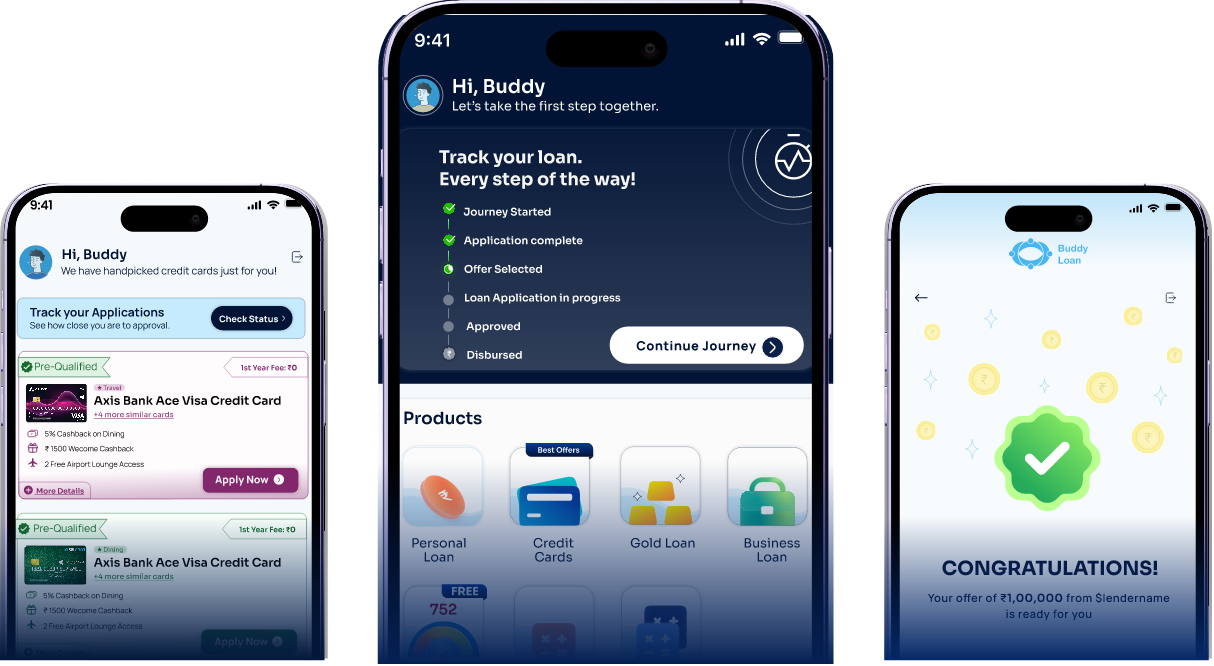
Download the Buddy Loan App Now!
One solution to each of your financial needs at your fingertip.

Scan to download now