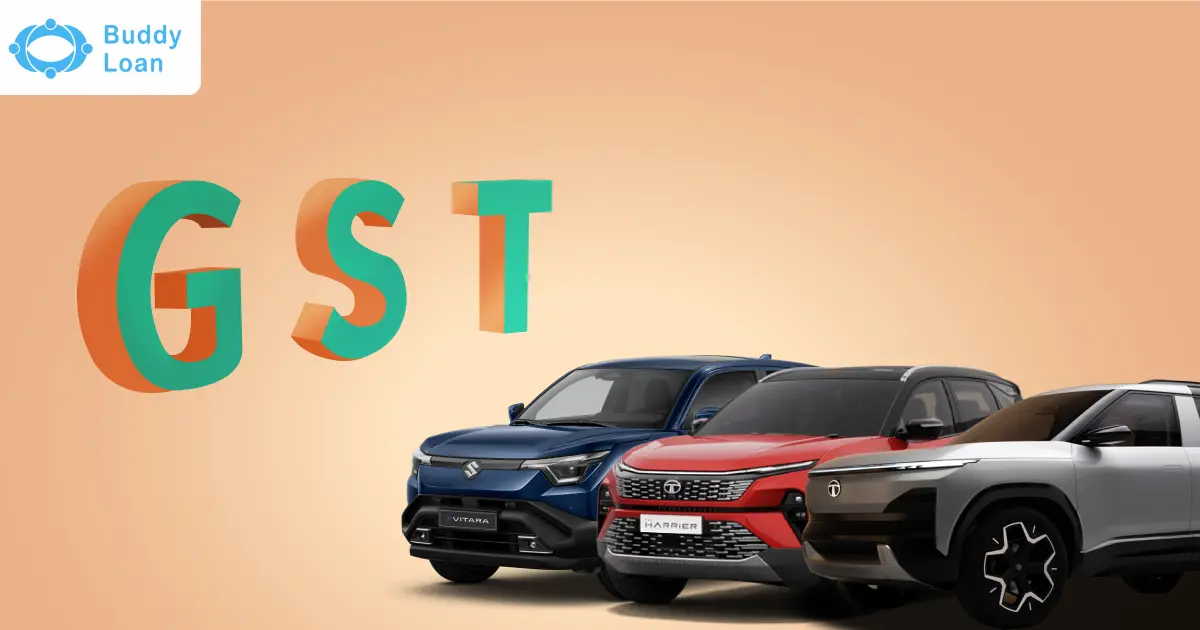
For common people, buying a car in India often comes down to timing. In 2025, it will become even more interesting with the new GST rates for cars.
As the GST 2.0 has been implemented starting 22nd September 2025, the old 12% and 28% slabs are gone, merged with or replaced by a simpler structure that makes small cars, two-wheelers, and commercial vehicles more affordable. Luxury cars, on the other hand, have moved into a flat 40% tax bracket.
For you, this means clearer pricing and more savings during the upcoming festive season. Read on to learn more about the updated GST rates on cars, what’s changed, and how it impacts your next big purchase.
Overview of GST 2.0 for Automobiles
Under the GST 2.0, instead of the old 12% and 28% slab rates for vehicles, there is now a 5% GST rate for electric vehicles and bicycles, an 18% rate for most two-wheelers and cars, and 40% for luxury vehicles.
This rationalisation aims to make everyday transport more affordable, while premium and high-capacity models contribute more tax.
Here is an overview of how GST 2.0 has implemented the rate changes for other vehicles:
| Items | Old GST Rate (Base) | New GST Rate (Base) | GST Difference (Reduced/Increased) |
| Two-Wheelers (Petrol ≤350cc, >350cc with cess, Mopeds, Gearless Scooters) | 28%
(+3% cess for >350 cc) | 18%
(+3% cess for >350 cc) | Reduced by 10% (on base GST) |
| Three-Wheelers (Petrol/Diesel Auto Rickshaws) | 28% | 18% | Reduced by 10% |
| Electric Rickshaws (E-Rickshaws) | Varies
(12%+) | 5% | Significantly Reduced |
| Commercial Goods Vehicles (Small Vans, Medium & Heavy Trucks) | 28% | 18% | Reduced by 10% |
| Passenger Vehicles (Mini & Large Buses) | 28% | 18% | Reduced by 10% |
| Auto Parts (Engines, Tyres, Batteries, Gearbox, etc.) | 28% | 18% | Reduced by 10% |
Also Read: GST Rates on Automobiles

New GST Rate on Cars
Here is the complete list of changes in rates for Cars:
Small Cars (Generic)
| Items | Old GST Rate
(Base Rate) | New GST Rate
(Base Rate) | GST Difference (Reduced/Increased) |
| Small Petrol Cars (≤1200 cc, ≤4000mm)
e.g., Maruti Swift, Hyundai i10 | 28% | 18% | Reduced by 10% |
| Small Petrol Hybrid Cars (≤1200 cc, ≤4000mm)
e.g., Toyota Glanza Hybrid | 28% | 18% | Reduced by 10% |
| Small LPG Cars (≤1200 cc, ≤4000mm)
e.g., Hyundai Santro LPG | 28% | 18% | Reduced by 10% |
| Small CNG Cars (≤1200 cc, ≤4000mm)
e.g., Tata Tiago CNG, Maruti WagonR CNG | 28% | 18% | Reduced by 10% |
| Small Diesel Cars (≤1500 cc, ≤4000mm)
e.g., Hyundai i20 Diesel | 28% | 18% | Reduced by 10% |
| Small Diesel Hybrid Cars (≤1500 cc, ≤4000mm)
e.g., Honda City e:HEV (Diesel Hybrid) | 28% | 18% | Reduced by 10% |
Large Cars (Luxury/High-End)
| Items | Old GST Rate (Base Rate) | New GST Rate (Base Rate) | GST Difference (Reduced/Increased) |
| Luxury Sedans
e.g., BMW 5 Series, Mercedes C-Class | 28% + cess | 40% flat | Increased |
| High-End SUVs
e.g., Toyota Fortuner, Land Rover Defender | 28% + cess | 40% flat | Increased |
| Hybrid Luxury Cars
e.g., Lexus ES 300h, Toyota Camry Hybrid | 28% + cess | 40% flat | Increased |
| Imported Cars (CBU units)
e.g., Audi Q7 (CBU), Jeep Wrangler | 28% + cess | 40% flat | Increased |
List of Cars That Cut Price after GST 2.0
Here is a list of specific vehicles and the maximum price reduction (in INR) announced by manufacturers following the GST rate changes:
Maruti Suzuki
- S-Presso
- Alto K10
- Swift
- Dzire
- Brezza
- Fronx
- Grand Vitara
- Ertiga
- WagonR
- Baleno
- Eeco
- Celerio
- Ignis
- Jimny
- XL6
- Invicto
Mahindra & Mahindra
- XUV 3XO (Diesel)
- XUV 3XO (Petrol)
- Scorpio N
- XUV700
- Thar range
- Thar Roxx
- Bolero Neo
- Scorpio Classic
Tata Motors
- Nexon
- Safari
- Harrier
- Altroz
- Punch
- Tigor
- Tiago
- Curvv
- Kia India
- Carnival
- Syros
- Sonet
- Carens Clavis
- Seltos
- Carens
Toyota
- Fortuner
- Legender
- Hilux
- Vellfire
- Innova Crysta
- Innova Hycross
- Camry
- Other models (Toyota)
Range Rover / Luxury
- Range Rover 4.4P SV LWB
- Range Rover 3.0D SV LWB
- Range Rover Sport 4.4 SV Edition Two
- Defender range
- Range Rover 3.0P Autobiography
- Velar 2.0D/2.0P Autobiography
- Evoque 2.0D/2.0P Autobiography
- Discovery
- Discovery Sport
Hyundai
- Tucson
- Venue
- i20
- Exter
- Aura
- Alcazar
- Grand i10 Nios
- Creta
- Verna
Honda Cars
- Amaze 3rd Gen
- Amaze 2nd Gen
- Elevate
- City
- Skoda
- Kodiaq
- Kushaq
- Slavia
Other Car Models
- Renault Kiger
- Nissan Magnite CVT Tekna+
- Nissan Magnite CVT Tekna
- Citroën C3 hatchback
- Two-Wheelers (Bikes 350cc)
- KTM 250 Adventure
- Honda CB350
- Honda CB350RS
- Honda CB350 H’ness
- Honda NX200
- Honda Hornet 2.0
- Kawasaki Versys-X 300
- Kawasaki KLX 230
- Honda SP160
- Honda Unicorn
- Honda CB125 Hornet
- Hero Xtreme 125R

Price Comparison: Before vs After GST 2.0
With GST 2.0 on cars now in action, everyday commuters get some relief as small cars across petrol, diesel, CNG, and hybrid variants move to a lower 18% slab.
On the flip side, premium buyers will feel the heat, as luxury sedans, SUVs, and imported models now fall under the higher 40% GST bracket.
Here is a simple overview of how much you will be saving on each price segment of cars with the implementation of new GST rates:
| Items | Price With GST, Before GST 2.0 | Price With GST, After GST 2.0 | Total Savings |
| Small Petrol Cars
(≤1200 cc, ≤4000mm) | ₹768,000 | ₹708,000 | ₹60,000 |
| Small Petrol Hybrid Cars
(≤1200 cc, ≤4000mm) | ₹896,000 | ₹826,000 | ₹70,000 |
| Small LPG Cars
(≤1200 cc, ≤4000mm) | ₹832,000 | ₹767,000 | ₹65,000 |
| Small CNG Cars
(≤1200 cc, ≤4000mm) | ₹832,000 | ₹767,000 | ₹65,000 |
| Small Diesel Cars
(≤1500 cc, ≤4000mm) | ₹1,024,000 | ₹944,000 | ₹80,000 |
| Small Diesel Hybrid Cars
(≤1500 cc, ≤4000mm) | ₹1,152,000 | ₹1,062,000 | ₹90,000 |
| Luxury Sedans | ₹5,120,000 | ₹5,600,000 | ₹-480,000 |
| High-End SUVs | ₹6,400,000 | ₹7,000,000 | ₹-600,000 |
| Hybrid Luxury Cars | ₹5,760,000 | ₹6,300,000 | ₹-540,000 |
| Imported Cars (CBU units) | ₹8,960,000 | ₹9,800,000 | ₹-840,000 |
Disclaimer: Prices are indicative estimates based on GST 2.0 rates (Sept 2025). Actual costs may vary by brand, state taxes, insurance, and dealer charges. Always confirm with authorised dealers before purchase.
Tips to Save More Cars After GST Cut
Here are some practical tips you can follow to make the most out of this festive season on your next car purchase:
- Compare before you decide
Different dealers and websites may list the same car at different prices or add freebies like accessories and extended warranties.
- Combine bank offers with exchanges
Festive tie-ups with banks can get you an instant 5–10% off. Combined with the value of your old car in exchange, the final amount could become much lighter, now that it is combined with GST cuts.
- Look for limited festive schemes
Manufacturers often roll out festival-only deals such as free insurance, registration fee waivers, or gold vouchers. These offers are mostly time-limited, so you would have to act quickly.
- Plan your EMI in advance
The lower GST rates on cars might offer you some relief, but don’t rush. Use an EMI calculator to make sure the monthly payments fit comfortably into your budget.
- Look for state-provided perks
Some states offer rebates on road tax or added subsidies on electric cars during festivals. Combining these with GST cuts gives you double savings.
- Think about the full package
Sometimes a car with a slightly higher upfront cost can be better if it includes free servicing, roadside assistance, or accessories. Always consider the overall ownership cost, not just the discount.
- Consider Vehicle Loans
Even with the GST rate cuts on cars, if your dream car’s total cost is too much or you have some amount in hand but need some more to cover the entire expense, look for options like a car loan to cover your expenses. In some trusted sources, you can get it as low as 11.99%, too.
Conclusion
The GST 2.0 reforms on cars have made them more affordable for the general public. The shift was done to most segments of the 18% slab while moving luxury cars into a flat 40% bracket.
This means lower upfront costs, better festive offers, and a chance to plan smarter purchases during the 2025 sales season.
With the added benefit of exchange programmes, bank discounts, and seasonal freebies, this festive season is shaping up to be one of the most rewarding times to invest in a new vehicle. Be the first one and get your dream vehicle today.
Disclaimer: The GST rates, car categories, and price illustrations provided in this blog are based on the GST 2.0 reforms announced on 22nd September 2025. Actual on-road costs may differ depending on brand, variant, state-level taxes, insurance, and dealer policies. Readers are advised to verify the latest updates and consult authorised dealers before making a purchase decision.

Download the Buddy Loan App Now!
One solution to each of your financial needs at your fingertip.

Scan to download now