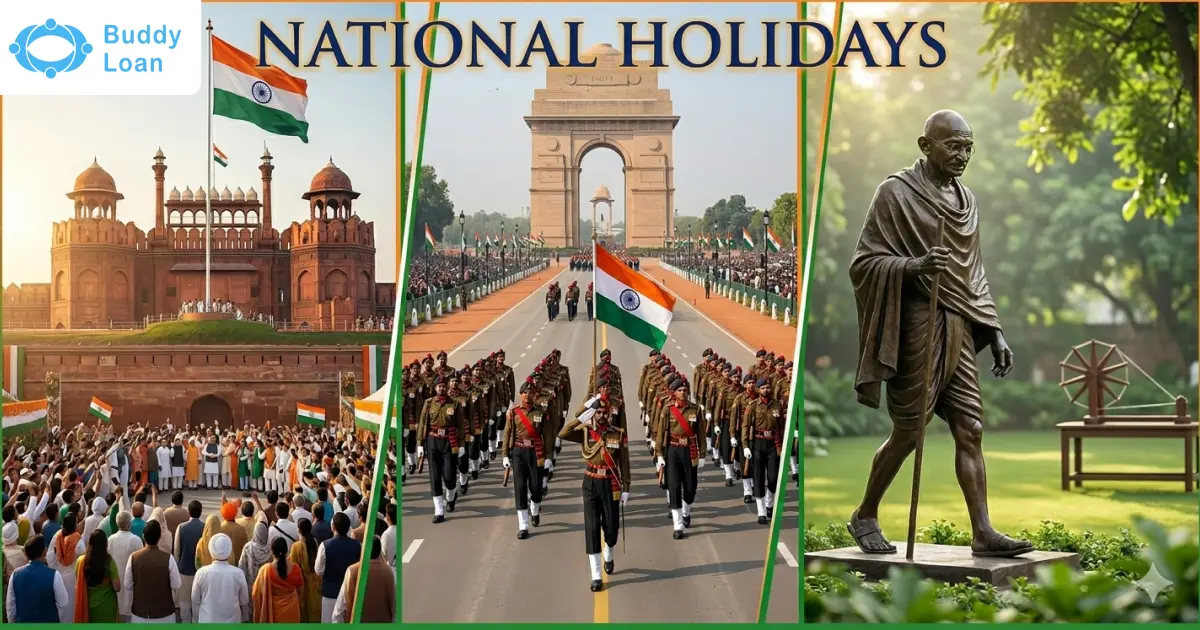
The Government of India recognises exactly three national holidays. For the financial sector, these dates represent absolute liquidity freezes. Many business owners confuse these with standard gazetted holidays, but this distinction carries heavy legal and financial weight. You cannot treat a national holiday as a standard operational day for your banking or payroll cycles.
Federal law mandates strict closure rules for commercial establishments and financial institutions on these three dates. Read on for the exact details of the 2026 national holiday schedule. We explain the mandatory double-wage payroll rules, nationwide banking halts, and supply chain financing disruptions associated with these specific days. Use this data to maintain strict corporate compliance and ensure smooth treasury operations.


The 2026 National Holiday Schedule
The government fixes these three dates permanently. They do not change based on lunar cycles or religious calendars.
| Date | Day | National Holiday | Historical Significance |
| 26th Jan | Monday | Republic Day | Marks the adoption of the Indian Constitution in 1950. |
| 15th Aug | Saturday | Independence Day | Commemorates India’s freedom from British rule in 1947. |
| 2nd Oct | Friday | Gandhi Jayanti | Honours the birth anniversary of Mahatma Gandhi. |
The 2026 Weekend Impact
The 2026 calendar neutralises one major break. Independence Day falls on a Saturday. Corporate employees working a standard five-day week lose this extra day off. Republic Day and Gandhi Jayanti fall on a Monday and a Friday. These create two natural three-day weekends for the workforce.
Suggested Read: Gazetted Holidays
National Holidays vs. Gazetted Holidays
You must separate these categories to avoid compliance penalties. A government holiday 2026 list contains many dates, but only three hold the highest statutory power.
| Feature | National Holiday | Gazetted Holiday |
| Total Count | Exactly 3 days. | 14 additional days (e.g., Diwali, Christmas). |
| Legal Mandate | Strict mandatory closure for all sectors. | Mandatory for government; optional for private sectors. |
| Wage Rules | Double pay is required if worked. | Standard pay applies. |
| Exemptions | Only essential services (hospitals, police). | Varies by state and corporate policy. |

The Impact on Payroll & Mandatory Wage Rules
The National and Festival Holidays Act governs these three dates. Employers must grant these days as paid leaves to all employees. This includes contract workers and daily wage earners.
Some continuous process industries require staff to work on a national holiday. If operational needs demand attendance, the employer faces strict compensation rules. You must pay the employee double their standard daily wage. Alternatively, you provide a standard day’s wage plus a compensatory day off within a specified period.
HR managers must audit their shift rosters carefully. A failure to apply the double-wage rule triggers severe labour compliance penalties. You document employee consent and attendance logs meticulously for these three specific dates.
Also Read: Central Government Holidays
National Holidays & Banking Halts
National holidays trigger a complete shutdown of the physical banking network. The Reserve Bank of India halts all Cheque Truncation System (CTS) grids nationwide.
Digital payment rails like UPI, IMPS, and NEFT function normally. However, physical reconciliation stops entirely. Suppose you initiate a high-value RTGS transfer using an SBI IFSC Code in Tamil Nadu on October 2. The digital ledger updates instantly. Yet, any discrepancy requiring manual branch intervention will wait until October 3.
Treasury teams must clear large vendor payouts 24 hours before a national holiday. You cannot access bank lockers or process physical trade finance documents on these dates.
Supply Chain and Customs Disruptions
National holidays mandate closure for non-essential commercial establishments. This creates a ripple effect across global trade logistics.
Ports and customs authorities operate with skeleton crews on January 26, August 15, and October 2. This delays cargo clearance and physical inspections. Supply chain financing cycles stretch by an extra 24 hours. Businesses relying on just-in-time inventory must stockpile raw materials ahead of these dates. Freight forwarders often apply holiday surcharges for moving goods during these restricted windows.
National Holidays: The Dry Days
The government declares all three national holidays mandatory dry days. Retail liquor sales halt completely across all states.
This creates a sharp cash flow dip for the hospitality and food service sectors. Restaurant and hotel owners must adjust their revenue projections. This is especially critical for August 15 in 2026, as it falls on a Saturday. A dry Saturday significantly reduces average order values in the hospitality sector. Business owners must optimise their food inventory and staffing costs to offset this predictable revenue drop.
Conclusion
A national holiday dictates strict operational boundaries for every business in India. You cannot treat January 26, August 15, or October 2 as standard public holidays. The legal requirement to provide double wages or compensatory time off demands precise payroll auditing. Furthermore, the complete halt of physical banking and customs clearance requires treasury teams to advance their settlement schedules by at least 24 hours.
Download the Buddy Loan App Now!
One solution to each of your financial needs at your fingertip.

Scan to download now