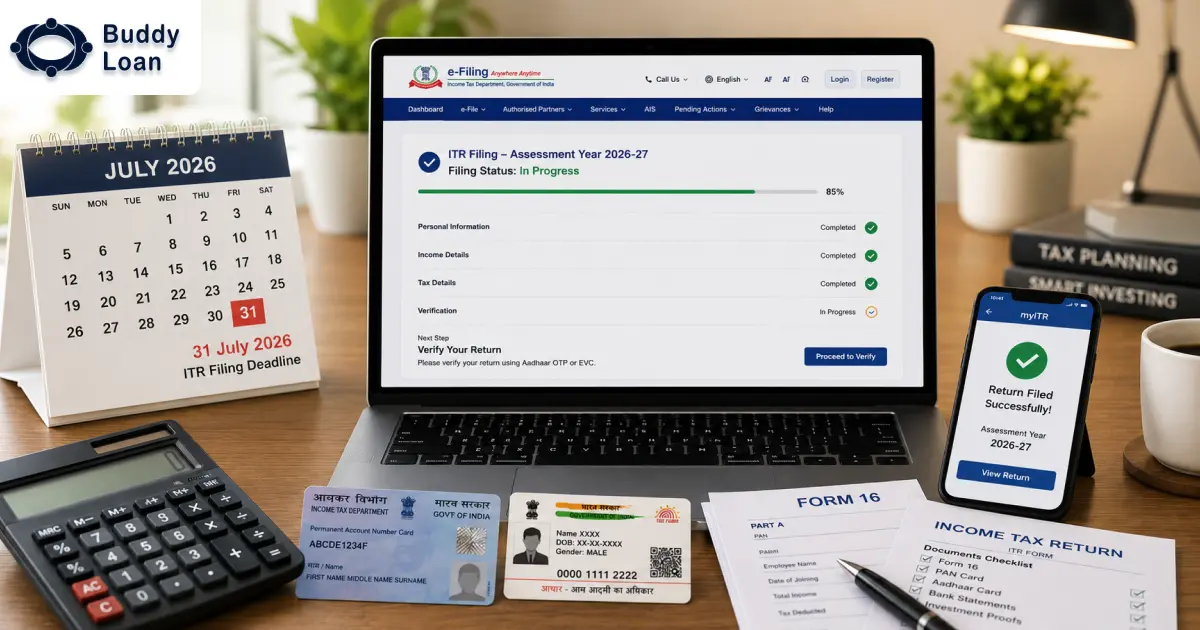
The last date to file an ITR that doesn’t require an audit for the year of 2026 is 31 July 2026. However, ITR filing is not only about paying tax. It also helps you claim refunds, report income correctly, maintain financial records and support future applications for loans, visas, credit cards or business documentation. If you file your ITR on time, you also avoid late fees and unnecessary interest.
Read on to learn more about the main due dates, who should file by which date, what happens if you miss the deadline, which documents you need, how to file ITR online and what to check before submitting your return.

Overview of Deadlines for Filing Your ITR
For many salaried individuals, pensioners and non-audit taxpayers, the deadline in 2026 is 31 July 2026 for Assessment Year 2026-27. However, this is not the last date for every taxpayer. Business or professional taxpayers, audit cases and transfer pricing cases may have different due dates.
Here is a list of final dates for various categories:
| Taxpayer Category | Last Date | Common ITR Forms |
| Salaried individuals and pensioners not requiring audit | 31 July 2026 | ITR-1, ITR-2 |
| Individuals or HUFs with business or professional income not requiring audit | 31 August 2026 | ITR-3, ITR-4 |
| Taxpayers requiring audit | 31 October 2026 | ITR-3, ITR-5, ITR-6, ITR-7 |
| Transfer pricing cases | 30 November 2026 | Applicable ITR form |
| Belated return for AY 2026-27 | 31 December 2026 | Applicable ITR form |
| Revised return for AY 2026-27 | 31 March 2027 | Applicable ITR form |
Note: Always check the date that applies to your income type and audit requirement. The July deadline applies to many taxpayers, but not to all.
What Income Tax Return Is
ITR 2026 usually refers to the Income Tax Return filed in 2026 for income earned during financial year 2025-26. This return belongs to Assessment Year 2026-27. In simple words, you earn income from 1 April 2025 to 31 March 2026, and you report that income through ITR filing in 2026.
This distinction is important as many people confuse financial year and assessment year.
- The financial year is the year in which you earn the income.
- The assessment year is the year in which you file the return and the Income Tax Department processes it.
Who Should File ITR in 2026?
Citizens must file an ITR if their income, tax deduction, refund claim or financial activity requires return filing. Salaried employees, pensioners, freelancers, professionals, business owners, investors, landlords and taxpayers with foreign income or assets may need to file ITR depending on their profile.
Even when your employer deducts TDS, you may still need to file ITR. TDS only means tax was deducted from your income. ITR filing is the process of reporting your total income, deductions, exemptions, taxes paid, refunds and tax payable.
You may need to file an ITR if you have:
- Salary or pension income
- Income from house property
- Capital gains from shares, mutual funds or property
- Business or professional income
- Freelance income
- Interest income
- Dividend income
- Foreign income or foreign assets
- Tax refund to claim
- High-value transactions that need reporting
If your case includes business income, capital gains, foreign assets or audit requirements, choose the correct ITR form carefully. Filing the wrong form can lead to defects or follow-up notices.
ITR Forms for AY 2026-27
The right ITR form depends on your income source, residential status, business income, capital gains and other financial details. Do not choose the form only because it looks simple. Choose it based on eligibility.
| ITR Form | Generally Used By | Common Use Case |
| ITR-1 | Resident individuals with simple income | Salary, pension, one or more eligible income sources within limits |
| ITR-2 | Individuals and HUFs without business or professional income | Capital gains, multiple income sources, foreign assets where applicable |
| ITR-3 | Individuals and HUFs with business or professional income | Business income, professional income, partnership income |
| ITR-4 | Eligible presumptive income taxpayers | Small business or professional income under presumptive scheme |
| ITR-5 | Firms, LLPs, AOPs and similar entities | Non-company entities |
| ITR-6 | Companies | Company return filing |
| ITR-7 | Trusts, political parties and specified entities | Returns under specified sections |
If you are unsure, check the Income Tax e-filing portal instructions or consult a tax professional. A simple salary case may use ITR-1, but salary plus capital gains may require ITR-2.
Why You Should Not Wait Until the ITR Last Date 2026
Many wait until the final few days before filing their ITR. This can create avoidable problems. You may discover a Form 26AS mismatch, missing TDS entry, wrong AIS data, incorrect bank account, unavailable document or login issue at the last moment.
Early ITR filing can help you:
- Claim refund sooner
- Correct Form 26AS, AIS or TIS mismatches
- Collect missing documents
- Avoid late filing fees
- Reduce last-minute portal stress
- Review tax regime choice carefully
- Verify the return within the required timeline
Filing close to the deadline may still be valid, but it leaves little room for correction. A planned approach is safer.
Documents Needed Before ITR Filing
Keep all documents ready before starting ITR filing. This reduces errors and makes the process smoother. Do not rely only on pre-filled data.
Here is a list of documents most commonly needed for filing ITR:
| Document or Detail | Why It Is Needed |
| PAN | Taxpayer identification |
| Aadhaar | Verification and linking |
| Form 16 | Salary and TDS details |
| Form 26AS | TDS, TCS and tax payment details |
| AIS and TIS | Income information reported to the department |
| Bank statements | Interest income and transaction review |
| Capital gains statement | Share and mutual fund gains |
| Home loan certificate | Interest and principal details |
| Rent receipts | HRA claim support, if applicable |
| Investment proofs | Deductions, if applicable |
| Bank account details | Refund credit and validation |
Also check whether your bank account is pre-validated on the e-filing portal. Refunds can get delayed if the bank account details are incorrect or inactive.
How to File ITR Online in 2026
The Income Tax e-filing portal allows taxpayers to file returns online. The exact steps may vary by ITR form, but the basic journey remains similar for most users.
- Visit the official Income Tax e-filing portal.
- Log in using PAN or user ID and password.
- Select the relevant assessment year.
- Choose the correct ITR form.
- Review pre-filled income, TDS and tax details.
- Add income that is missing from pre-filled data.
- Claim eligible deductions, if applicable.
- Check tax payable or refund amount.
- Submit the return.
- E-verify the ITR within the required timeline.
Do not submit the return without checking AIS, TIS, Form 26AS and Form 16. If the portal has pre-filled an amount, still verify it with your documents.
E-Verification After ITR FilingYou can e-verify through Aadhaar OTP, net banking, bank account EVC, demat account EVC or other available options on the e-filing portal. If you do not e-verify within the required time, the return may not be treated as valid within normal processing rules. The Income Tax Department has specified a 30-day timeline for verification in relevant cases. If you cannot e-verify online, you may send the signed ITR-V to the Centralised Processing Centre as per the prescribed process. However, online e-verification is usually faster and easier. |
What Happens If You Miss the ITR Deadline 2026?
If you miss the original ITR filing deadline of 2026, you may still file a belated return by the applicable last date. For AY 2026-27, the belated return deadline is 31 December 2026. However, late filing can come with consequences.
Possible consequences include the following:
- Late filing fee
- Interest on unpaid tax, if applicable
- Delay in refund processing
- Restrictions on carrying forward certain losses
- Difficulty in revising details after available timelines
- Additional compliance stress
Late filing should be your backup option, not your plan. File before the due date wherever possible.
Late Filing Fee for ITR 2026
If you file ITR after the due date, a late filing fee may apply. For AY 2026-27, the Income Tax Department FAQs mention a delayed filing fee of ₹1,000 where total income does not exceed ₹5 lakh and ₹5,000 in other cases.
- Total income up to Rs. 5 lakh: ₹1,000
- Total income above Rs. 5 lakh: ₹5,000
This fee is different from tax payable and interest. If you still owe tax, you may need to pay tax, interest and a late fee before filing the return.
Belated Return vs Revised Return
A belated return and a revised return are not the same. A belated return is filed after the original due date. A revised return is filed when you want to correct a return already filed.
| Return Type | When It Is Used | AY 2026-27 Timeline |
| Belated return | When you missed the original due date | Up to 31 December 2026 |
| Revised return | When you need to correct a filed return | Up to 31 March 2027, subject to conditions |
From AY 2026-27, revised return rules allow more time in specified cases. However, revisions after 31 December may involve an additional fee under the applicable provision. So, file correctly the first time and revise only when required.
Common Mistakes to Avoid During ITR Filing
Small errors can create notices, refund delays or return defects. Take time to review the return before submission.
- Choosing the wrong assessment year
- Selecting the wrong ITR form
- Not reporting interest income
- Ignoring AIS or Form 26AS mismatch
- Entering wrong bank account details
- Not pre-validating the bank account
- Missing capital gains details
- Forgetting foreign asset reporting, if applicable
- Claiming deductions without proof
- Not e-verifying the return
Also avoid copying last year’s data without checking current-year numbers. Income, deductions, TDS, capital gains and bank details can change every year.
Suggested Read: Previous Year ITR Deadline 2025
Final Thoughts
The ITR Filing Deadline 2026 depends on your taxpayer category, income type and audit requirement. For many salaried individuals and non-audit taxpayers, 31 July 2026 is the key date. For some business and professional taxpayers and audit and transfer pricing cases, later dates may apply.
Do not wait for the final day. Collect your documents, check Form 26AS, review AIS and TIS, choose the correct form and file carefully. Also remember to e-verify your return after submission.
In short, ITR filing is not just a yearly compliance task. It is part of responsible financial planning. File early, file correctly and keep proof of submission safely for future use.

Download the Buddy Loan App Now!
One solution to each of your financial needs at your fingertip.

Scan to download now