Are you someone planning to drive your favourite car home this year?
With new and exciting models in conventional as well as electric vehicles gaining popularity, along with the booming financing options that make the whole deal affordable, 2026 might just be the perfect time to get that dream car you wanted.
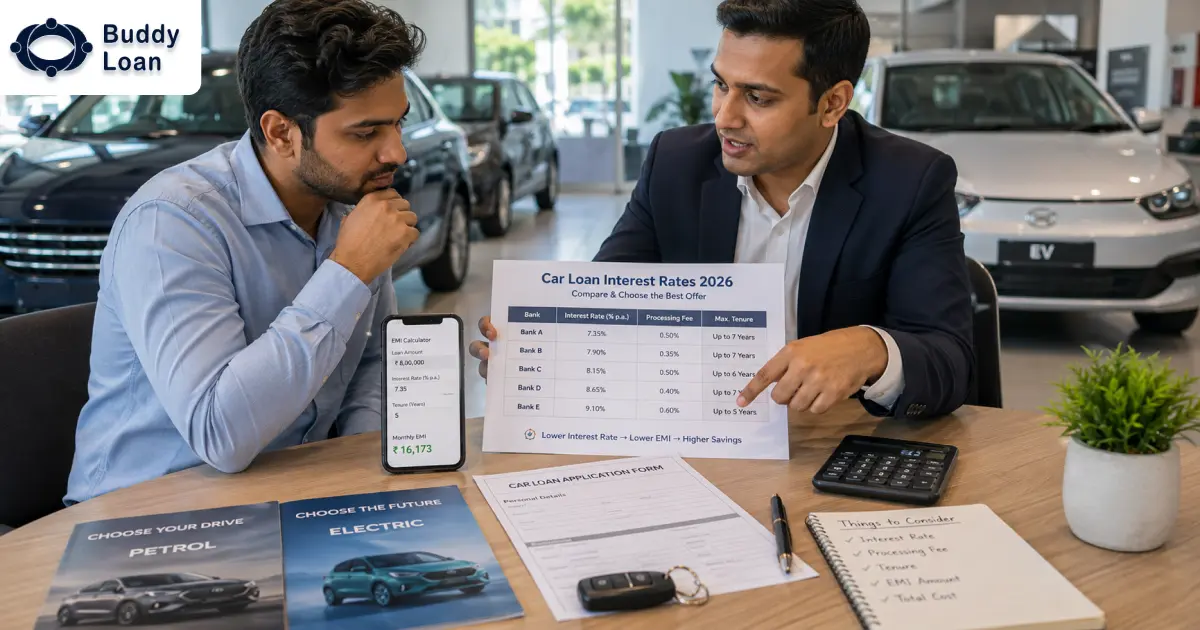
But before you apply for a car loan, it’s important to check for one thing: Interest rates. Yeah, these small numbers called car loan interest rates can make or break your deal.
Let’s explore what’s new in the world of car loan interest rates across major Indian banks, how they can affect your choice, and how to pick the right one for you.
How Car Loans Work
Simply put, a car loan is a type of secured loan offered by banks or NBFCs that helps you finance the purchase of a new or used vehicle.
With so many loan schemes available in the Indian market today, instead of paying the full amount upfront, you borrow the amount and repay it in monthly EMIs (Equated Monthly Instalments) over a tenure that typically ranges from 1 to 7 years.
Car Loan Interest Rate Explained
Like any other loan interest rate, the car loan interest rate is the cost you pay to the lender for borrowing the money.
It is usually expressed as an annual percentage and can either be fixed (doesn’t change during the loan period) or floating (can change based on repo rates or other benchmarks).
Suggested Read: Bank of Baroda Cuts Car Loan Rates
Car Loan Interest Rates in 2026: All Major Indian Banks
Here’s a comprehensive view of the starting interest rates from leading public and private sector banks.
Car Loan Interest Rates by Top Nationalised Banks
Here is a comprehensive overview of the top nationalised banks in India:
| Bank Name | Car Loan Interest Rate Starting From |
| State Bank of India (SBI) | 8.90% onwards |
| Punjab National Bank (PNB) | Rates vary by scheme and borrower category |
| Bank of Baroda (BoB) | 8.40% onwards |
| Canara Bank | Rates linked to the bank’s applicable lending rate |
| Union Bank of India | 8.80% onwards |
| Indian Bank | 9.15% onwards |
| Bank of India (BOI) | 8.50% onwards |
| Central Bank of India | 7.90% onwards |
| Indian Overseas Bank (IOB) | 7.85% onwards |
| UCO Bank | 7.70% onwards |
| Bank of Maharashtra | 7.70% onwards |
Car Loan Interest Rates by Top Private Sector Banks
Here is a comprehensive overview of the top private sector banks in India:
| Bank Name | Car Loan Interest Rate Starting From |
| HDFC Bank | 9.40% onwards |
| ICICI Bank | 9.15% onwards |
| Kotak Mahindra Bank | 7.70% onwards |
| Axis Bank | 8.85% onwards |
| IndusInd Bank | 8.00% onwards |
| IDBI Bank | 8.40% onwards |
| Yes Bank | Approx. 10% onwards |
| Federal Bank | 10.50% onwards |
| IDFC FIRST Bank | 9.99% onwards |
| AU Small Finance Bank | 8.00% onwards |
Please note that these rates are indicative and subject to change based on lender policies, borrower profile, credit score, loan type, vehicle category, and regulatory updates.
Also Read: Car Loan vs Personal Loan
Useful Tip
Always check with the bank before applying, as rates depend on your eligibility, income, and credit profile. The interest rates published by banks are indicative starting rates.
In reality, if you have a moderate credit score, the bank advertising the lowest starting interest rate may not necessarily offer you the best rate.
Types of Car Loans in India
Although the concept of a car loan is straightforward, these loans are available in different forms based on customer requirements.
- New Car Loan: Specifically for purchasing brand-new vehicles.
- Used Car Loan: Designed for purchasing second-hand or pre-owned vehicles.
- Top-up Car Loan: An additional loan over your existing car loan.
- Loan Against Car: Borrow funds by pledging your existing vehicle as collateral.

New Car Loans vs Used Car Loans: What’s the Difference?
Though both help you buy a vehicle, they differ in several aspects.
| Factor | New Car Loan | Used Car Loan |
| Interest Rates | Lower interest rates | Higher due to increased risk |
| Loan-to-Value Ratio | Up to 90–100% of the car’s value | Typically 60–80% of the car’s value |
| Tenure | Longer repayment periods | Usually shorter loan tenure |
| Documentation | Basic documentation | Additional paperwork such as ownership proof and vehicle condition documents |
Also Check Out: Get Car Loans Without Collateral
Factors That Influence Car Loan Interest Rates
It is always helpful to understand the factors that lenders consider before deciding your car loan interest rate.
- Credit Score: A score above 750 generally helps secure lower interest rates. The closer your score is to 900, the better your chances.
- Type of Vehicle: Interest rates may vary depending on whether you purchase an electric, premium, or conventional vehicle.
- Loan Amount & Tenure: Higher loan amounts or longer repayment periods may slightly affect the applicable rate.
- Income & Employer Profile: Stable income and employment with a reputed organisation improve your eligibility.
- Relationship with the Bank: Existing customers often receive preferential pricing, especially for top-up loan offers.
- Repo Rate Movements: Floating-rate car loans may change whenever the RBI revises the repo rate.
Before selecting the bank offering the lowest advertised car loan interest rate, evaluate your own financial profile, including your credit score, repayment history, income stability, and existing liabilities.
Your credit score plays a significant role in securing better interest rates and favourable repayment terms. If you’re unsure about your credit score or want to improve it, you can check your credit score for free with Buddy Score.
If you’re looking for flexible financing options beyond car loans, Buddy Loan connects you with trusted lenders based on your borrowing needs.
Stay informed, stay prepared, and drive into 2026 with confidence.
Download the Buddy Loan App Now!
One solution to each of your financial needs at your fingertip.

Scan to download now