Your CIBIL score is the single most critical metric defining your financial credibility in India. While a score of 750 is the industry-standard ‘magic number’ for instant approvals, the reality is nuanced. A score below 700 doesn’t automatically mean rejection, but it does mean higher interest rates and lower limits. If you need to check CIBIL score for credit card eligibility, know that TransUnion CIBIL’s algorithm dictates not just if you get a card, but which card you qualify for—from basic entry-level options to premium metal cards.
Today, your credit history is your currency. If you are looking for the minimum CIBIL score for credit card approval or trying to fix a damaged report, understanding this three-digit number is non-negotiable. Read on as we explain the scoring mechanism, bank-specific benchmarks, and actionable strategies to manipulate your score in your favor.


Minimum CIBIL Score for Credit Card
There is no universal ‘pass’ or ‘fail’ number, but risk brackets are clearly defined. Most major Indian banks set the CIBIL score required for credit card approval at 750. However, fintech lenders and specific issuer policies create opportunities for those with scores between 650 and 749.
CIBIL Score Brackets & Approval Probability
Here is a typical range of credit scores banks and NBFCs look for, before issuing your credit card.
| Score Range | Category | Approval Probability | Card Tier Availability |
| 800 – 900 | Elite | Frictionless / Instant | Super-Premium (Metal Cards, Invite-Only) |
| 750 – 799 | Prime | High | Premium & Mid-Range Rewards Cards |
| 650 – 749 | Average | Moderate / Conditional | Entry-level, Cashback, Co-branded |
| 550 – 649 | Subprime | Low | Secured Cards only (FD-backed) |
| 300 – 549 | High Risk | Near Zero | None (Requires credit repair) |
| -1 or 0 | NH/NA | Variable | Student Cards / Secured Cards |
Bank-Specific Score Benchmarks
When considering CIBIL score specifically for credit cards, just like personal loans, different banks have different risk appetites. While HDFC is stringent, issuers like Axis or SBI Card often have broader underwriting criteria to capture market share.
Take a look at this list of minimum CIBIL score requirements by major credit card issuers:
| Issuer | Minimum Score Target | Strategy / Notes |
| HDFC Bank | 750+ | Strictly relationship-based. High income can override a 740 score, but 750 is the standard for cards like Regalia Gold. |
| SBI Card | 700 – 750 | Diversified risk. Flagship cards (Elite) need 750+, but SimplySAVE is often approved for 650-700 with stable income. |
| Axis Bank | 750 (Baseline) | Aggressive expansion. Co-branded cards (Flipkart Axis) often see approvals at 700-720 for young professionals. |
| ICICI Bank | 750+ | Digital-first. Uses an internal ‘propensity score’ alongside CIBIL. Pre-approved offers are common for account holders. |
| IDFC FIRST | 700+ | Flexible. Willing to onboard ‘New to Credit’ users via wealth-based underwriting rather than just CIBIL. |
Pro Insight: Do not confuse a ‘Credit Score‘ with a ‘CIBIL Score.’ Credit score is a broader category, under which bureaus like CIBIL fall. Lenders can specifically pull the TransUnion CIBIL report. A 780 on Experian might translate to a 740 on CIBIL due to different algorithms. Always check free CIBIL score specifically from the CIBIL platform or banking apps that partner directly with TransUnion.
Importance of CIBIL Score for Credit Card Approval
Your CIBIL score acts as an algorithmic gatekeeper, not just in case of credit card but all types of credits. It replaces subjective trust with objective data. For the lender, the score predicts the likelihood of default over the next 12 months. For you, it determines the ‘Cost of Capital’—the interest rates and perks you are offered.
The Cost of Risk: Interest Rates and Limits
A high score can get you something more than a credit card; it gets you better terms. This is often overlooked. A borrower with a 780 score might be offered an Annual Percentage Rate (APR) of 30%, while a borrower with a 680 score might be capped at the statutory maximum of 42-45%.
Here is on overview of impact of CIBIL score on credit card terms:
| Feature | Impact of High Score (750+) | Impact of Low Score (<700) |
| Credit Limit | High (2x-3x monthly income) | Low (0.5x-1x monthly income) |
| Interest Rate (APR) | Negotiable (1.5% – 2.5% monthly) | Maximum (3.5% – 4% monthly) |
| Processing Speed | Instant / Green Channel | Manual Verification (Weeks) |
| Documentation | Minimal / KYC only | Extensive (Payslips, ITR, Statements) |
| Pre-approved Offers | Frequent (Loans on card, upgrades) | Rare / Non-existent |
Note: Although the provided table is accurate, this is generic and is prone to changes as per specific card issuer.
The ‘Virtuous Cycle’ of High Scores
Understanding the importance of the score reveals a hidden mechanic: the Virtuous Cycle.
- A high score leads to a higher credit limit.
- A higher limit means your normal spending utilises a smaller percentage of your limit.
- Lower credit utilisation (e.g., spending ₹20k on a ₹2L limit vs. a ₹50k limit) boosts your score further.
This further improves your score, leading to even better offers.
Conversely, a low score restricts you to low limits, where even basic spending spikes your utilization ratio, damaging your score further. This is why establishing a good CIBIL score for credit card usage early is vital.
Factors Influencing Required CIBIL Score
The CIBIL algorithm is a weighted calculation of five specific pillars. However, the required score for approval is also influenced by external factors like your income, employment stability, and existing relationship with the bank.
The 5 Pillars of the CIBIL Algorithm
To manage your score, you must understand what moves the needle. TransUnion CIBIL assigns specific weights to different data points in your Credit Information Report (CIR).
Here is a detailed disection of how your CIBIL score is calculated:
| Factor | Weightage | What It Measures | The ‘Red Flag’ Threshold |
| Payment History | 35% | Longitudinal reliability. Did you pay on time? | Even one 30-day late payment (DPD) drops score significantly. |
| Credit Utilisation | 30% | Leverage. How much credit are you using? | Consistently using >30% of your limit signals ‘credit hunger.’ |
| Credit History Length | 15% | Depth of data. How old is your oldest account? | Closing old cards shortens history and hurts the score. |
| Credit Mix | 10% | Balance. Secured (Home Loan) vs. Unsecured (Cards). | Having only credit cards (unsecured) is less ideal than a mix. |
| Number of Enquiries | 10% | Desperation. How often do you apply? | Multiple applications in 30 days looks like financial distress. |
Factors Beyond CIBIL Score on Your Credit Card Application
Even with a 750 score, you might face rejection. This is because banks look at the ‘whole customer’ profile when taking the ‘risk’ of lending someone money.
Take a look at these non-score approval factors
| Factor | Why It Matters |
| Income to Debt Ratio (FOIR) | If >50% of your income already goes to EMIs, a high CIBIL score won’t help. Banks fear over-leverage. |
| Employer Reputation | Employees of ‘Category A’ companies (MNCs, Govt) get approved at lower CIBIL thresholds than SME employees. |
| Settled Accounts | A ‘Settled’ status on an old loan is a major negative. It means the bank took a loss. It overrides a good current score. |
| Location/Address | Addresses in ‘negative areas’ (high default zones) can trigger automatic rejection regardless of score. |
Pro Insight – The 2026 Shift: A major regulatory change is coming in July 2026. The RBI has mandated a move from monthly to weekly reporting. Previously, if you max out your card but pay it off before the reporting date, CIBIL might never know. Now, high utilisation spikes will be visible almost instantly. This makes maintaining a low utilisation ratio continuously, not just monthly, essential for maintaining the minimum CIBIL score for HDFC credit card or other premium issuers.
Tips to Improve CIBIL Score for Better Credit Card Offers
Repairing a damaged score is a strategic process, not a quick fix. It typically takes 6 to 12 months of disciplined behavior to move from ‘Subprime’ to ‘Prime.’ The goal is to erase ‘doubtful’ patterns from your report.
A. The 12-Month Recovery Roadmap
If your CIBIL score is currently below 700, follow this strict regimen to qualify for premium cards.
Strategic Recovery Timeline:
| Duration | Actionable Steps | Expected Outcome |
| Month 1 Diagnosis | CIBIL score check online by PAN number. Audit CIR for errors. Dispute incorrect ‘Late’ tags. | Removal of clerical errors boosting score by 20-30 points. |
| Month 2-4 Stabilisation | Aggressively pay down balances. Bring credit utilisation (CUR) below 30% on all cards. Stop all new applications. | Halting the downward trend. Score stabilises. |
| Month 5-8 Proof of Behavior | Ensure 100% on-time payments. Automate minimum dues. Do not close old cards. | Building a ‘Green String’ of ‘000’ or ‘STD’ status in the report. |
| Month 9-12 Diversification | If mix is poor, take a small consumer durable loan or secured card. | Score crosses 750 threshold due to improved mix and history. |
B. Critical Behavioral Adjustments for Better CIBIL score
- The 30% Rule: Never let your credit card statement balance exceed 30% of your limit. If you have a ₹1 Lakh limit, do not spend more than ₹30,000. If you need to spend more, make a pre-payment before the bill generates.
- Avoid ‘Settlement’: Never accept a ‘One Time Settlement’ (OTS) from a bank. Ensure the account is closed as ‘Paid in Full.’ A ‘Settled’ tag is a black mark that stays for 7 years.
- Limit Hard Inquiries: Every time you apply for a card, a ‘Hard Inquiry’ hits your report. If rejected, wait 3-6 months. ‘Loan Stacking’ (applying to 5 banks at once) screams desperation.
| Pro Insight: Be careful with ‘Buy Now Pay Later’ (BNPL) apps. Most of these report as consumer loans. Having 10 active small BNPL loans looks like financial instability to a credit card issuer, even if you pay on time. |
Tips to Get a Credit Card with Low CIBIL Score
A low score (600-650) or a ‘New to Credit’ status (-1) is a barrier, but not a dead end. You need to enter the ecosystem through ‘entry-level’ doors designed for higher risk. This builds the history needed for premium cards later.
1. Strategies for the Sub-700 Scorer
If you are asking which bank will give credit card for low CIBIL score, the answer is usually banks offering secured or co-branded entry products. Here are some strategies you can use in your favour, utilising your existing relation with the bank:
| Strategy | How It Works | Success Rate |
| Salary Account Offer | Leverage your cash flow. If you receive salary in HDFC/Axis, approach the branch manager. They can override CIBIL based on banking history. | High |
| Add-On Cards | Piggyback on a family member’s good score. You get a card linked to their limit. It builds your exposure to credit usage. | Very High |
| Co-Branded Retail Cards | Apply for cards like Amazon Pay ICICI or Flipkart Axis. They have broader underwriting logic based on your shopping history, not just CIBIL. | Moderate |
| Fintech/Neobank Cards | Apps like OneCard or Slice often offer cards with lower limits to younger demographics with thin credit files. | Moderate |
2. Get Secured Credit Card without CIBIL Score
This is the most effective method for credit card for 600 CIBIL score applicants. A secured credit card is backed by a Fixed Deposit (FD). The bank has zero risk because if you default, they liquidate the FD.
Why it works:
- Guaranteed Approval: No CIBIL check is usually required.
- Credit Builder: It reports to CIBIL as a normal credit card. Regular payments on this card will generate a 750+ score within 6-8 months.
- Earns Interest: Your FD continues to earn interest while you use the card.
List of top secured credit card options:
| Card Name | Min. FD Required | Key Benefit | Best For |
| IDFC FIRST WOW! | ₹2,000 | Lifetime Free + Zero Forex Markup | Students & Travelers |
| ICICI Insta Platinum | ₹20,000 | Instant issuance via Net Banking | Existing ICICI customers |
| Axis Insta Easy | ₹25,000 | Flexible limit (80% of FD value) | Those wanting higher limits |
| Kotak 811 DreamDifferent | ₹10,000 | No income proof required | Freelancers / Gig workers |
| SBI Unnati | ₹25,000 | Waiver of fees on milestones | Building relationship with SBI |
Action Plan: If you have no score, open an IDFC WOW or Kotak 811 card today. Use it for small expenses (groceries, fuel) and pay the full bill on the 1st of every month. By the time the card is 6 months old, you will likely have a credit score for credit card approval from major banks like HDFC or SBI.
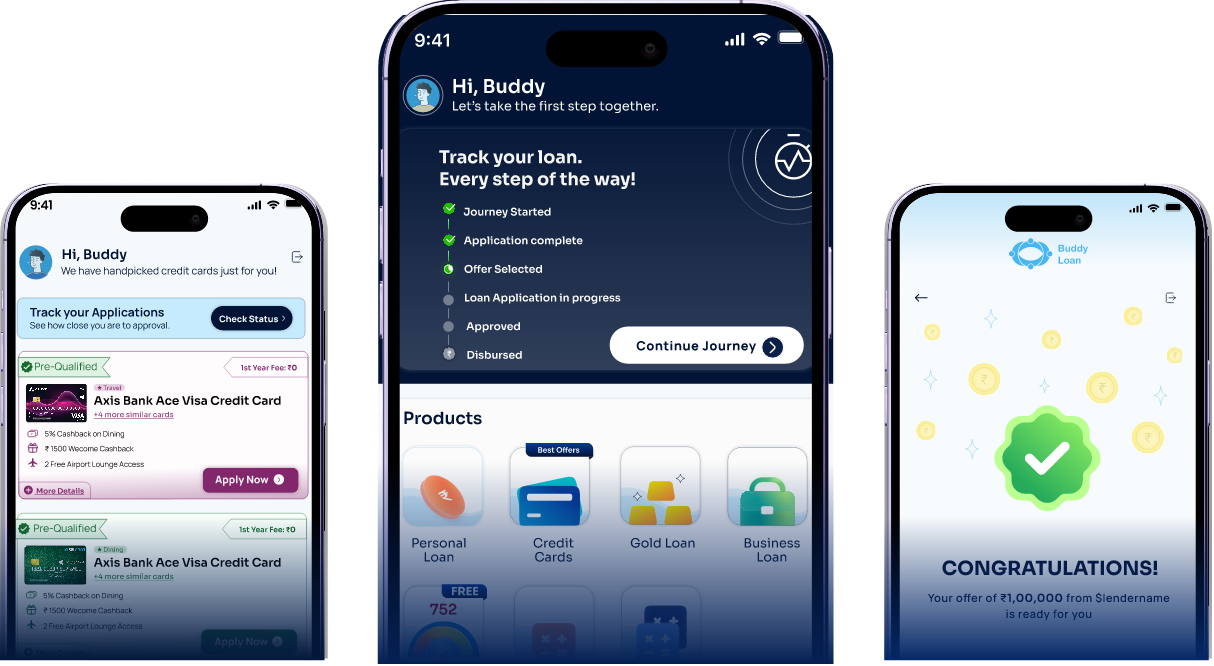
Download the Buddy Loan App Now!
One solution to each of your financial needs at your fingertip.

Scan to download now