Digital banking and fintech services have transformed how people save, invest, borrow, and make payments. However, the convenience of online financial services has also increased exposure to cyber fraud, phishing attacks, fake investment schemes, identity theft, and unauthorized financial activities.
To protect consumers and maintain trust in India’s financial ecosystem, the Reserve Bank of India (RBI) regularly publishes caution notices, fraud advisories, awareness campaigns, and public alerts.
RBI repeatedly emphasizes that consumers must stay vigilant and verify financial communications before sharing personal or banking information.
This guide explains RBI cautions, common financial scams, warning signs, preventive measures, and actions to take if fraud occurs.

RBI Caution List
The RBI has issued public cautions and awareness notices covering multiple categories of financial fraud and unauthorized activities.
These include:
- Fictitious emails and phishing mails sent in RBI’s name
- Recruitment-related fraud using fake RBI communication
- Fake websites impersonating RBI
- Fake credit cards issued using RBI’s name
- Unauthorized deposit collection activities
- Fake e-wallet and payment scams
- Fraudulent banking apps
- Unauthorized financial entities and investment platforms
- Multi-level marketing (MLM) schemes
- Virtual asset and digital investment risks
- Internet banking credential theft
- Lottery and foreign remittance scams
Understanding these warnings helps individuals and businesses reduce financial risks.
Also Read: RBI Guidelines on Personal Loan & Digital Lending
Understanding Fictitious Offers and Phishing Scams
Fraudsters increasingly use sophisticated digital methods to impersonate trusted institutions.
Victims may receive:
- Emails appearing to originate from RBI
- Fake bank notifications
- Lottery announcements
- Job offers
- Investment proposals
- Social media messages
- SMS containing suspicious links
- Calls requesting account verification
These scams often create urgency and pressure users into making quick decisions.
Common objectives include:
- Collecting banking credentials
- Stealing OTPs
- Extracting processing fees
- Installing malware
- Unauthorized fund transfers
Key RBI Warnings Every Consumer Should Know
Let’s go through the key RBI warnings every consumers should know:
1. Beware of Unsolicited Calls, Emails and Messages
RBI cautions consumers against responding to unexpected financial communication.
Fraudsters frequently impersonate:
- RBI officials
- Bank representatives
- Loan providers
- Recruitment officers
- Regulatory authorities
Prevention Tips
- Never trust unsolicited communication.
- Verify independently using official channels.
- Avoid clicking unknown links.
- Do not transfer money for account activation.
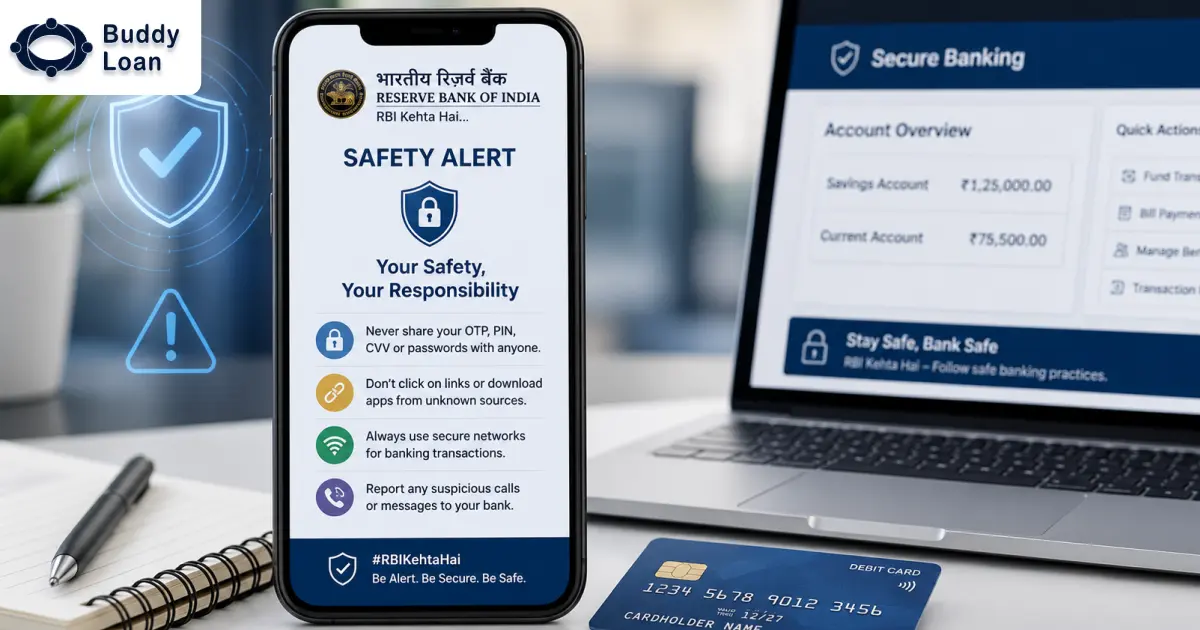
2. RBI Does Not Ask for Banking Information
One of RBI’s strongest public warnings is that it never asks individuals to share:
- OTP
- PIN
- Internet banking credentials
- Debit card details
- Credit card information
- CVV
- Passwords
Prevention Tips
- Never disclose confidential banking information.
- Enable multi-factor authentication.
- Use official banking apps only.
3. RBI Cautions Against Fake Emails and Phishing Attempts
Phishing emails are designed to look authentic.
These emails commonly contain:
- Fake RBI logos
- Urgent notices
- Payment requests
- Suspicious attachments
- Verification links
Prevention Tips
- Verify sender domains.
- Avoid downloading attachments.
- Report suspicious emails.
4. RBI Recruitment Fraud Alert
Fraudsters frequently target job seekers using fake RBI recruitment notifications.
These scams often demand:
- Registration charges
- Interview fees
- Processing payments
RBI clarifies that recruitment-related information is published only through official RBI channels.
Prevention Tips
- Apply only through official RBI notifications.
- Ignore recruitment offers requesting payment.
5. Fake Websites Impersonating RBI
Cybercriminals create fake websites that imitate official institutions.
Their goals include:
- Data theft
- Login credential collection
- Financial fraud
- Prevention Tips
Before entering information:
- Check URL spelling
- Verify HTTPS security
- Confirm website authenticity
6. RBI Does Not Issue Credit Cards
RBI has repeatedly clarified:
- It does not issue credit cards.
- It does not authorize third parties to issue cards in its name.
Prevention Tips
Ignore:
- Pre-approved RBI card offers
- Lifetime free RBI cards
- Guaranteed approval advertisements
7. RBI Caution on Investment and MLM Schemes
Investment scams often promise:
- Fixed returns
- Guaranteed profits
- Referral commissions
- Quick wealth generation
These may operate as unauthorized financial activities.
Prevention Tips
- Verify regulatory status.
- Avoid pressure-based investment decisions.
- Research before investing.
8. RBI Advisory on Digital Wallets and Payment Apps
Digital payments have increased fraud exposure.
Risks include:
- Fake wallet apps
- Payment redirection
- QR manipulation
- Unauthorized transfers
Prevention Tips
- Download only official apps.
- Enable alerts.
- Review permissions regularly.
9. RBI Caution Against Fake Banking Applications
Fake banking apps often imitate:
- Internet banking portals
- Balance enquiry tools
- Payment gateways
Prevention Tips
- Install apps from trusted sources.
- Check developer details.
- Avoid APK downloads.
10. RBI Caution on Virtual Assets and High-Risk Investments
RBI has repeatedly highlighted risks associated with speculative and highly volatile investment products.
Risks may include:
- Consumer protection concerns
- Operational risks
- Market volatility
- Fraud exposure
Prevention Tips
- Understand risks fully.
- Verify platform legitimacy.
- Avoid guaranteed-return claims.
11. RBI’s Alert List and Unauthorized Financial Activities
RBI periodically publishes information to help consumers identify potentially unauthorized activities.
Consumers should:
- Verify authorization status
- Review official announcements
- Avoid unverified financial operators
Latest RBI Fraud Trends Consumers Should Watch
Recent fraud patterns increasingly include:
- Remote Access App Fraud
Victims install apps that give scammers control of devices. - Screen Sharing Fraud
Users unknowingly expose banking information. - Investment Telegram Groups
Fraudsters manipulate users into fake investment schemes. - Task-Based Income Scams
Victims deposit money expecting returns. - Fake Customer Care Numbers
Users lose funds while seeking support.
Also Read: RBI Retail Direct
Modus Operandi of Financial Fraud
Fraud typically follows this pattern:
Step 1: Initial Contact
Phone call, email, SMS, app, or social media.
Step 2: Trust Building
Fraudsters impersonate trusted entities.
Step 3: Urgency Creation
Victims are pressured to act immediately.
Step 4: Payment Request
Money or sensitive information is collected.
Step 5: Continued Extraction
Additional charges are demanded.
What To Do If You Become a Victim of Financial Fraud
Step 1: Contact Your Bank Immediately
Request:
Transaction block, Card freeze & Credential reset
Step 2: Report to Cyber Crime Authorities
Call: 1930
Report quickly to improve recovery chances.
Step 3: File Complaint Online
Use India’s official cybercrime reporting platform.
Step 4: Preserve Evidence
Save: Screenshots, Messages, Emails, Transaction records
RBI Safe Banking Checklist
Use this before every financial transaction:
Verify website authenticity
Never share OTP
Avoid unknown QR codes
Enable alerts
Use strong passwords
Review account activity
Install official applications only
Verify investment opportunities
Also Check: RBI Bonds Calculator
Conclusion
Financial fraud continues to evolve alongside digital innovation. RBI’s caution notices act as an important safeguard for consumers, businesses, and fintech users.
By staying informed, verifying communications, and following secure banking practices, individuals can significantly reduce the risk of becoming victims of financial scams.
Awareness remains one of the strongest forms of financial protection.
Download the Buddy Loan App Now!
One solution to each of your financial needs at your fingertip.

Scan to download now