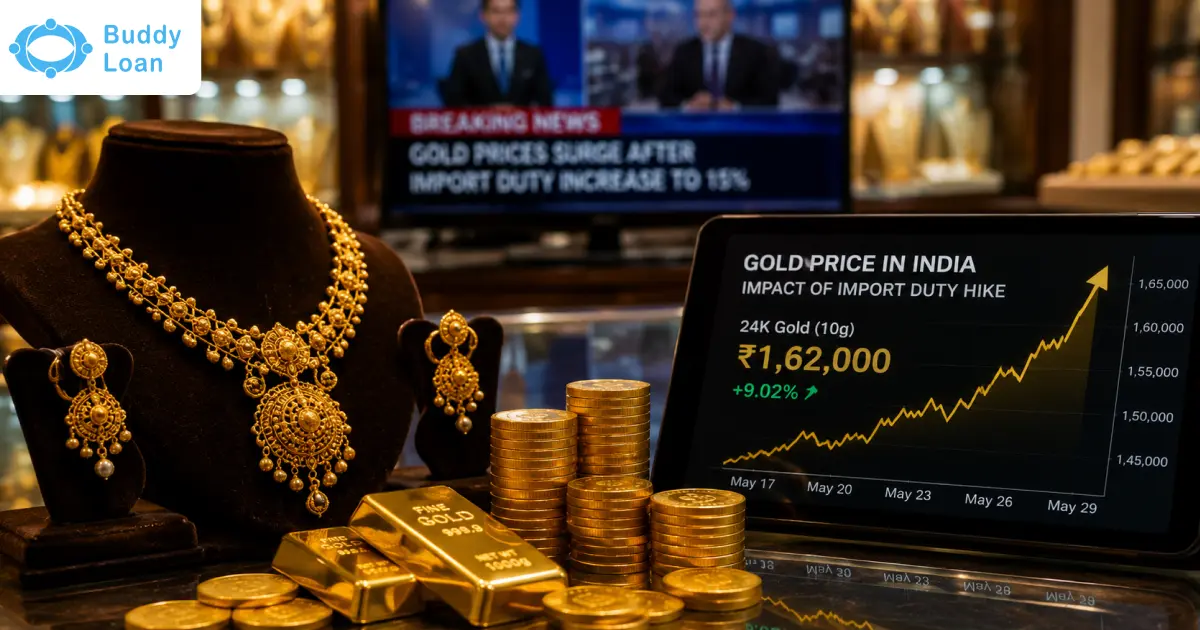
It is just dawn of 2026 and the gold rate has officially crossed the ₹1.6 Lakh mark, a figure that seemed impossible just five years ago. Then, prices were hovering around ₹48,000. But the rearview mirror is only useful for history; investors need the windscreen view. The pressing question for every Indian household today is: Is the rally over, or is this just the new floor?
Current Market Price of Gold (24K) is ₹1,62,670 per 10 grams.
Gold has fundamentally shifted from a passive savings asset to a geopolitical shield. With global central banks buying bullion at the fastest pace since 1967 and the Rupee continuing its natural depreciation against the Dollar, the mathematical trajectory for the yellow metal remains upward.
Let’s take a serious look into the gold rate prediction for the next 5 years in India, using facts—like compound annual growth rate (CAGR) models to forecast where prices might land by 2030.

The Hidden Driver of Indian Gold Rates
Before looking at the targets, you must understand the engine driving them. Most retail investors assume gold prices rise only when there is a war or a pandemic. While true, that is only half the story.
In India, gold rate prediction is heavily dependent on the USD-INR exchange rate. Think of them as inversely proportional: if one goes up, the other goes down. Even if international gold prices (in USD) remain flat, if the Indian Rupee depreciates against the Dollar, the domestic price of gold must rise.
The Catch: Historical data shows that approximately 40% of Gold’s return in India over the last 15 years has come purely from the Rupee losing value against the Dollar. With analysts projecting the USD/INR rate to touch ₹105–₹111 by 2030, domestic gold has a built-in safety net. Even in a bearish global market, the currency difference provides an automatic upward lift.
Also Read: USD & Currency Impact on Gold Price
Gold Price Forecast: Three Scenarios (2026–2030)
Forecasting any asset requires probability, not certainty. Based on historical CAGRs and current macroeconomic trends (inflation, de-dollarisation, and debt crises), we have modelled three distinct scenarios for the gold rate prediction for the next 5 years in india.
The following table projects the price per 10 grams of 24K gold.
| Scenarios | Market Condition | Est. CAGR | 2028 Probability | 2030 Probability |
| Bear Case | Global Peace & Strong Dollar | 6% | ~₹1,82,000 | ~₹2,04,000 |
| Base Case | Status Quo (Mild Inflation) | 10% | ~₹1,96,000 | ~₹2,37,000 |
| Bull Case | Currency Crisis / Conflict | 14-15% | ~₹2,10,000 | ~₹2,73,000 |
1. The Bear Case (Peace & Stability)
If global conflicts are resolved and the US economy strengthens significantly, the “fear premium” on gold will vanish. In this case, gold will likely revert to matching inflation (approx. 6%).
- The USD influence: A strengthening US Dollar typically forces global gold spot prices down (inverse relationship); however, domestic prices in India will still rise slightly due to the natural depreciation of the Rupee.
- Outcome: Note that even in this worst-case scenario, the nominal price rises, but wealth creation is minimal in real terms.
2. The Base Case (Most Likely)
This scenario assumes the ‘Status Quo’. It factors in a standard Indian inflation rate of 4-5% and a steady depreciation of the Rupee by about 3% annually.
- The USD influence: With the Dollar remaining range-bound, global gold prices can grow at a natural pace, while the Rupee’s weakness acts as a multiplier for Indian investors.
- Outcome: This beats bank FDs while preserving purchasing power, continuing the historical average performance of 10% returns.
3. The Bull Case (Crisis Mode)
This is the scenario where the future gold rate in India accelerates. If the de-dollarisation trend intensifies, where countries like China and Russia dump US Treasury bonds to buy gold, supply will shrink while demand spikes.
- The USD Influence: If the US Dollar crashes or weakens significantly due to debt, global gold spot prices will skyrocket inversely, creating a massive upside for rupee-denominated gold.
- Outcome: Combined with a potential recession or high inflation, gold could deliver returns of 14-15% CAGR, mirroring the 2016-2026 run.
However, forecasting the gold price at this point is a high-risk, high-gain moment.
Is Gold Still a Buy at ₹1.62 Lakhs?
Many investors fear gold prices entering all-time highs. However, data suggests that waiting for a correction can be costly.
- The ‘Floor’ Theory: Central Banks are creating a permanent price floor. When sovereign nations view gold as a strategic reserve asset rather than a commodity, they buy on dips, preventing deep crashes.
- The 10-Year Horizon: If you buy 10 grams today at ₹1.62 Lakhs for a long-term goal (like a child’s marriage), the Base Case projection puts that value at roughly ₹4.2 Lakhs by 2036.
- Investment Strategy: Avoid buying jewellery for investment; the 15-20% making charges will eat your first two years of returns. Focus on Sovereign Gold Bonds (SGBs) available in the secondary market or highly liquid Gold ETFs.
Conclusion
The gold rate prediction for the next 5 years in india points toward a continued upward trajectory, driven not just by market sentiment but by the structural mathematics of the INR/USD equation. While the explosive growth of the last few years may stabilise, a target of ₹2.3 Lakhs to ₹2.5 Lakhs per 10 grams by 2030 is statistically probable under current economic conditions.
An average Indian investor must view gold-related investments as less about getting rich quickly and more about ensuring that your wealth survives the erosion of inflation and currency devaluation.

Download the Buddy Loan App Now!
One solution to each of your financial needs at your fingertip.

Scan to download now