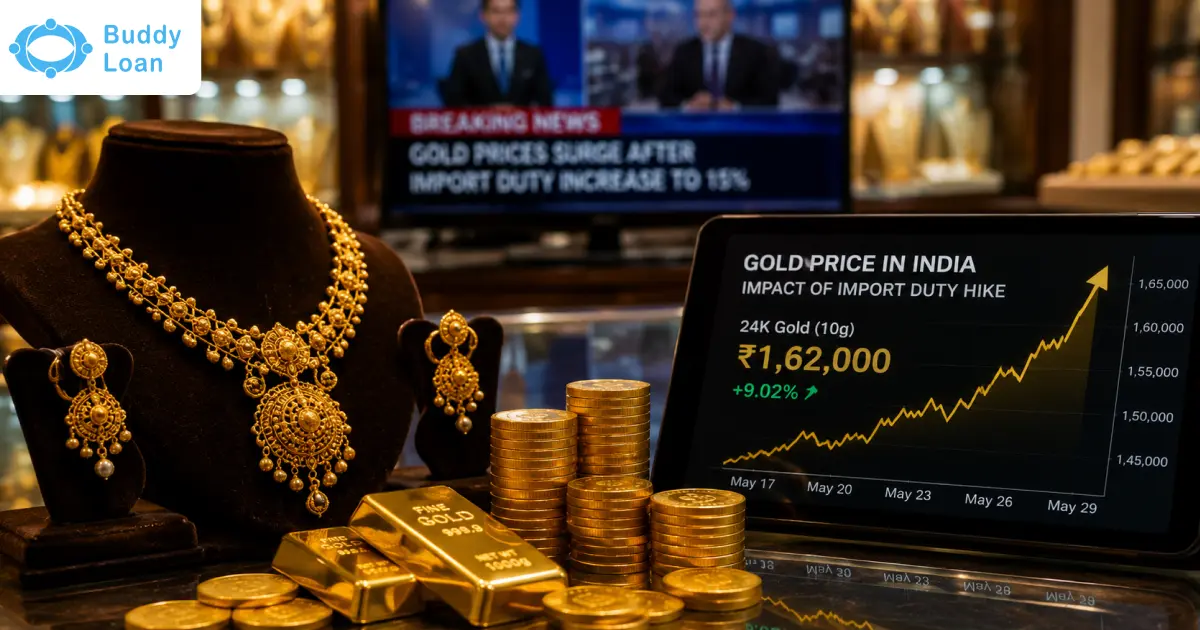
If you had predicted in 2016 that the gold rate would cross ₹1.6 Lakhs by 2026, most analysts would have called it hyperbole. Yet, here we are. The relentless march of the yellow metal has proven that it is not merely a commodity; it has become a barometer of global economic anxiety.
Current market price of Gold is ₹1,62,670 per 10 grams.
As we look toward the next decade, the question for Indian families and investors is no longer “Will the gold price rise again?” but rather (almost sarcastically) “How high will the gold rate go?” With Central Banks aggressively de-dollarising and the Indian Rupee continuing its natural depreciation against the USD, the mathematical floor for gold prices is shifting upward.
In this comprehensive analysis, we will utilise Compound Annual Growth Rate (CAGR) models to forecast the gold rate prediction for the next 10 years in india, creating a roadmap for 2036.
The Historical Baseline: Why We Predict Growth
To understand where we are going, we must respect where we came from: Gold in India follows a very specific trajectory, driven largely by the currency equation and public consumption.
| Year | Average Gold Price (₹/10g) | 10-Year Growth (CAGR) | Major Driver |
| 2006 | ₹8,400 | — | Pre-2008 Boom |
| 2016 | ₹28,623 | ~13% | Post-Crisis Recovery |
| 2026 | ₹1,62,670 | ~18.5% | Fear Trade/Debt Crisis |
Key Insight: The long-term average return of gold in India is typically between 10% and 12%. The recent spike (18.5% CAGR) is an anomaly driven by global wars and inflation, suggesting a potential normalisation in the coming decade.
However, even a “normal” return creates massive nominal wealth due to the power of compounding.
Also Read: USD & Other Currency Impact on Gold Price

10 Year Gold Price Forecast – Three Scenarios 2026 to 2036
Unlike a gold rate prediction for the next 5 years, forecasting the gold price for the next 10 years in Indian rupees requires analysing three potential economic realities. We have modelled these scenarios based on inflation data, USD-INR projections, and geopolitical trends.
Here is a simple fact to keep in mind; If dollar value increases, gold value decreases.
In normal markets, gold and the dollar move in opposite directions. However controversially, in these geopolitically tense times, both can rise together as the world seeks safety, effectively decoupling gold from its traditional currency anchor.
The following table projects the price per 10 grams of 24K gold for the year 2036.
| Scenario | Market Condition | Est. CAGR | 2036 Projected Price |
| Bear Case | Peace, Stability & Strong Rupee | 6% | ₹2,91,000 |
| Base Case | Status Quo (Historical Norm) | 10% | ₹4,21,000 |
| Bull Case | Currency Crisis / High Inflation | 14% | ₹6,00,000 |
Scenario Breakdown
1. The Base Case (Most Likely)
This scenario assumes the world returns to “business as usual”. It factors in India’s standard inflation rate (4-5%) and the Rupee depreciating against the Dollar by roughly 3-4% annually.
- The Logic: If gold delivers a steady 10% annual return—which it has done consistently over 20-year periods—the gold rate prediction suggests a price doubling every 7 years.
- Result: Your 10 grams of gold, currently worth ₹1.62 Lakhs, would grow to approximately ₹4.21 Lakhs by 2036.
2. The Bull Case (Crisis Mode)
This is the scenario where the gold price in the next 10 years in Indian rupees accelerates aggressively.
- The Logic: If the global sovereign debt bubble bursts or the trend of “De-dollarisation” (nations dumping US Dollars for Gold) intensifies, the Rupee could weaken significantly while Gold (USD) skyrockets.
- Result: A 14% CAGR, similar to what we saw between 2006-2026, pushes the price to a staggering ₹6 lakh per 10 grams.
3. The Bear Case (Peace & Stability)
Even if global peace breaks out and the US Dollar strengthens (usually bad for gold), the price in India will likely still rise.
- The Logic: Gold acts as a hedge against Indian inflation. Even in a bear market, gold typically matches the inflation rate (approx. 6%).
- Result: The price reaches ₹2.91 lakh, preserving your purchasing power even if it doesn’t generate massive “profit”.
Also Read: Check Gold Purity on BIS Care App

The Drivers of The 10-Year Gold Price Rally
Why are these numbers so high? It comes down to two critical factors that average investors often overlook.
1. The INR/USD Correlation
Sadly, gold in India is a derivative of the Rupee’s weakness.
- The Math: If the international price of gold stays flat for 10 years, but the Rupee falls from ₹90 to ₹120 against the Dollar, the domestic gold price must rise by 33% just to keep parity.
Roughly 40% of gold’s return in India comes purely from currency depreciation, providing a built-in safety net for the gold rate prediction for the next 10 years in India.
2. The Supply Crunch
It is rather simple to explain. We have mined all the “easy gold”.
- Production Peak: Major miners in South Africa and Australia are digging deeper for lower-grade ore. This raises the “All-In Sustaining Cost” (AISC).
- Floor Price: Miners cannot sell gold below their cost of production without going bankrupt. As energy and labour costs rise over the next decade, the floor price of gold naturally lifts.
Investment Strategy for the Next Decade
Knowing the gold rate prediction is useful, but executing the trade is profitable. Here is the hierarchy of investment efficiency for a 10-year horizon:
- Sovereign Gold Bonds (SGBs): It is the undisputed winner among the gold investment options. If you are to hold until maturity (8 years), the capital gains are tax-free. Plus, you earn 2.5% annual interest. In a high-tax environment, this beats physical gold by a wide margin.
- Gold ETFs: This is the best option for liquidity. If you need to sell in Year 4 or Year 7, ETFs allow instant exit at fair market value, unlike jewellery, which suffers from deduction losses.
- Physical Gold: Although traditionally it is considered a good “savings” option, it is best to only buy it for consumption (weddings). It would be wise to avoid investment bars unless you have a specific need to hold assets outside the banking system, as storage and insurance costs eat into the 10-year returns.
Conclusion
The trajectory for the gold price for the next 10 years in Indian rupees is unmistakably upward. While the explosive 18% growth of recent years may cool down, the structural economics of the Rupee and global debt ensure that gold remains a vital portfolio anchor.
Mathematical models suggest a high probability of gold trading between ₹4.2 Lakhs and ₹6.0 Lakhs per 10 grams by 2036. For the Indian investor, the strategy remains simple: Ignore the daily volatility, accumulate on dips, and let the compounding of currency devaluation work in your favour.

Download the Buddy Loan App Now!
One solution to each of your financial needs at your fingertip.

Scan to download now