A Loan Against Property (LAP) is a secured credit facility that enables individuals to leverage the value of their existing real estate assets, residential, commercial, or leasedfor substantial funding needs. It is widely used for various financial requirements such as business expansion, higher education, healthcare expenses, or personal obligations.
But not every property will have the value you would expect. There are specific criteria for eligibility for your property to give you the maximum value it could.
This guide outlines the complete eligibility framework for obtaining an LAP in India, including criteria for salaried and self-employed applicants, loan limits, documentation requirements, interest rates, and lender-specific details.
Common Eligibility Criteria for Loan Against Property
The gateway for you to be eligible for LAP begins with checking if you meet your lender’s basic conditions. Lenders often evaluate your income, age, credit score, and the type of property you own. Let’s see how these vary for different profiles.
Here is a comprehensive list of typical eligibility criteria followed by most lenders:
| Criteria | Salaried Individuals | Self-Employed Individuals/Professionals |
|---|---|---|
| General Requirements | Indian, residing in India. | Indian, residing in India.
NRIs can apply to certain lenders (like SBI, ICICI). (Bajaj Finserv doesn’t allow NRIs.) |
| Minimum Income | Varies by lender: ICICI HFC needs ₹7,000/month, SBI requires ₹25,000/month, and Kotak sets the bar at ₹40,000/month. | Most ask for an income above ₹1.8 LPA. Provide two years’ profits and proof of at least three years of business. |
| Age Limits | Generally, from 20/24 to 60/65 years, depending on the lender. | Ranges from 21 to 85 years, depending on the lender and co-applicants. |
| Credit Score | A score of 700 is typically expected, but lenders like ICICI prefer 750+ for better terms. | Lower benchmark required, but sometimes higher credit scores give better leverage. |

| Tip: If you want to boost your LAP eligibility, add a co-applicant. If they earn or co-own the property, your chances get a solid boost.
ICICI HFC even offers better rates if your co-applicant is a woman, even if she’s not earning. |
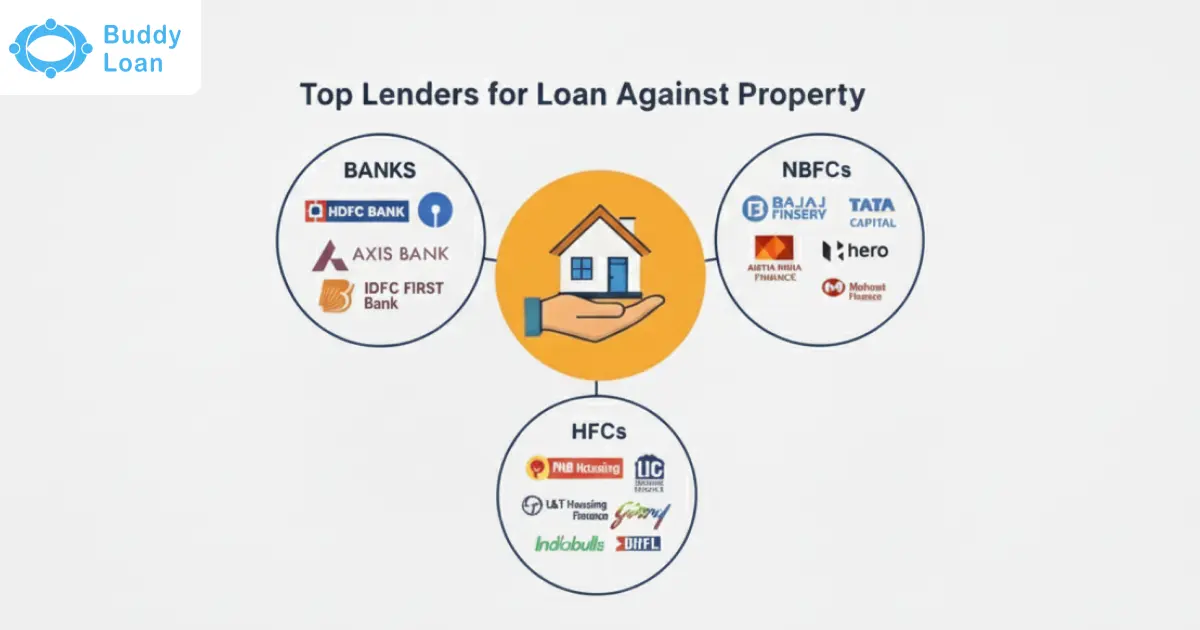
Loan Against Property Eligibility of Top Banks
Lenders usually sanction 60%-80% of your property’s market value as the loan amount. Here’s a snapshot:
| Lender | Loan Range (Maximum) | Maximum LTV Ratio Offered | Key Requirements |
|---|---|---|---|
| Bajaj Finserv | Up to ₹10.5 crore | Up to 80% | All types of properties are accepted, including plots and industrial units. |
| ICICI HFC | ₹5 lakhs to ₹10 crores | Not specified | Fully constructed residential, commercial, or leased properties are accepted. |
| Kotak Mahindra Bank | Based on market value | Up to 80% | Any owned land, even specialised industry plots. |
| ICICI Bank | High amounts possible | Up to 75% | Accepts residential, commercial, and industrial properties. |
| SBI | ₹10 lakhs to ₹5 crores (metro only) | 60%–65% | Only term loans. Property must be SERFAESI compliant and non-agricultural. |
| Axis Bank | ₹5 lakhs to ₹5 crores | 45%–60% | LRD funding is capped at 50% of the value or 85% of NPV. |
Typical LAP Tenures for Different Lenders
LAP comes at a range of tenures, which might vary according to the bank. Here is an overview of different banks:
-
Axis Bank: Up to 20 years.
-
SBI: Up to 15 years, with an extra 5 years of property life required.
-
ICICI Bank: Up to 15 years.
-
Bajaj Finserv: Flexible terms up to 15 years.
Types of Properties Accepted for LAP
Lenders accept various types of properties as eligible collateral for a Loan Against Property, as long as they are legally owned and properly documented. Commonly accepted property types include:
- Residential properties: Self-occupied or rented homes/flats
- Commercial properties: Offices, shops, or business spaces
- Industrial properties: Premises used for manufacturing or industrial work
- Vacant plots: Non-agricultural land with clear ownership
- Leased properties: Properties that earn regular rental income
The property must be non-agricultural, dispute-free, and usually have a remaining life of at least 5 years beyond the loan tenure.
Rates, Fees, and Charges Associated with LAP Eligibility
Complete transparency might vary between the banks, but most banks now offer clarity on interest rates and processing fees under the new regulations of the RBI.
1. LAP Interest Rates
Interest rates for a Loan Against Property vary depending on the lender, loan amount, and applicant profile.
- General Range: 9.30% to approximately 11.50% p.a. (floating rates)
- For loan amounts up to ₹1 crore, rates may start around 9.30%–10.60%.
- For larger loans (₹2 crores to ₹5 crores), rates may rise up to 11.50%, depending on the lender and risk profile.
These rates are typically linked to internal benchmarks (e.g., ICICI HFC’s IHPLR) or the 1-year MCLR (used by SBI) and are applied on a monthly/daily reducing balance basis.
2. LAP Fees and Charges
Here is a generic table for an overview of general charges associated with LAP:
| Charge Type | Typical Range/Practice |
|---|---|
| Application/Login Fee | Usually between ₹5,000 and ₹10,000 + GST; non-refundable; paid at the time of application. |
| Processing/Admin Fee | Typically, 0.5% to 1.5% of the sanctioned loan amount + GST may be capped at a fixed limit. |
| Legal and Valuation Fees | May be charged separately or included in processing fees; varies based on property type. |
| Prepayment/Foreclosure | Often NIL for floating rate loans; some lenders may charge for fixed-rate closures. |
| Other Administrative Charges | Could include documentation, stamp duty, or technical charges, depending on lender policies. |
Documents Required for Loan Against Property
There are certain documents that are mandatory for LAP eligibility, like any other loan application. Let’s take a look at all the documents that are necessary and some more that can make the whole application process a lot smoother.
Mandatory Documents (General KYC and Property)
- Duly filled and signed loan application form
- KYC: Aadhaar, PAN, Passport, Voter ID, Driving License
- Property documents (title deed, chain of ownership, and encumbrance proof)
- Date of birth and signature proof
Income Proof for Salaried Individuals
- Latest 2–3 months’ salary slips
- Form 16
- 3–6 months’ bank statements
- Proof of employment continuity
Income Proof for Self-Employed
-
The latest 2 years’ P&L and balance sheet
-
2–3 years ITRs
-
Business bank statements (6 months)
-
Business registration and continuity documents
-
Tax audit reports (if applicable)
LAP Application Process
As LAP is a secured loan option, you can expect a streamlined and digitised process from most lenders, more so than compared to other unsecured loan options. This can make your profile most eligible for approval, considering you have a good profile.
Most lenders provide 2 options for application:
- Online: Through the lender’s official website or digital platforms
- Offline: By visiting physical branches, many lenders operate across major cities and towns
Here are the typical steps to follow:
1. Submit Application
Complete the loan application form online or at a branch. Ensure that all mandatory documents are attached, including identity proof, income statements, and property papers. This step typically takes 10–15 minutes if the documentation is ready.
2. Pay Login/Application Fee
A non-refundable login fee, usually ranging from ₹7,000 to ₹10,000 + GST, is payable at the time of application submission. This covers initial processing and documentation setup.
3. Document Verification & Credit Assessment
Lender-appointed experts evaluate your eligibility based on multiple factors:
- Age and income stability
- Existing EMIs and Debt-to-Income ratio
- Credit score (CIBIL)
- Property valuation and legal compliance
4. Loan Sanction and Offer Letter
If your profile meets the eligibility norms and creditworthiness checks, the lender issues a sanction letter with the loan amount, interest rate, tenure, and applicable conditions.
5. Pay Processing/Administrative Fee
At the sanction stage, you’ll be required to pay a processing fee, generally 1%–1.5% of the approved loan amount + GST. This fee may vary depending on the property type and loan value.
6. Legal Check and Final Disbursement
The property’s legal documentation is verified, and ownership is confirmed. Once cleared, the loan amount is disbursed, and the original property documents are held as collateral by the lender.
Note: The provided steps are generic, and the process can differ specifically based on the lender.
Tips to Strengthen Your Profile for LAP Approval
If you are looking for an easier borrowing process, sure-shot approval, or a quicker disbursal, there are some tips that you can use.
- Credit Score: Maintain a CIBIL score of 750+ for better rates and smoother approval.
- Debt Management: Keep your EMI-to-income ratio below 50–60%. Clear existing debts if possible.
- Stable Income
- Salaried: Preference for government/reputed employers.
- Self-Employed: Provide 2–3 years of ITRs, P&L, and business proof.
- Add a Co-applicant: Improves eligibility. Women co-applicants may unlock better interest rates.
- Property Compliance: Ensure the property is clear, non-agricultural, and has valid legal documents. It should outlast the loan tenure by at least 5 years.
Comparison and Consideration of LAP Options
If you’re seeking a transparent, quick way to check if you are eligible for LAP, a digital lending platform like BuddyLoan might be what you need. Not being a lender itself, BuddyLoan bridges you to verified lenders while offering a seamless experience.
While you are at it, do not forget to:
- Check your credit score for free so that you know what rate to expect from lenders.
- Use an EMI calculator so that you can plan your monthly EMIs.
Whether you’re salaried or self-employed, BuddyLoan simplifies the LAP journey and helps you make informed choices without the hassle.
Conclusion: Leverage Your Property with Confidence
A Loan Against Property can be a practical solution for accessing significant funds without having to liquidate your assets. However, it’s essential to approach it with a clear understanding of eligibility norms, documentation requirements, and lender-specific conditions.
By preparing your financial profile, maintaining a strong credit history, and ensuring property compliance, you can improve your chances of LAP approval and secure favourable terms.