Higher education is a significant investment that can open doors to better career opportunities and long-term financial growth. However, rising tuition fees and other academic expenses often make it difficult for students and their families to manage costs entirely through savings. An education loan helps bridge this financial gap by covering expenses such as tuition fees, accommodation, books, travel, and other education-related costs. Understanding the education loan eligibility criteria can help students and co-applicants prepare the required documents, assess their repayment capacity, and improve their chances of securing funding on favourable terms.


Education Loan Eligibility Criteria
Education loans are offered by banks and financial institutions to support students pursuing higher education in India and abroad. While eligibility requirements vary across lenders, applicants are generally assessed based on their academic profile, admission status, chosen course, institution, and the financial strength of the co-applicant.
| Eligibility Parameter | General Requirement |
|---|---|
| Nationality | Indian Citizen; NRIs may be eligible under select schemes |
| Age | Generally 16 to 35 years at the time of application |
| Admission Status | Confirmed or provisional admission to a recognised educational institution |
| Academic Performance | Usually 50% to 60% or above in qualifying examinations, depending on the lender and course |
| Co-applicant | Parent, legal guardian, spouse, or eligible sibling with a stable income |
| Institution | Recognised by authorities such as UGC, AICTE, NAAC, or other approved regulatory bodies |
| Course Type | Undergraduate, postgraduate, professional, technical, vocational, or recognised overseas programmes |
| Repayment Capacity | Primarily assessed based on the co-applicant’s income and financial profile |
Note: Eligibility criteria vary across lenders and education loan schemes. Final approval depends on the student’s academic profile, co-applicant’s repayment capacity, institution, course, and the lender’s internal credit assessment.
Education Loan Eligibility Criteria of Top Banks
Leading public and private sector banks offer education loans with varying loan limits, collateral requirements, and repayment options. The comparison below highlights the general eligibility features of some of the leading banks.
| Bank | Maximum Loan Amount | Key Eligibility Highlights |
|---|---|---|
| State Bank of India (SBI) | Up to ₹1.5 crore | Offers education loans for recognised institutions in India and abroad. Collateral requirements depend on the loan amount and scheme. |
| Bank of Baroda | Up to ₹1.5 crore | Provides specialised education loan schemes for premier institutions and eligible overseas programmes. |
| ICICI Bank | Up to ₹3 crore | Offers education loans for studies in India and over 150 countries with flexible repayment options. |
| Axis Bank | Up to ₹1.5 crore under eligible unsecured schemes | Provides education financing with pre-visa disbursement and flexible repayment for eligible students. |
| IDFC FIRST Bank | Up to ₹2 crore | Offers collateral-free education loans for eligible students under selected programmes. |
| Punjab National Bank (PNB) | Varies by scheme | Offers education loans for recognised courses in India and abroad based on academic merit and co-applicant eligibility. |
| Indian Bank | Varies by scheme | Provides education loans under the Indian Banks’ Association (IBA) Model Education Loan Scheme for eligible students. |
Note: Maximum loan amount, collateral requirements, eligible institutions, and repayment terms differ across banks and loan schemes.
Education Loan Eligibility Criteria of Top NBFCs
NBFCs provide education loans with faster processing, flexible documentation, and customised repayment options. Many also evaluate employability and future earning potential while assessing loan applications.
| NBFC | Maximum Loan Amount | Key Eligibility Highlights |
|---|---|---|
| InCred | Up to ₹1.5 crore | Focuses on overseas education with quick approvals and financing for tuition and living expenses. |
| Auxilo | Profile-based | Evaluates applications based on academic profile, institution, course, employability, and co-applicant strength. |
| Propelld | Profile-based | Offers education financing for students enrolled in recognised educational institutions with flexible repayment options. |
| HDFC Credila | No predefined upper limit, subject to eligibility | Offers customised education loans with both secured and unsecured funding options. |
| Avanse Financial Services | Profile-based | Finances up to 100% of eligible education expenses for approved courses and institutions. |
Note: Loan amount, collateral requirements, repayment terms, and approval criteria vary across NBFCs depending on the applicant’s profile and lending policies.
Also Read: Vidya Lakshmi Education Loan
Education Loan Calculator
Your Amortization Schedule (Yearly/Monthly)
Before applying for an education loan, it is advisable to estimate your monthly repayment using the a Education Loan EMI Calculator. The calculator helps students and co-applicants understand how different loan amounts, interest rates, and repayment tenures affect the monthly EMI, making it easier to plan future repayments.
Steps to Use the Buddy Loan EMI Calculator
- Visit the Buddy Loan EMI Calculator.
- Enter the desired loan amount.
- Provide the applicable annual interest rate.
- Select the preferred repayment tenure.
- Review the entered details.
- Submit the information to view the estimated monthly EMI, total interest payable, and total repayment amount.
Example Calculation
Suppose you borrow ₹5,00,000 for higher education at an interest rate of 10.25% per annum for a repayment tenure of 5 years or 60 months.
Based on these details, the Buddy Loan EMI Calculator estimates a monthly EMI of approximately ₹10,685. This estimate helps students and co-applicants evaluate whether the repayment comfortably fits their monthly budget before applying.
Note: Calculator results are indicative only. Final EMI, loan amount, interest rate, tenure, and eligibility depend on lender verification, co-applicant income, credit profile, institution, course, and internal policy.
Factors Affecting Education Loan Eligibility
Lenders consider several academic and financial factors before approving an education loan. Understanding these factors can help students and co-applicants improve their eligibility and secure better loan terms.
- Academic Performance: Consistently good academic records and entrance examination scores demonstrate the student’s ability to successfully complete the chosen course.
- Recognised Institution: Admission to a recognised university or institution approved by bodies such as UGC, AICTE, or NAAC generally strengthens the loan application.
- Course Employability: Professional, technical, medical, engineering, management, and other career-oriented courses are often viewed favourably due to stronger employment prospects.
- Co-applicant’s Credit Score: A credit score of 700 or above, preferably 750+, helps improve approval chances and may result in better interest rates.
- Co-applicant’s Income: Stable employment or business income demonstrates sufficient repayment capacity.
- Collateral Where Applicable: For higher loan amounts, lenders may evaluate the value and legal status of the collateral offered.
- Existing Financial Obligations: Lower existing loan commitments improve the co-applicant’s debt-to-income ratio and overall loan eligibility.
Tips to Improve Education Loan Eligibility
Students and co-applicants can strengthen their application by following these practical tips before applying.
- Choose a Financially Strong Co-applicant: A parent or guardian with a stable income and good credit history significantly improves the chances of approval.
- Maintain a Good Credit Score: Ensure the co-applicant pays EMIs and credit card bills on time to maintain a healthy credit profile.
- Apply Early: Start the loan application process soon after receiving admission to avoid delays in fee payments.
- Keep Academic Documents Ready: Maintain updated mark sheets, admission letters, entrance examination results, and fee structures.
- Select a Recognised Institution: Admission to accredited colleges and universities improves credibility and eligibility.
- Borrow According to Actual Expenses: Apply for a loan amount that reflects genuine educational costs and repayment capacity.
- Compare Multiple Lenders: Evaluate interest rates, processing fees, collateral requirements, and repayment options before making a decision.
Documents Required for Education Loan
Submitting complete and accurate documentation helps speed up verification and loan processing.
| Document Category | Required Documents |
|---|---|
| Student KYC | Aadhaar Card, PAN Card, Passport, Voter ID, or Driving Licence |
| Academic Documents | Admission letter, fee structure, mark sheets, entrance examination scorecards, and course details |
| Co-applicant KYC | Aadhaar Card, PAN Card, Passport, or other valid identity and address proof |
| Income Proof (Salaried) | Latest salary slips, Form 16, and bank statements for the last 6 months |
| Income Proof (Self-employed) | Income Tax Returns, audited financial statements, GST registration if applicable, and business proof |
| Bank Statements | Student’s and co-applicant’s bank statements, wherever required |
| Collateral Documents (if applicable) | Property documents, fixed deposit receipts, or other acceptable security documents |
| Overseas Education Documents | Passport, visa, offer letter, and test scorecards such as IELTS, TOEFL, GRE, or GMAT, if applicable |
Steps to Apply for an Education Loan
Applying for an education loan is straightforward, and most lenders now offer online application facilities for added convenience.
Step 1: Estimate Your Education Expenses
Calculate the total cost of education, including tuition fees, hostel charges, books, travel, and other related expenses.
Step 2: Compare Loan Options
Compare education loan schemes offered by banks and NBFCs based on eligibility, interest rates, processing fees, repayment tenure, and collateral requirements.
Step 3: Check Your Eligibility
Review the lender’s eligibility criteria and use the Loan EMI Calculator to estimate your monthly repayment before applying.
Step 4: Complete the Application
Fill in the online or offline application form with your personal, academic, and co-applicant details.
Step 5: Submit the Required Documents
Upload or submit the necessary KYC documents, academic records, admission letter, fee structure, income proof of the co-applicant, and collateral documents if applicable.
Step 6: Verification and Loan Disbursal
After verifying the documents, the lender evaluates the application and sanctions the loan. Depending on the lender’s policy, the approved amount is disbursed directly to the educational institution or the applicant’s account in stages.
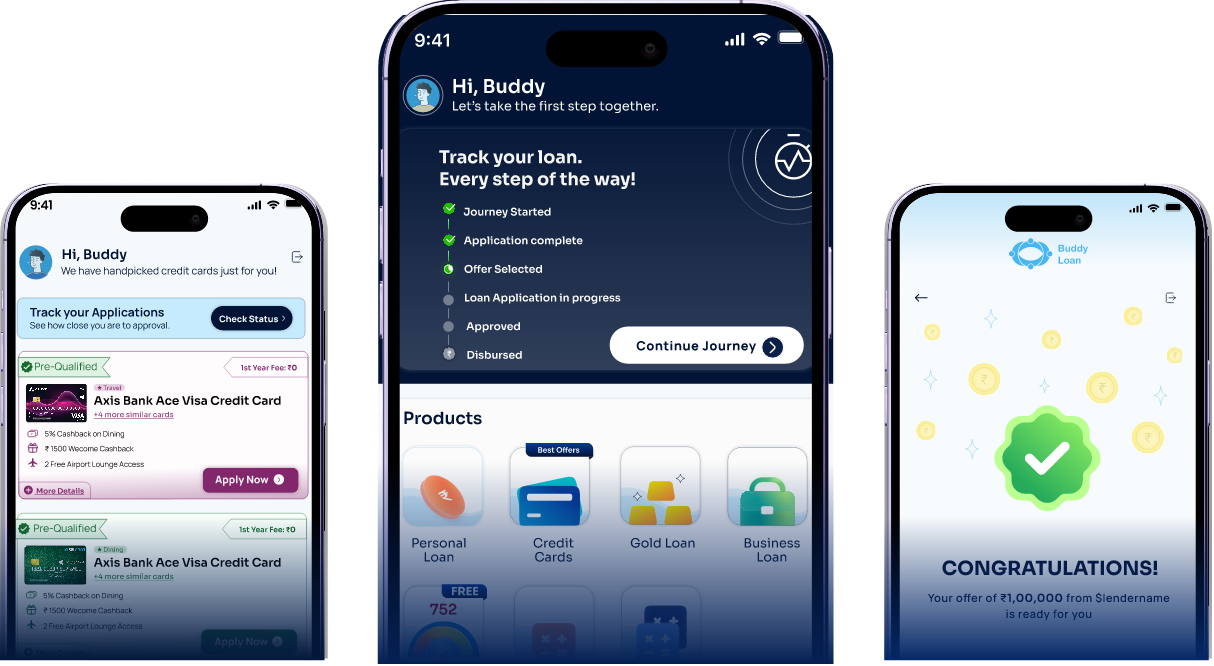
Download the Buddy Loan App Now!
One solution to each of your financial needs at your fingertip.

Scan to download now