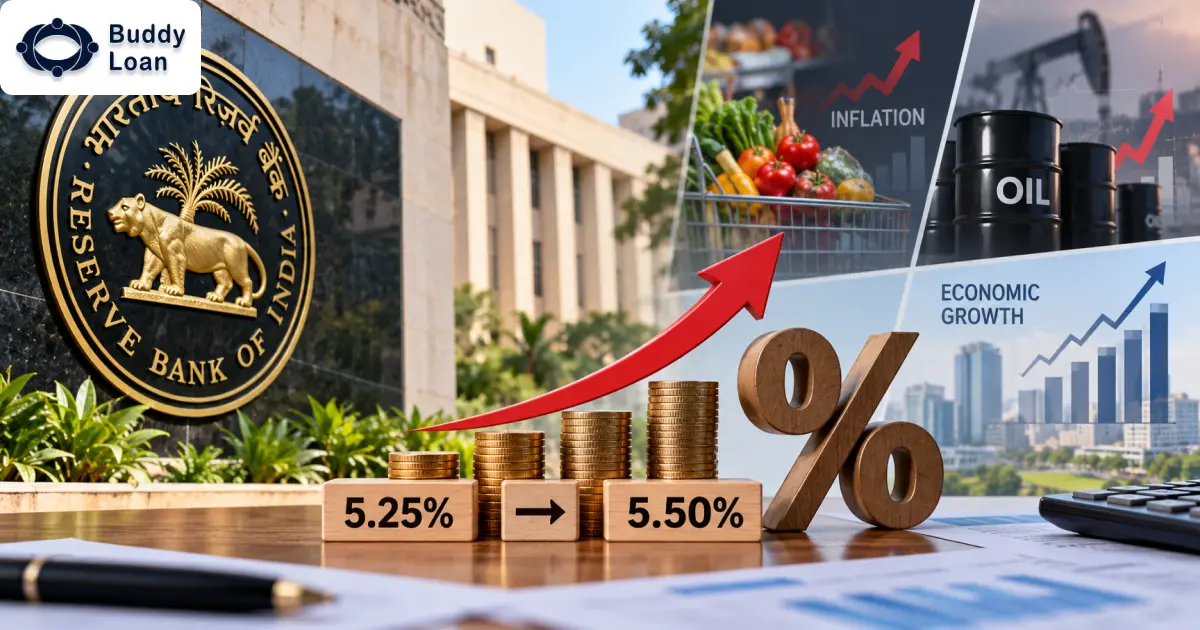
On October 7, 2026, the repo rate was increased by 25 basis points from 5.25% to 5.50% by the RBI. This rise in the repo rate by the RBI can lead to an increase in borrowing costs as financial institutions pass on the increased benchmark rate to floating rate loans. The MPC also changed its position from neutral to calibrated tightening, which is a sign that any rate cuts in the near future are not likely.
Following this rate hike, the SDF rate has been revised to 5.25%, whereas the MSF rate and bank rate increased to 5.75%.
Key Highlights of RBI Repo Rate Hike in October 2026
The October monetary policy marks a shift from keeping rates unchanged to actively controlling emerging inflation pressure. Here are the main RBI repo 2026 decisions in one place.
| Particular | October 2026 Decision |
| Repo Rate | 5.50% |
| Previous Repo Rate | 5.25% |
| Change | +25 basis points |
| Standing Deposit Facility | 5.25% |
| MSF Rate | 5.75% |
| Bank Rate | 5.75% |
| Monetary Policy Stance | Calibrated Tightening |
| FY 2026-27 GDP Growth Forecast | 7.1% |
| FY 2026-27 CPI Inflation Forecast | 5.2% |
| Next MPC Meeting | December 2–4, 2026 |

Why Did RBI Increase the repo rate to 5.50%?
RBI’s repo rate hike towards late 2026 mainly reflects growing concern that inflation could remain elevated even as the Indian economy continues to grow at a healthy pace.
1. Rising Inflationary Pressure
CPI inflation rose from 4.5% in July to 4.8% in August 2026. Food and fuel prices increased, while core inflation also moved higher, suggesting that price pressure was spreading beyond a few categories.
RBI now expects CPI inflation to average 5.2% in FY2026-27, including 6.0% in Q3 and 5.7% in Q4.
2. Food, Energy, and Supply-Side Risks
Inflation risks are also coming from factors that monetary policy cannot directly control. RBI highlighted the deficient southwest monsoon, El Niño conditions, high energy prices, and pressure from other commodities.
Higher input costs can gradually spread to the prices consumers pay, which is one reason RBI wants to limit second-round inflation effects.
3. Strong Economic Growth Gives RBI Room to Tighten
The repo rate increase in 2026 has come while economic activity remains strong. Real GDP grew 7.8% in Q1 FY27, while RBI expects full-year FY2026-27 growth of 7.1%.
Stronger growth gives RBI more room to focus on inflation without responding to a weak economy at the same time.
| What Does ‘Calibrated Tightening’ Mean?
RBI has moved away from a neutral policy stance. This doesn’t automatically mean several more rate hikes, but it changes the direction of possible near-term policy action.
In simple terms, RBI is signalling that interest rates are unlikely to fall soon. The next move can be a pause or another increase, depending on inflation and economic conditions. |
Effect of Repo Rate Hike on Borrowers
The impact will not be identical for every borrower. It depends on how the loan interest rate is calculated and when the lender resets that rate.
1. Impact on Existing Floating-Rate Loans
Floating retail loans linked to an external benchmark can become more expensive when their benchmark resets. For repo-linked loans, a lender can pass part or all of the 25-bps increase to the lending rate.
The change does not mean every borrower’s EMI immediately rises by 0.25%. The actual impact depends on the benchmark, reset date, lender policy, and remaining loan tenure.
2. Impact on New Borrowers
New borrowers could face higher lending rates if banks revise their loan pricing after the RBI repo rate increase. For the same loan amount and tenure, a higher interest rate results in a higher EMI and total interest cost.
Also Read: RBI Cut Repo Rate in Oct 2025
Effect of 2026’s Repo Rate Hike on Various Loans
The connection with the repo rate is strongest for floating loans linked to external benchmarks. Fixed-rate loans usually behave differently until their fixed-rate period ends.
- Home Loans: Floating home loans can see an increase in EMI, repayment tenure, or a combination of both when the benchmark rate rises. The lender must communicate the impact of an interest-rate reset to the borrower.
- Personal Loans: An existing fixed-rate personal loan usually does not change simply because RBI raised the repo rate. Floating-rate personal loans can be affected at their next reset, while newly sanctioned personal loans could be priced differently.
- Car Loans: The same distinction applies to car loans. Fixed-rate borrowers generally retain the agreed rate, while floating-rate borrowers can see changes according to the loan benchmark and reset terms.
- Business and MSME Loans: Floating loans to MSMEs that use external benchmarks can also respond to repo movements. Higher borrowing costs can increase interest expenses for businesses when rates reset.

Repo Rate Hike EMI Example
The following example shows how a 25-bps increase from the 2026 repo rate increase can affect a long-term loan. It assumes the lender passes the entire repo rate increase to the borrower and raises the lending rate from 8.50% to 8.75%.
| Loan Amount | Tenure | Earlier Assumed Rate | Revised Assumed Rate | Earlier EMI | Revised EMI | Monthly Increase |
| ₹20 lakh | 20 years | 8.50% | 8.75% | ₹17,356 | ₹17,674 | ₹318 |
| ₹30 lakh | 20 years | 8.50% | 8.75% | ₹26,035 | ₹26,511 | ₹477 |
| ₹50 lakh | 20 years | 8.50% | 8.75% | ₹43,391 | ₹44,186 | ₹794 |
Note: These figures are illustrative. Actual EMI changes depend on how much of the repo increase the lender passes on, the outstanding balance, the reset date, and the remaining tenure.
What Can Existing Borrowers Do After the Repo Rate Hike?
Borrowers should first understand how their loan is priced rather than reacting only to the headline repo rate increase.
- Check Which Benchmark Your Loan Uses: Find out whether the loan is linked to the repo rate, another external benchmark, MCLR, or a fixed rate. This determines how quickly the RBI decision can affect your loan.
- Check Your Interest Reset Date: A benchmark change and a loan-rate change do not always happen on the same date. External benchmark-linked retail loans must reset periodically according to RBI rules.
- Compare EMI Increase vs Tenure Extension: If the lender offers a choice, compare a higher EMI with a longer loan tenure. Keeping the EMI unchanged for many extra months can significantly increase the total interest paid.
- Consider Partial Prepayment: Using surplus funds to reduce the outstanding principal can lower future interest. Borrowers should first check liquidity needs and any conditions applicable to their loan.
- Ask About Fixed-Rate Conversion: RBI’s framework for EMI-based floating personal loans requires lenders to provide applicable options during rate resets, including switching between floating and fixed rates under the lender’s policy and charges.
| Will Fixed Deposit Interest Rates Increase After the Repo Rate Hike?
A higher repo rate can create conditions for banks to offer better deposit rates, especially when they need more funds. However, an RBI repo rate increase does not require banks to raise FD rates immediately or by the same 25 basis points. Deposit-rate changes depend on liquidity, credit demand, funding requirements, and competition between banks. Savers should therefore compare actual FD rates rather than assuming an automatic increase. |
RBI’s Updated Inflation and GDP Forecasts
RBI’s October projections show why it is balancing strong growth against increasing inflation risks.
| Period | GDP Growth Forecast |
| FY 2026-27 | 7.1% |
| Q2 FY27 | 7.2% |
| Q3 FY27 | 6.9% |
| Q4 FY27 | 6.8% |
| Q1 FY28 | 7.1% |
| Period | CPI Inflation Forecast |
| FY 2026-27 | 5.2% |
| Q2 FY27 | 4.9% |
| Q3 FY27 | 6.0% |
| Q4 FY27 | 5.7% |
| Q1 FY28 | 5.6% |
RBI Repo Rate Changes in 2025–2026
The October decision ended a period in which the repo rate had remained at 5.25% through several MPC meetings in 2026.
| Effective Period | Repo Rate | Change |
| October 2026 | 5.50% | +25 bps |
| August 2026 | 5.25% | No change |
| June 2026 | 5.25% | No change |
| April 2026 | 5.25% | No change |
| February 2026 | 5.25% | No change |
| December 2025 | 5.25% | -25 bps |
What is RBI’s next move?
The next MPC meeting is scheduled for December 2–4, 2026. RBI has not committed to another hike, but its calibrated-tightening stance limits the likely near-term choices to a pause or another rate increase under current conditions.
The decision will depend on inflation, how widely price pressure spreads, second-round effects from supply shocks, economic demand, and the overall growth outlook.
Repo Rate vs. Reverse Repo Rate vs. SDF vs. Bank Rate
RBI uses several policy and liquidity rates for different purposes. They should not be treated as interchangeable terms.
| Rate | Current Rate | Simple Meaning |
| Repo Rate | 5.50% | Rate used by RBI to provide short-term liquidity to banks against eligible securities |
| Fixed Reverse Repo Rate | 3.35% | Legacy fixed rate at which RBI can absorb liquidity under the reverse repo facility |
| SDF | 5.25% | Facility through which RBI absorbs liquidity without requiring collateral |
| MSF | 5.75% | Overnight borrowing facility available to eligible banks under specified conditions |
| Bank Rate | 5.75% | RBI’s standard bank rate, revised after the October policy decision |
Download the Buddy Loan App Now!
One solution to each of your financial needs at your fingertip.

Scan to download now